GS1 Sunrise 2027 is becoming a practical packaging discussion for food and snack buyers, not only a barcode-theory topic. The initiative is an industry milestone around the ability to scan and process 2D barcodes at retail point of sale, while the transition still includes existing UPC workflows. For importers, that means packaging and artwork briefs should start capturing barcode intent earlier, especially when a product is expected to move through modern retail, organized distribution, or multi-market private-label review.
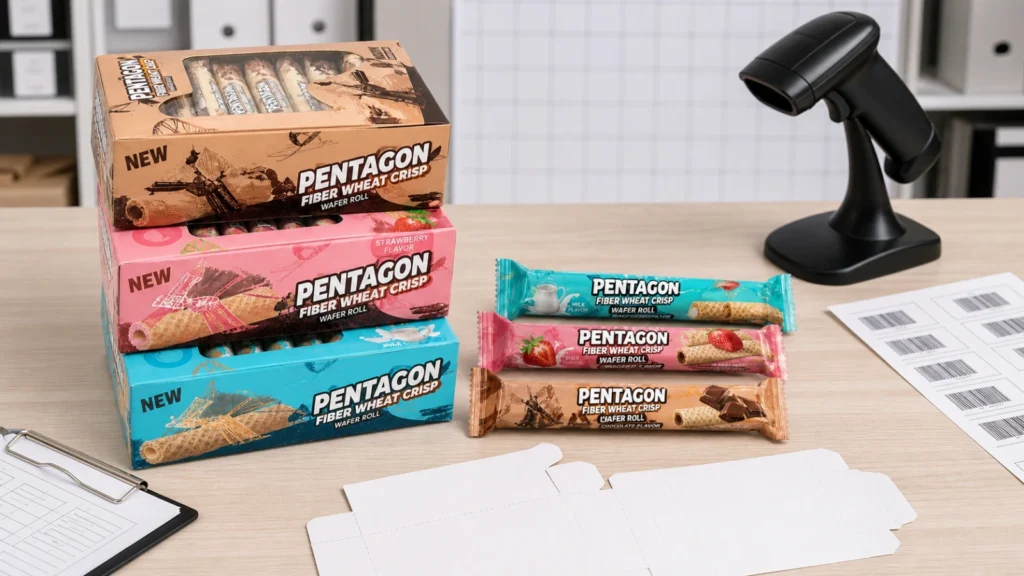
KidStar SKU YMX-062 is a useful example because it is a display-box biscuit-and-snack route rather than a bulk commodity line. The product is packed as 13 g units, 30 pieces per display box, 20 display boxes per carton. That makes it the kind of item where front-of-pack space, side-panel space, and barcode planning can become part of the commercial conversation before artwork is frozen. The YMX-062 product page gives the exact product anchor, but the market-facing question is larger: when should buyers start asking their supplier about 2D readiness, dual marking, and data ownership?
Understand what Sunrise 2027 is and what it is not
The first correction is simple. Sunrise 2027 is not a rule saying every imported candy item must switch overnight to one new barcode style. GS1 US describes it as an industry-set milestone to enable 2D barcode capabilities at retail point of sale. GS1 US also explains that it is not necessary to implement every 2D capability by that date, and that UPC barcodes continue to be part of the transition period.
That matters for importers because it keeps the planning conversation practical. A buyer does not need to tell a supplier, "Put a QR code on everything now." Instead, the buyer should ask:
- Will this product sell into retail systems that are already preparing for 2D scanning?
- Is the buyer expecting the code to do more than identify the item, such as connect to batch, expiry, or richer product information workflows?
- Does the current artwork cycle make this a good time to reserve barcode space, even if full 2D activation comes later?
That approach avoids two common mistakes: ignoring the transition until the last minute, or overpromising capabilities that the downstream market has not asked for yet.
Why biscuit bar display formats feel the barcode shift earlier
YMX-062 is not only a snack line. It is a display-box retail format, which means the outer presentation and the single unit both matter. When buyers talk about barcode strategy for this kind of product, they are really talking about several packaging surfaces at once:
- the single biscuit bar unit
- the display box used at shelf level
- the transport carton used by warehouses and distributors
That is why a biscuit bar import program often feels the Sunrise 2027 discussion earlier than a simpler bulk route. Packaging space is tighter. The buyer may want to preserve the existing UPC path while reserving room for future dual marking. The retail team may need to decide whether the single unit, the display, or both should carry expanded data in later phases. And if the product is moving into organized retail, the discussion can appear before the first repeat order rather than after years of stable supply.
This does not mean every YMX-062 project needs a major redesign. It means the packaging customization page should be used with clearer barcode questions in mind whenever the buyer is planning a retail-facing launch.
Use a decision table before asking for artwork changes
Most importers do not need a technical workshop in the first meeting. They need a commercial decision table that tells them whether to leave the barcode route unchanged, reserve space, or start a more formal readiness plan.
| Program condition | Recommended barcode posture | Why it fits | Buyer action now |
|---|---|---|---|
| Trial order for traditional wholesale or general trade | Keep current UPC workflow and document the existing barcode route | The buyer needs sales evidence before changing artwork | Ask the supplier to confirm current barcode placement and printable area |
| Modern retail review is expected within the next artwork cycle | Reserve design space for dual marking and capture data ownership questions | This keeps options open without forcing a rushed switch | Ask who owns GTIN, what data may be needed later, and what print area is available |
| Multi-market private-label launch with higher traceability expectations | Build a formal 2D-readiness discussion into packaging review | Later changes become expensive if artwork is already fixed | Add barcode strategy to the first artwork and compliance brief |
| Existing product is stable but retailer requests 2D exploration | Pilot on one SKU or one market before broad rollout | It reduces risk and creates a reusable learning path | Use YMX-062 as a single-SKU test instead of changing the full snack line |
This table also protects the supplier relationship. The buyer is not asking for a speculative redesign. The buyer is showing why the timing of the market route matters.
Put barcode questions into the first RFQ, not the last artwork email
The safest time to raise Sunrise 2027 is earlier than most teams expect. Not because the supplier must solve every barcode scenario immediately, but because the first RFQ is where the buyer can show which packaging decisions are still flexible.
For YMX-062, include these points in the first brief:
- destination market and retail channel
- whether the current project is stock-like, private label, or in between
- whether the buyer expects only GTIN identification or wants room for future richer data use
- whether unit-level and display-level barcode placement both matter
- when artwork approval is expected
That information helps the supplier answer with a realistic packaging route. It also works well with the MOQ and lead time page because any artwork revision or structured barcode review can affect commercial timing even when the candy recipe does not change.
Keep claims disciplined when discussing 2D readiness
The wrong way to sell Sunrise 2027 is to imply that one barcode change will solve compliance, traceability, retailer onboarding, and consumer engagement at once. GS1 materials describe important benefits and industry direction, but the buyer still needs to match those possibilities to the real destination market and the actual downstream systems.
That means the commercial language around YMX-062 should stay disciplined:
- do not promise that every retailer already accepts the same 2D workflow
- do not remove UPC assumptions without confirming downstream readiness
- do not treat a 2D symbol as proof that a product is fully market-ready
- do not ask the supplier to finalize artwork without first deciding what data is worth encoding
In practice, a stronger buyer brief is often enough. If the market is not asking for 2D readiness yet, the importer can still reserve space and document the path. If the market is asking for it, the buyer has already made the supplier conversation easier.
Use YMX-062 as the test case, not the whole portfolio
One reason YMX-062 is commercially useful is that it offers a clear, retail-facing snack format without forcing a portfolio-wide packaging decision. Buyers can use it as a pilot article, a pilot packaging discussion, or a pilot artwork review.
That is usually a better path than trying to redesign an entire snack range around a future retail objective. Start with one SKU, one destination, and one packaging review cycle. Use the certifications and compliance page when the market also needs documentation alignment, and use the contact page when you want KidStar to review whether YMX-062 should stay on a standard UPC route or enter a barcode-readiness discussion now.
Sunrise 2027 is best treated as a timing question. Buyers who wait until after artwork is locked will have fewer low-cost options. Buyers who ask earlier can keep their biscuit bar import program flexible without overstating what the market needs today.