
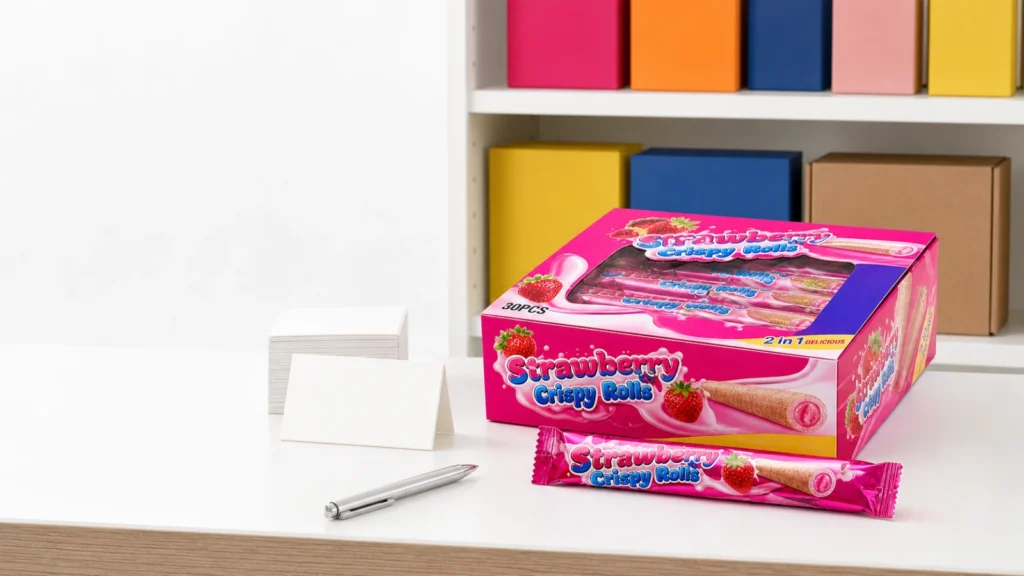
When an importer asks for a value-line candy quote, the real decision is rarely "Do you have a crispy roll?" The harder question is whether the product can hold shelf attention, travel well in a low-cost carton plan, and still feel simple enough for a fast-moving discount or convenience program. That is where KidStar SKU YMX-060 becomes useful. It is a dual-flavour crispy roll candy packed as 30 pieces per display box and 20 display boxes per carton, which gives buyers a concrete retail route instead of a vague category conversation.
For B2B teams, that matters because value retail rewards clarity. The buyer needs to know whether the item will sit on a checkout counter, inside a discount-store candy bay, or inside a wholesale replenishment mix. The YMX-060 product page gives the exact SKU anchor, but a workable program still depends on carton logic, display turnover, channel fit, and the first quote brief. A buyer who frames those inputs early can get a better first answer than a buyer who only asks for a low price.
Start with the channel decision before the flavor discussion
Dual-flavour crispy roll candy is usually not a premium storytelling item. It is a value-retail product that wins by being easy to understand, easy to display, and easy to replenish. That makes the channel decision more important than a long flavor debate in the first round.
Ask three commercial questions first:
- Will the item sell as a checkout impulse line, a fixed shelf line, or a mixed wholesale assortment?
- Does the customer need the display box itself to work on shelf, or will the importer break cartons and re-pack locally?
- Is the first order meant to test one route or to seed multiple low-price outlets at once?
Those answers affect how the supplier should think about the display box, carton count, artwork complexity, and restock rhythm. If the buyer cannot answer them yet, the first quote should be treated as directional only. In value retail, confusion at the channel stage usually becomes confusion about MOQ, freight efficiency, and shelf presentation later.
Use YMX-060 as a value-line benchmark, not just a candy sample
KidStar SKU YMX-060 is packed as 30 pieces per display box and 20 display boxes per carton. That structure already suggests a retail route. It is not a loose bulk candy and it is not a premium gift format. It sits best in programs where importers want an item that can move quickly through discount, convenience, or general-trade channels without needing complex secondary packaging.
The useful buyer move is to treat YMX-060 as a benchmark when reviewing similar items in the product catalog. Instead of asking, "What other crispy candy do you have?", ask:
- Which channels are you planning to serve with the first order?
- Do you need one display format or several price-point variations?
- Will the importer keep the original display box, or does the local market require a different shelf-facing route?
That changes the conversation from catalog browsing to retail planning. It also keeps the quote request grounded in one real SKU, one real carton footprint, and one real replenishment format.
Decide whether the display-box route matches the buyer’s real shelf plan
The display box is the core question for YMX-060. Some buyers want a display because it improves shelf speed and reduces local handling. Others discover that the box size, unit count, or local shelving practice does not fit their retail partners. The fastest way to avoid a weak first quote is to compare the route against the actual sales environment.
| Buyer situation | Why YMX-060 can fit | Where caution is needed | Best next action |
|---|---|---|---|
| Discount-store candy bay | Ready display format can simplify shelf setup and replenishment | Buyers still need to confirm how many facings one store can absorb | Ask for display dimensions, front-facing photos, and carton loading notes |
| Convenience-store counter offer | Small-unit candy can support impulse placement | Counter space may be tighter than buyers expect | Request photos showing how one full box looks when opened for retail |
| Wholesale cash-and-carry | Display boxes can be easy for resellers to take by the case | The buyer may prefer a more generic wholesale master carton route | Confirm whether downstream resellers keep or discard the display |
| Multi-country value program | One SKU can simplify first sourcing conversations | Label, language, and retail presentation may diverge by market | Freeze one pilot market before scaling the same box to all destinations |
The point is not to say the display box is always right. The point is to help the buyer avoid discovering the mismatch after samples, artwork, or freight planning already started.
Build the first RFQ around carton movement and reorder rhythm
In value retail, buyers often focus on unit price too early. A stronger RFQ for YMX-060 should make the logistics rhythm visible from the beginning. The supplier already knows the carton route: 20 display boxes per carton, with published carton dimensions in the product library. The buyer now needs to explain how that route should behave in market.
That means the first RFQ should state:
- target market and buyer type
- expected retail channel
- whether the display box stays unchanged or needs adaptation
- trial quantity versus repeat-order ambition
- any shelf, language, or label constraints already known
This structure works well alongside the packaging customization page and the MOQ and lead time page. Those pages help a buyer separate a stock-style value program from a route that will need more packaging work. If that distinction is not made early, one supplier may quote an existing display route while another assumes a semi-custom one, and the importer ends up comparing unlike-for-like offers.
Review the sample as a merchandising tool, not only a taste check
Buyers sometimes sample low-price candy as if they were only checking flavor acceptance. For YMX-060, that is incomplete. The sample should also answer shelf and handling questions. Ask the supplier to show:
- the closed retail box
- the opened display presentation
- one unit in hand
- one full export carton layout
- the front panel and side panel views used for shelf recognition
If the buyer will present the item to distributors or local retail chains, those views are often more useful than a generic close-up of the candy itself. An operationally good sample helps the importer decide whether the item is truly ready for value retail or still needs adjustments before a first shipment.
This is also where the buyer should check whether YMX-060 belongs in a one-SKU value launch or in a mixed fast-moving assortment. If the goal is a broader program, the buyer can compare it with other compact retail options inside the confectionery manufacturer overview, but the first quote still benefits from one exact benchmark SKU.
Turn the retail decision into a cleaner supplier brief
The cleanest first brief for YMX-060 is not long. It is specific. A buyer can usually move the conversation forward with one short commercial note plus one simple checklist.
Use this checklist before asking for the first firm quote:
- Confirm that the project is for discount, convenience, wholesale, or mixed retail.
- State whether the original 30-piece display box is acceptable or only a starting point.
- Give the first-order quantity band and the repeat-order expectation.
- Ask for carton dimensions, display photos, and front-facing shelf views together.
- List any market-specific label or artwork concerns that are already known.
That short list helps the supplier answer with the right route instead of a generic price file. It also makes the eventual contact request more useful because KidStar can respond around one real product decision rather than a broad catalog inquiry.
YMX-060 works best when buyers treat it as a value-retail operating format: SKU, display, carton, shelf logic, and reorder path. If you want KidStar to compare that route against your target channel, send the market, quantity band, and display preference through the contact page. That is usually enough to decide whether this crispy roll candy should stay in the first RFQ round.