
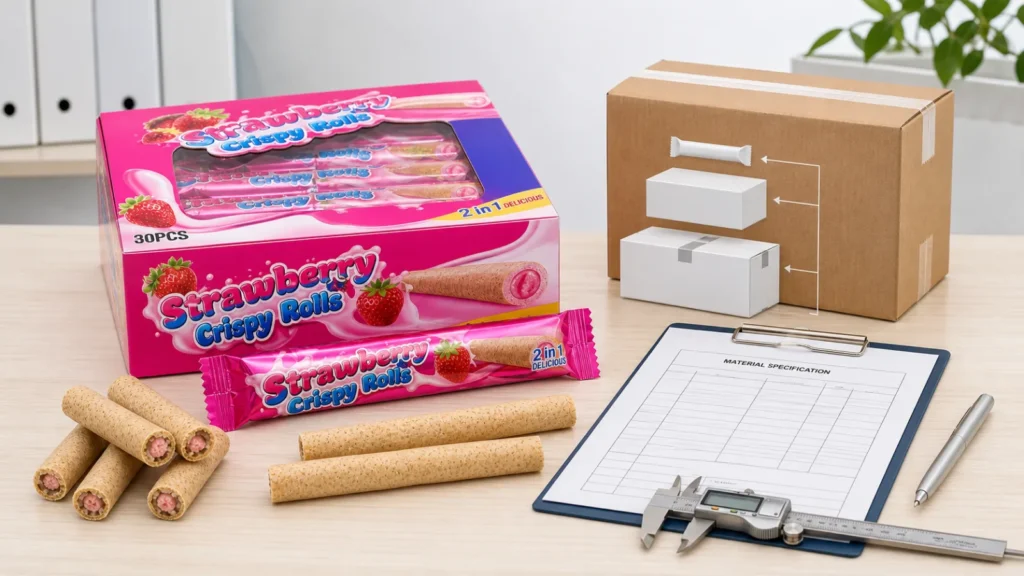
EU-bound candy projects now need packaging information to be collected earlier in the sourcing process. Regulation (EU) 2025/40 on packaging and packaging waste entered into force on 11 February 2025 and generally applies from 12 August 2026, according to the European Commission. The regulation covers packaging regardless of material or origin and introduces requirements across packaging sustainability, labelling, waste prevention, and economic-operator responsibilities.
For an importer, that does not mean every supplier conversation should turn into a legal opinion. It means the buyer should stop treating packaging as only an artwork file. The product brief should identify each packaging level, the material and function of that level, the information that must be shown, and the evidence that still needs review by the responsible EU operator or compliance adviser.
KidStar SKU YMX-060, a crispy roll product with an individual wrapper and a retail display box, provides a practical example. The exact legal obligations depend on the final product, packaging specification, role of each economic operator, and market. Buyers should confirm applicability with qualified local advisers, but they can collect the underlying supplier data before artwork approval.
Map every packaging level before discussing claims
One candy item can involve several packaging levels. For YMX-060, the visible product route includes the individual wrapper and a display box. A commercial shipment will also require an outer transport configuration. Each level serves a different purpose and may need different data.
Start with a packaging map:
- consumer or individual unit: protects one crispy roll and carries consumer-facing information
- retail display: groups units and presents them for sale or shelf handling
- transport carton: protects the displays during warehousing and shipment
- pallet or logistics materials, when used: support handling and transport rather than retail presentation
Do not copy material descriptions from an old project into a new one. Ask the supplier to confirm the actual structure used for the quoted version. A visual reference can show the format, but it does not prove material composition, weight, recyclability, or conformity.
The YMX-060 product page should therefore be used as the product anchor, while the packaging data sheet becomes the source for technical review.
Collect the minimum data set before artwork approval
The PPWR establishes requirements for the life cycle of packaging and includes obligations related to sustainability, labelling, conformity, and technical documentation. Annex IV also describes performance criteria such as product protection, manufacturing processes, logistics, functionality, information requirements, hygiene and safety, legal requirements, and recyclability or reuse.
Those criteria point to a practical buyer workflow. Before final artwork, request a data sheet that separates confirmed facts from items still under review.
| Packaging level | Data to request | Buyer use |
|---|---|---|
| Individual wrapper | Material structure, dimensions, weight, sealing function, print area | Label layout, material review, and unit-level specification |
| Retail display | Board or film structure, dimensions, weight, unit count, opening method | Shelf planning, trade-item setup, and display approval |
| Transport carton | Material, dimensions, gross and net weight, display count, markings | Freight, warehouse, pallet, and shipping-document planning |
| Product information | Product name, net content, ingredients or allergen inputs, date-code area | Destination label and artwork review |
| Identification | Barcode level, GTIN ownership decision, case marks | Retailer data, scanning, and traceability setup |
| Evidence status | Supplier declaration, test report, specification, or pending review | Prevents unverified claims from entering artwork |
The final evidence list will vary. The value of the table is that it shows which information belongs to the supplier, which belongs to the brand or importer, and which needs independent or authority-facing review.
Keep environmental wording separate from verified facts
Packaging projects often become risky when marketing language appears before the technical structure is confirmed. Terms such as recyclable, reusable, reduced plastic, or environmentally friendly should not be added simply because the pack looks lightweight. The buyer needs the actual packaging specification and must evaluate any claim under the rules and guidance that apply in the destination market.
Use three status labels in the working file:
1. Confirmed supplier fact: a value supported by the current specification or document. 2. Buyer decision: information controlled by the importer or brand, such as language, GTIN ownership, or design hierarchy. 3. Review required: a legal, environmental, certification, or market claim that has not been cleared for use.
This distinction protects the artwork process. Designers can reserve the correct space without turning a pending assumption into public packaging text.
Review display efficiency and empty space with real dimensions
The PPWR includes packaging-minimisation requirements and addresses empty space in grouped, transport, e-commerce, and sales packaging. Some provisions have later application dates and detailed methodologies, so buyers should not reduce the rule to a simple universal percentage for every candy pack.
The useful sourcing action is more immediate: collect dimensions and photograph the filled pack at the intended unit count. For YMX-060, ask how the individually wrapped rolls sit inside the display, how the display is arranged in the transport carton, and whether product protection depends on any internal space.
Compare alternatives using real measurements rather than a flat artwork preview. A slightly smaller display may improve logistics, but it must still protect the rolls, work on the filling line, open correctly at retail, and leave space for required information. Annex IV explicitly recognises product protection, manufacturing, logistics, packaging functionality, and information requirements as performance criteria in packaging-minimisation assessment.
Make the sample approval produce reusable evidence
A packaging sample should create a record that can be used by purchasing, quality, design, logistics, and the destination-market reviewer. Photograph the front, back, side, opening method, individual unit, display interior, and transport marks. Record dimensions and weights from the approved version rather than relying on an earlier quotation sheet.
The approval note should identify:
- SKU and product version reviewed
- individual wrapper and display version
- sample date and reviewer
- confirmed dimensions and unit counts
- artwork version or file name
- open questions and responsible owner
- documents received and documents still required
GS1’s product image standard is a helpful reference for consistent product, label, barcode, nutrition, ingredient, and certification-image views. Importers can use the same structure even when the retailer has its own image specification.
Build an EU-ready supplier request without overclaiming
The first supplier request does not need to solve the entire PPWR. It should create a complete enough packaging record for the EU operator and its advisers to perform the right review. Send the destination market, product SKU, packaging hierarchy, expected sales channel, requested quantity, artwork stage, and the packaging data fields required by the buyer’s team.
Review the wider product directory when comparing alternative pack formats, and use the packaging customization page to separate stock packaging from adapted or private-label work. For documentation questions, the compliance overview explains how KidStar handles buyer requests without promising market approval.
To request the YMX-060 packaging data route, send a buying brief with the destination country and the packaging levels your team needs to review.