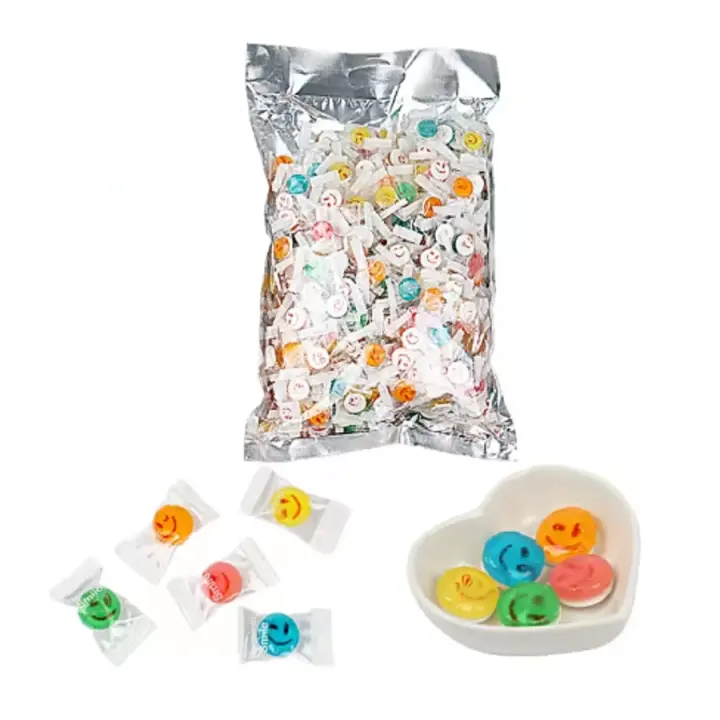
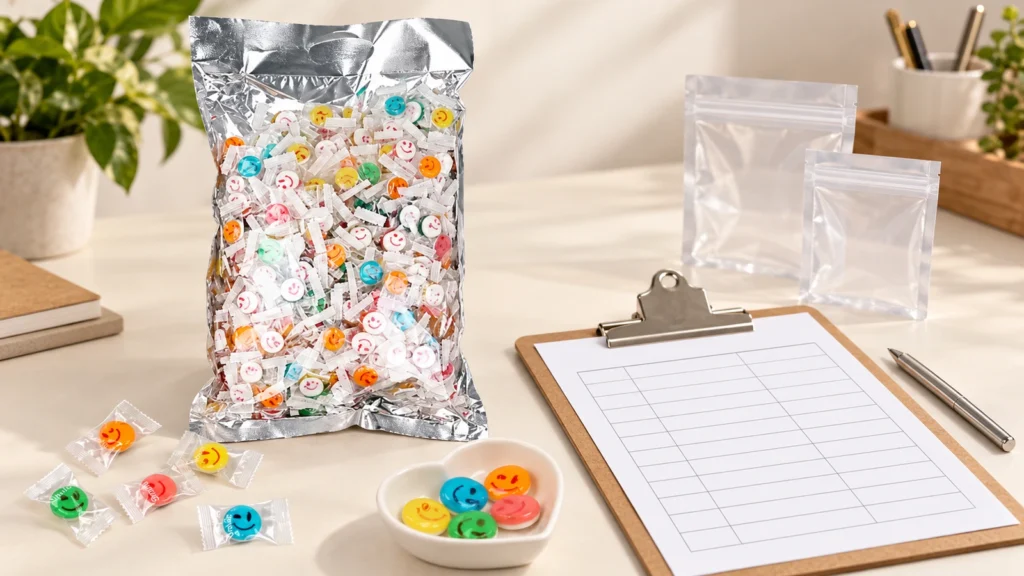
To manage pick and mix candy allergens, obtain a current ingredient and allergen file for every SKU, map each component to the finished assortment, and check the actual packing and selling route before approving customer information. A supplier catalogue or a photograph of individually wrapped sweets cannot replace that file.
For importers, distributors, wholesalers and private-label buyers supplying repackers, the practical deliverable is a controlled handover: product identity, specification version, ingredient allergens, precautionary statements and the person responsible for the final pack. KidStar Smiley Candy YMX-174 is the pack-format example here, not an allergen-free recommendation. Its current ingredient and allergen declarations must be requested and reviewed before use.
Identify what the repacker will actually sell
Start with a written description of the operation. Will the business resell the original bag, place still-wrapped pieces into a new pouch, or handle unwrapped sweets in open bins? Will customers select their own assortment, or receive a fixed mixture? These are different information and handling problems, even when the purchase order uses the same bulk SKU.
YMX-174’s published specification is 3 g per piece, 500 g per bag and 30 bags per carton. Those figures identify the purchasing format; they do not establish ingredients, allergen suitability, a destination-ready label or permission to make dietary claims. Keep the supplier’s original bag label and specification reference when stock is separated for repacking. Do not calculate an exact piece count from the nominal bag and piece weights.
For the commercial choice between whole-bag resale and repacking, use the separate 500 g bulk-bag planning guide. This checklist addresses the next decision: what information must accompany those sweets after the original selling unit changes.
Build an internal record for every component
Give each component its own row before creating a finished-mix record. A colour description such as “red sweets” is insufficient: a replacement with the same appearance can have a different formulation or supplier statement. Match the supplier SKU, flavour or variant, specification revision and incoming label photographs.
Use the following as an internal document-request checklist, not as a completed consumer allergen declaration:
| Record field | Evidence to obtain | Hold condition |
|---|---|---|
| Product identity | Exact SKU, variant and original pack photographs | Sample and specification identify different items |
| Ingredients | Current complete supplier ingredient specification | Only a catalogue description is available |
| Ingredient allergens | Reviewed declaration for the destination market | A blank field is being interpreted as “none” |
| Precautionary information | Supplier’s exact statement and supporting clarification | “May contain” wording has been guessed or removed |
| Document version | Revision date and supplier confirmation | Two conflicting specifications are circulating |
| Finished assortment | Approved component list and substitution rules | Staff may swap sweets without updating information |
| Release ownership | Named reviewer and approved customer-information version | Nobody owns the final pouch or sales listing |
For YMX-174, the correct initial ingredient and allergen status is “awaiting reviewed supplier documents”, not a row of reassuring ticks. Ask the same questions for every other component. A completed row for one sweet does not clear the rest of the assortment.
Keep ingredient allergens separate from handling risks
The internal record should distinguish allergens intentionally present in the formulation from precautionary statements and risks introduced by the repacking operation. Combining these into a single unexplained tick can leave the next person unable to tell what has actually been verified.
The FSA’s allergen matrix resources provide an editable starting point for written information. They are not a completed assessment for your mixture. Use the full destination-market framework and specific ingredient identities; do not turn “not yet reviewed” into “absent”.
Check what happens at the workbench as well as in the spreadsheet. Identify shared scoops, containers, scales and packing surfaces; confirm the documented cleaning and separation arrangements with the person operating the process. Still-wrapped sweets and opened sweets require different handling assessments. This article does not prescribe a validated cleaning method or certify that any particular setup controls cross-contact.
Avoid adding an “allergen-free” claim because a supplier row looks clear. The FSA’s business guidance distinguishes free-from claims from ordinary ingredient information and warns that a vegan description does not necessarily rule out animal-based allergen cross-contact.
Confirm the selling route before printing labels
The following official examples concern England, Wales and Northern Ireland; Scotland has separate guidance. They are a starting point for review with the responsible food-business adviser or local authority, not a universal label template for every destination.
GOV.UK’s loose-food guidance expressly includes pick and mix sweets, including individually wrapped sweets. An individual wrapper therefore does not, by itself, answer how the eventual assortment must be presented to customers.
For food classified as prepacked for direct sale, the FSA’s PPDS guidance requires a food name and ingredients list with relevant allergenic ingredients emphasised. Do not assume that a wholesaler’s off-site packed pouch supplied to another retailer belongs in that category. Record where packing occurs, who sells the pack and whether it is packed before the customer selects it, then confirm the applicable route.
Online sales need a separate check. FSA guidance states that allergen information must be available before purchase is completed and at delivery. Review the product listing and delivered pack together; a warehouse file that customers cannot access does not complete that handover.
Stop substitutions from silently changing the answer
A mixed-sweet programme can drift after launch. One component sells out, a replacement is visually similar, and the old ingredient file remains attached to the listing. Prevent that by treating a changed component as a new review event rather than an informal warehouse choice.
Consider a fictional two-component mix. Component A has an approved file; component B is replaced by B2. The correct next step is to hold the revised mix pending B2’s documents and the finished-pack review. Do not copy B’s declaration simply because B2 has the same flavour name. This example describes document control, not the ingredients of YMX-174 or any other KidStar product.
Before releasing the replacement, check four places: the internal component record, the approved packing instruction, the consumer-facing label and the online information. Archive the previous version with its effective dates. Keep lot references connected to each packing run so the team can investigate which version reached which recipients; the candy recall checklist covers that separate traceability exercise.
Send an RFQ that includes the document handover
An efficient enquiry states the destination, exact SKU, proposed resale unit and who will repack it. Add whether the pieces remain wrapped, whether the assortment is fixed or customer-selected, and where the product will be sold. Request current specifications rather than asking the supplier to endorse a broad claim such as “suitable for all allergies”.
Before approving a first order, confirm that the sample identity matches the documents, unresolved fields have an owner, and the final information has been reviewed for the actual market. Pack appearance and pricing can be assessed in parallel, but they cannot close an unresolved ingredient question.
Send KidStar your buying brief with YMX-174, your market and intended repacking route. Include the ingredient and allergen documents your reviewer needs, so the next discussion addresses the proposed programme without assuming that the catalogue image establishes compliance.