
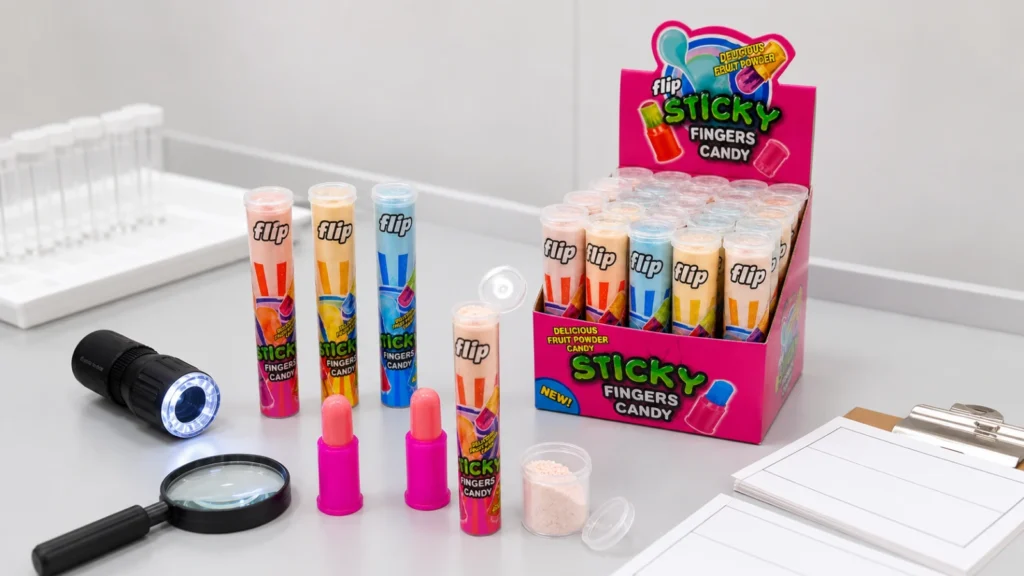
Powder candy complaints usually appear after the shipment arrives, but they normally start much earlier. A buyer approves a product because the flavor is right, then later discovers that the seal, display handling, carton pressure, or shelf route was never described clearly enough for a distributor, warehouse, or retailer. KidStar SKU YMX-063 is a good example because it is a finger powder candy packed as 30 sticks per box and 24 boxes per carton. That format can move well in value retail, but only when the buyer treats it as a handling and packaging workflow, not only as a taste sample.
For importers, distributors, wholesalers, and private-label buyers, the first question should not be "Can the supplier eliminate all leakage risk?" The stronger question is "What should we verify before production, before shipment, and before market rollout so the leakage risk is reduced and the complaint route is easier to judge?" That is the difference between a clean sourcing program and a costly dispute after landing.
Leakage claims begin with unclear packaging assumptions
Powder candy can fail commercially even when the candy itself is acceptable. The problem may come from how the stick seal performs in transport, how the display box is opened by retailers, how tightly the units are packed, or how the cartons are stacked in warehouse handling. If the buyer never defines those checkpoints, the supplier and importer may both think the product was approved when they were actually approving different things.
That is why the YMX-063 product page should be used as the exact product anchor in the first brief. The SKU tells both sides what item is being discussed. But the first RFQ or sample note should also mention:
- target market and sales channel
- whether the first order is a small pilot or a broader value-retail launch
- who will open the display box first: importer, wholesaler, or store staff
- how much handling the sticks are likely to face before final sale
- whether warm-climate transport or rough cash-and-carry handling is expected
Without those details, the supplier may quote a standard route while the importer expects a harder-use one.
Build one acceptance checklist around YMX-063 before approving samples
The cleanest move is to approve powder candy using one operational checklist. Buyers often separate flavor review, packaging review, and shipment review into different conversations. That creates gaps. Instead, use one file that follows the SKU from sample to shipment.
| Checkpoint | What to confirm on YMX-063 | Why it matters |
|---|---|---|
| Stick seal integrity | Look for visible powder escape, uneven sealing, or weak edges | A small sealing issue becomes a visible claim after carton friction |
| Display-box fit | Check whether sticks sit firmly and whether the display protects them during opening | Loose presentation can increase breakage or abrasion in retail handling |
| Carton packing | Confirm 24-box carton arrangement and pressure on inner packs | Compression issues may not appear until export handling |
| Handling route | Ask how cartons should be stacked, loaded, and opened downstream | Complaint risk rises when the real route is rougher than the approved route |
| Complaint evidence plan | Agree on which photos, batch details, and samples will be needed if a problem appears | It reduces argument and speeds root-cause review |
This table is practical because it does not ask the buyer to solve engineering questions alone. It asks the buyer to make the operational environment visible before production is closed.
Use a hold-or-release decision table before the first order
Importers do not always need to stop a project because one question is open. But they do need a clearer release logic. The fastest way to avoid avoidable claims is to decide what should trigger a hold, a pilot, or a full release.
| Situation | Recommended decision | Reason |
|---|---|---|
| Sample tastes right, but stick seals have not been checked under handling | Hold for packaging review | Flavor approval is not enough for powder candy |
| Seals look stable and display handling is acceptable, but climate route is new | Run a small pilot order | A pilot is cheaper than a wide rollout with unknown field conditions |
| Carton plan, sealing quality, and handling route are all understood | Move to first commercial order | The buyer has enough evidence for a fair operational release |
| Complaint route is unclear and no batch evidence plan exists | Hold release language in the PI | Without evidence rules, later claims become difficult to judge |
This step is especially helpful when the first order will go through distributors or wholesalers that may not preserve the same handling standards as the original sample review.
Collect the right photos and records before shipment
Many powder candy disputes become expensive because the buyer only has sales photos and the supplier only has factory-line photos. Neither side has the intermediate evidence. A better YMX-063 workflow should capture:
- one clear photo of the closed stick pack
- one photo of several units removed from the box
- one photo of the full display-box arrangement
- one photo of the export carton before closing
- batch or production reference tied to the shipment lot
The point is not to create paperwork for its own sake. It is to make later review faster and fairer. If the downstream market reports leakage, both sides can compare the shipped condition, the approved display route, and the likely damage points more quickly.
This also connects naturally to the packaging customization page. If the buyer already knows the market will handle the item roughly, that is the right time to discuss whether the standard route is enough or whether the packaging path needs adjustment before the commercial order.
Write complaint-prevention logic into the RFQ and PI discussion
The buyer does not need a legal essay in the first email. But the first commercial brief should say what kind of usage environment the powder candy is expected to survive. If the item is for cash-and-carry wholesale, informal general trade, or hot-climate resale, that should be visible in the first RFQ. If the importer expects a more controlled retail chain, that should be visible too.
For YMX-063, the first brief can stay simple:
- Identify the SKU and exact pack route.
- State the destination market and likely handling intensity.
- Ask for seal photos, display-box photos, and carton details in the same reply.
- Confirm whether the first order is a pilot or a repeatable route.
- Request any special complaint-review evidence that should travel with the shipment.
That structure helps the supplier quote correctly and helps the buyer judge whether a standard route is good enough. It also works well with the MOQ and lead time page because pilot logic, repeat logic, and packaging discussion often affect order timing even when the unit price does not change much.
Keep the final claim disciplined and operational
No credible buyer workflow can promise zero leakage risk. The useful goal is narrower: reduce preventable claims, improve evidence quality, and make the release decision more realistic. That is a stronger position for both sides because it focuses on actual controls instead of vague assurances.
If you are evaluating YMX-063 for a first order, the next step is not to ask for a perfect assurance statement. The next step is to ask for the right evidence and describe the right handling route. When those are clear, powder candy sourcing becomes much easier to manage.
If you want KidStar to review whether the standard YMX-063 route fits your channel or needs a stricter packaging brief, send the market, handling conditions, and target order scale through the contact page. That gives the team enough detail to respond with a cleaner shipment checklist instead of a generic powder candy quote.