
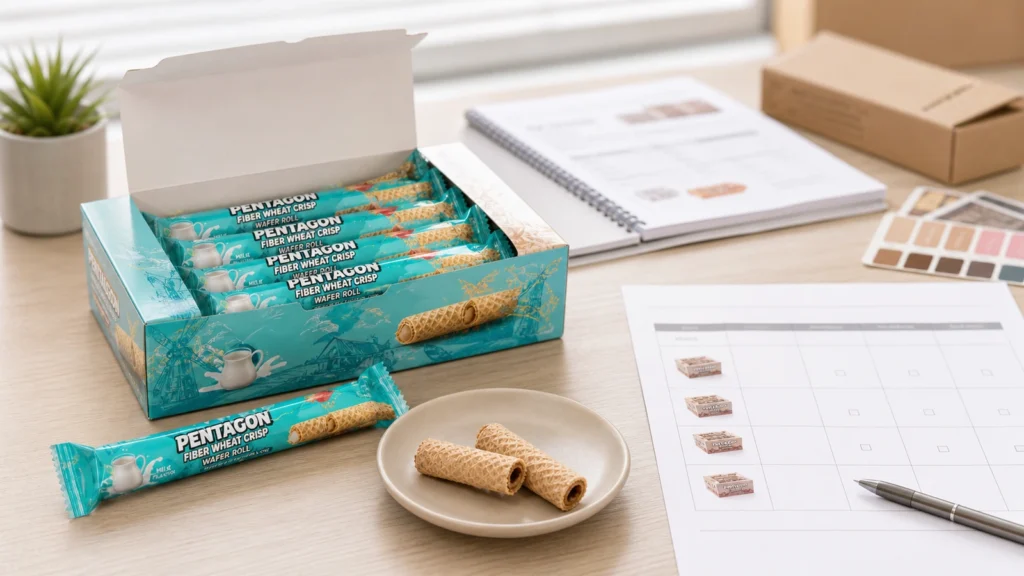
Importers often start a confectionery RFQ with a simple assumption: keep candy lines together and leave snack items for later. That sounds tidy, but it can slow down a real buying decision. A display-box biscuit bar can sometimes belong in the first quote round because it solves a shelf, channel, or price-point problem that a sugar candy line does not solve. In other cases, adding it too early only mixes different commercial routes and makes the first comparison harder.
KidStar SKU YMX-062 is a useful test case because it is not a bulk snack and it is not a premium boxed product. It is a 13 g crispy biscuit bar packed as 30 pcs × 20 display boxes/carton, which gives buyers a real display-box route, a known carton structure, and a practical shelf format. The question is not whether biscuit bars are "allowed" inside a candy RFQ. The real question is whether YMX-062 belongs in the same commercial decision as the buyer’s first candy shortlist.
Start with the route, not the category label
The first RFQ should group products by buying logic, not by factory department or trade-show category. A buyer who is building a checkout, convenience, discount, or general-trade offer may find that a biscuit bar belongs in the same first discussion as hard candy, novelty candy, or small gummy lines because the route is the same: fast shelf movement, simple display handling, and low-friction replenishment.
That is why the first screen is commercial rather than technical:
- Is the buyer testing a low-price display-box line for value retail?
- Will the item sit near candy, near snacks, or in a mixed impulse zone?
- Does the buyer need a shelf-ready display, or only a product sample for later local repacking?
- Is the first order meant to compare several small retail-ready lines under one commercial frame?
If the answer to those questions is yes, YMX-062 may belong in the first RFQ. If the biscuit bar would go to a different buyer team, a different retail shelf, or a different packaging workflow, it is usually cleaner to keep it outside the first quote round.
This is where the product page for YMX-062 becomes useful. The SKU gives the discussion one exact pack format instead of a vague "biscuit snack" request.
Use YMX-062 as a filter, not a catalog distraction
Some buyers add snack-adjacent SKUs too early and create a comparison mess. Others leave them out so long that they miss an item that actually fits the channel better than another candy line. The safer move is to use YMX-062 as a filter with three commercial checks.
First, check whether the product solves the same shelf problem as the candy items in the RFQ. YMX-062 is already packed in a display-box route, so it can sit inside a retail-ready conversation more naturally than a loose bulk SKU.
Second, check whether the product sits inside the same price-point discussion. A first RFQ becomes weak when one line is a simple stock-style display program and another line silently assumes extra packaging development. Buyers should use the MOQ and lead time page to decide whether they want a quick stock-style comparison or a broader mixed-format sourcing discussion.
Third, check whether the supplier answer will still be comparable. If YMX-062 is being tested alongside other display-box products with similar channel goals, it can make the first quote round better. If it pulls the conversation toward a different shelf story, different artwork path, or different sample expectation, it should wait for phase two.
Use a decision table before adding YMX-062 to the first quote round
| Buyer situation | Put YMX-062 in the first RFQ? | Why | Best next move |
|---|---|---|---|
| Discount or convenience buyer testing several display-box impulse items | Yes | The shelf logic and replenishment logic are already similar | Request YMX-062 with the same commercial brief as the candy lines |
| Importer comparing candy items for one mixed general-trade launch | Usually yes | A biscuit bar can act as a crossover line if the route is still display-box and fast-turn | Keep the same quantity band and same destination assumptions across the shortlist |
| Buyer building a private-label snack program with custom artwork needs | Usually no | The packaging and approval route may diverge too early | Finish the candy shortlist first, then open a separate snack-artwork lane |
| Team is unsure whether shelf placement is candy, snack, or mixed checkout | Not yet | Channel confusion will create weak quote comparisons | Ask for sample photos and route notes before treating the item as RFQ-ready |
This table protects the buyer from a common mistake: adding more SKUs without improving the decision quality. The goal is not a bigger list. The goal is a tighter first comparison.
Ask for sample evidence that matches the shelf job
If YMX-062 enters the first RFQ, the sample review should do more than confirm flavor acceptance. The sample should answer whether the display route works for the intended shelf job.
Ask for:
- the closed retail display box
- the opened display presentation
- one single wrapped unit in hand
- carton photos showing how display boxes are arranged
- front-facing images that help a buyer judge impulse visibility
That is especially useful when the buyer still has to decide whether the biscuit bar belongs beside novelty candy or beside small snack packs. The samples page and packaging customization page are relevant here because the buyer is really testing shelf behavior, not only product taste.
If the sample only shows the product closely cropped, the buyer still cannot answer the real RFQ question: does this line belong in the first commercial round for the target channel?
Send one short supplier brief instead of a mixed catalog request
The cleanest first brief for YMX-062 is short and specific. It should show why the SKU is being compared in the first round and what kind of answer the buyer wants back.
Use this checklist:
- name the exact SKU: YMX-062 Crispy Biscuit Bar
- state the target market and target channel
- explain whether the display box stays as standard or is only a starting point
- give one quantity band for the first quote round
- ask for shelf-facing photos, carton details, and sample route together
- say which other product types it is being compared against and why
That short note is far more useful than "please quote your biscuit bars and candies." It helps KidStar answer around one real route, one real display format, and one real buyer decision.
Keep the first RFQ clean enough to compare
YMX-062 belongs in the first RFQ when it shares the same commercial lane as the rest of the shortlist: same channel, similar display logic, similar order intent, and similar speed-to-quote expectations. It should stay out when it introduces a second workflow too early.
That is the practical rule. Buyers should not exclude a biscuit bar only because it is not technically candy. They should include it only when it improves the first buying decision.
If you want KidStar to check whether YMX-062 belongs in your first shortlist or should sit in a later snack lane, send your channel, quantity band, and comparison set through the contact page. That gives the team enough context to respond with a cleaner RFQ route instead of a broad catalog dump.