
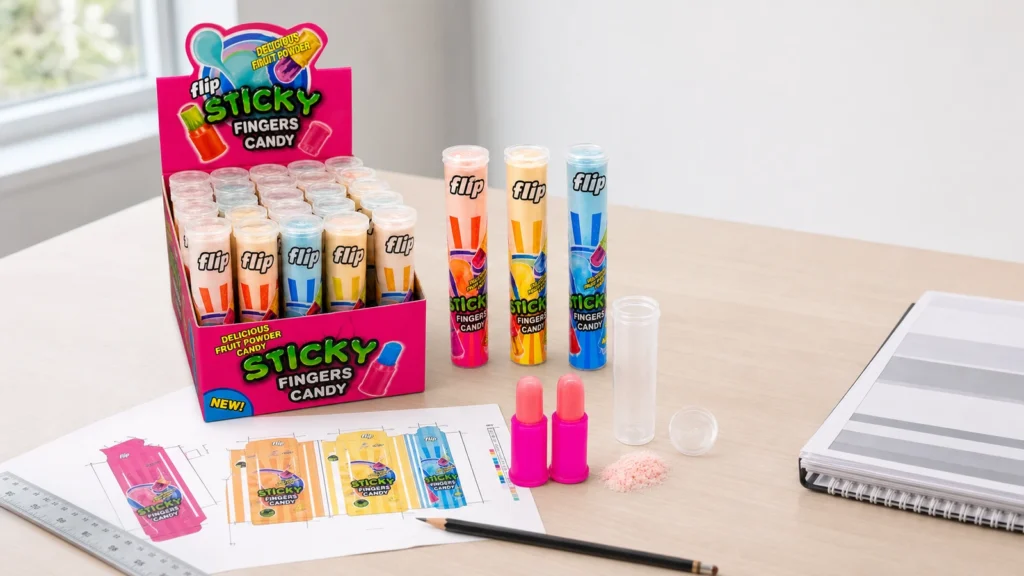
For a U.S.-focused buyer, front-of-pack space is becoming a real sourcing question, not only a design question. Small-format candy packs already struggle to fit brand cues, flavor language, net weight, and date or distributor information without looking crowded. When a market is also watching a possible new front-of-package nutrition box, that space pressure becomes part of the first packaging discussion.
KidStar SKU YMX-063 is a good example because it is a 6 g finger powder candy packed as 30 sticks × 24 boxes/carton. That is a compact, display-box route where the principal display panel matters quickly. The current U.S. question is not "Must we redesign this now?" The better question is "As of July 20, 2026, what has FDA actually proposed, what has not been finalized, and what should importers do now if powder candy sticks may go into the U.S.?"
What FDA has officially done so far
The official timeline matters because buyers should not treat a proposal like a final rule.
Based on the FDA and Federal Register pages reviewed:
- On January 16, 2025, FDA published the proposed rule titled *Food Labeling: Front-of-Package Nutrition Information*.
- The proposal would require a compact Nutrition Info box on most foods that must bear a Nutrition Facts label if the rule is finalized.
- On May 9, 2025, FDA published an extension of the comment period, moving the deadline to July 15, 2025.
- FDA’s 2026 Human Foods Program priorities say the agency received tens of thousands of public comments on the proposal.
- FDA’s current *Foods Program Regulations Under Development* page lists Front-of-Package Nutrition Labeling Final Rule – 2026/12 as a target timing item.
That last point is a planning signal, not a final legal outcome. As of Monday, July 20, 2026, the official pages reviewed still present this as a proposed rule and a rule under development, not a finalized requirement already in force. Buyers should therefore distinguish between:
1. a current packaging-planning signal, and 2. a binding final U.S. requirement.
That distinction matters when a buyer is reviewing YMX-063 with a supplier today.
Why small powder candy stick packs feel this pressure earlier
Large bags, tubs, and boxes often have more room to absorb a future labeling change. Small stick formats do not. A powder candy stick already uses front-facing space for product identity, flavor language, and pack recognition. If the U.S. route later requires a front-of-package nutrition box under a final rule, that panel discipline will matter more.
For YMX-063, the buyer should not wait until final artwork to ask basic U.S. questions:
- Which panel is treated as the principal display panel for the U.S. route?
- Is the current visual hierarchy too crowded for later front-of-pack changes?
- Would a U.S. route use the same stick design as another export market, or should it be separated earlier?
- Is the importer planning a stock-style first launch or a private-label path that will already need artwork work?
This is why YMX-063 is commercially useful as a planning example. The product page gives one exact SKU and one exact pack route. That makes the discussion concrete instead of theoretical.
Use a decision table before changing any U.S. artwork
The safest move is not "redesign now" or "ignore it completely." The safest move is a staged decision based on the buyer’s real U.S. timing.
| U.S. buyer situation | Recommended action now | Why it fits | What to tell the supplier |
|---|---|---|---|
| U.S. is only a possible future market, not the current launch | Monitor only | The proposal is not final as of July 20, 2026 | Keep YMX-063 on the standard route and note U.S. review for later |
| U.S. review may happen in the next artwork cycle | Reserve front-of-pack flexibility | Small stick packs are harder to revise cheaply later | Ask for a cleaner principal-display layout and avoid overcrowding |
| U.S. private-label launch is already being planned | Build a U.S.-specific artwork brief now | Future rework is more expensive after artwork approval | Separate U.S. panel priorities from non-U.S. versions early |
| Buyer is asking whether the rule is already mandatory | Do not claim that it is final | The official sources reviewed do not show a final rule yet | Explain the proposal status and plan conservatively |
This table is useful because it turns regulation watching into a sourcing action instead of a vague compliance fear.
Put the right U.S. questions into the first brief
Importers do not need to solve FDA policy alone. They do need to make their artwork assumptions visible earlier. For YMX-063, the first U.S.-facing brief should include:
- whether the U.S. is a live launch market or only a future option
- whether the current project is stock-style, semi-custom, or private label
- whether the buyer wants a common global pack or expects a U.S.-specific panel
- who will review U.S. label content before production
- whether the buyer wants reserve space or a full redesign discussion now
That structure works well with the packaging customization page and the certifications and compliance page. A supplier can help with panel planning and export documentation support, but the importer still needs to decide how aggressively to prepare for the U.S. route.
Keep the compliance language disciplined
Buyers should be careful with the words they use in emails and briefs. Three common mistakes create trouble:
- saying the FDA rule is already final when the reviewed official pages do not show that
- treating a projected 2026/12 final-rule target as an assured publication outcome
- promising that one small layout adjustment today will solve every future U.S. label issue
The more accurate position is this: FDA proposed the rule on January 16, 2025; FDA later extended comments to July 15, 2025; FDA’s current development page targets a 2026/12 final rule; and the proposal itself says compliance would be 3 years after the final rule’s effective date for businesses with $10 million or more in annual food sales and 4 years after the final rule’s effective date for businesses with less than $10 million in annual food sales, if the rule is finalized as proposed. That is a planning framework, not a current certainty.
For a powder candy stick, that means the right move is often layout discipline now and legal certainty later.
Use YMX-063 as an artwork-planning pilot
YMX-063 is a practical pilot SKU because the pack is small, retail-facing, and easy to overfill visually. If a buyer can build a disciplined U.S. panel brief around this kind of product, larger display-box or bag formats often become easier later.
If you want KidStar to review whether YMX-063 should stay on a standard export route or move into a U.S.-specific artwork discussion now, send your market plan, timing, and artwork status through the contact page. That is the cleanest way to turn regulatory uncertainty into a workable sourcing decision.