
A one-pallet test order sounds simple, but it often fails because the buyer and supplier are solving different problems. The buyer thinks, "I only want a low-risk trial." The supplier hears, "Please quote a small order," without knowing whether the real goal is retailer feedback, distributor sampling, channel seeding, or a bridge toward a repeat program. That gap leads to weak samples, unclear carton assumptions, and a test order that does not actually answer the next buying question.
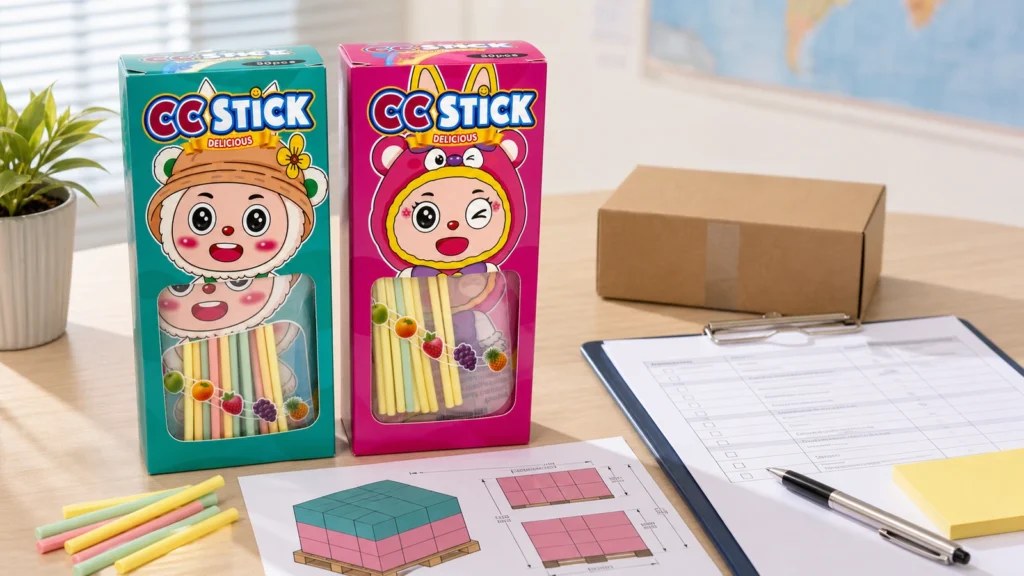
KidStar SKU YMX-011 is a good example because it is a hard-candy display-box line: 15.5 g × 30 pcs × 20 display boxes, packed in a route that buyers can test as a retail-facing program rather than a bulk route. That makes it a useful SKU for explaining how buyers should build a one-pallet test order without pretending that "small order" alone is a strategy.
Decide what the pallet is supposed to prove
The first mistake is using "one pallet" as a quantity label without stating the commercial job. A test order can mean very different things:
- a retail buyer wants to check shelf movement
- a distributor wants a sales-team sample route
- an importer wants to test customs, handling, and local breakage risk
- a wholesaler wants to compare two or three fast-moving lines before scaling
Those are not the same project. The supplier cannot prepare the same sample pack, the same carton discussion, or the same quote emphasis for all of them.
That is why a buyer should begin with one sentence: what decision should this test order unlock? If YMX-011 is being used to test impulse shelf movement, the display-box route matters more. If it is being used to test cash-and-carry resale, downstream carton handling and reseller logic matter more. If it is being used for a private-label next step, the test order may be too early unless the packaging customization page is already part of the plan.
Use YMX-011 carton logic to keep the trial realistic
YMX-011 is packed as 30 pcs × 20 display boxes/carton with carton dimensions listed as 44 × 26 × 38.2 cm in the current product library. That does not automatically tell a buyer how many cartons belong on one pallet, because pallet pattern, height limits, gross weight, and market handling rules still need confirmation. But it does tell the buyer something more important: this is a display-led trial, not a loose-bulk experiment.
So the right first questions are:
- Will the original display boxes go directly into the market?
- Does the buyer need the pallet to support store presentation, distributor sampling, or warehouse transfer?
- Is the trial checking the original KidStar route or a later local repack plan?
- Does the buyer want one SKU only, or one pallet split across several display-box lines?
When those points are unclear, the one-pallet request becomes decorative. The buyer receives a number, but not a test that teaches anything.
The product page for YMX-011 helps anchor the route in one exact SKU instead of a vague "hard candy sticks" request.
Use a decision table before fixing the pallet brief
| Test-order goal | Should YMX-011 stay in the original display route? | Why | Best next action |
|---|---|---|---|
| Convenience or discount-store shelf test | Yes, usually | The display box is part of the real selling format | Ask for open-box and shelf-facing photos with the quote |
| Cash-and-carry or wholesaler resale test | Usually yes | Resellers often judge case logic and display ease together | Confirm whether downstream buyers keep or discard the display |
| Mixed pallet for distributor line review | Maybe | The pallet may need comparable display formats across SKUs | Keep the assortment narrow and align carton assumptions |
| Private-label program using YMX-011 only as route proof | Usually no | The pallet test may happen before artwork and panel decisions are stable | Use a sample-and-brief stage first, then build the pilot order |
This table makes the one-pallet idea actionable. It turns "small order" into a real operating choice.
Ask for the right evidence before the first quote is frozen
For YMX-011, a useful test-order pack should include more than one price line. Buyers should ask for evidence that helps them judge whether the pallet route is worth repeating.
Request:
- the closed display box
- the opened display presentation
- one unit close-up and one multi-unit shelf view
- carton photos that show how display boxes sit inside the master carton
- confirmation of whether the pallet proposal assumes standard export palletization or floor-loaded shipment
This is where the samples page and MOQ and lead time page matter together. The buyer needs to know whether the trial is only for market testing or whether it is already close to a repeatable order route. If the supplier and buyer do not align on that point, the second quote often has to be rebuilt anyway.
Keep the first brief short and commercial
A strong one-pallet brief for YMX-011 does not need a long spreadsheet at the start. It needs a short commercial frame plus a few fixed inputs.
Use this checklist before asking for the first firm quote:
- exact SKU: YMX-011 CC Stick Candy
- target market and target buyer type
- purpose of the test order
- whether the original display route stays unchanged
- whether the pallet is single-SKU or mixed-SKU
- whether the buyer wants standard export handling or pallet-specific confirmation
- what success looks like after the test: repeat order, channel approval, or assortment expansion
This keeps the supplier from guessing whether the trial is a real market probe or only an internal sample exercise.
Treat the test order as the first repeat-order rehearsal
The best one-pallet test order is not the smallest possible shipment. It is the smallest shipment that still behaves like the route the buyer actually hopes to repeat. For YMX-011, that usually means keeping the display logic visible, the carton logic visible, and the commercial goal visible.
If the buyer strips away too much detail in the name of simplicity, the test becomes less useful. A shelf test without shelf-facing evidence is weak. A distributor test without carton assumptions is weak. A repeat-order rehearsal without a clear next-step metric is weak.
If you want KidStar to review whether YMX-011 is suitable for a one-pallet trial in your market, send your channel goal, quantity idea, and handling assumptions through the contact page. That gives the team enough detail to respond with a more realistic pilot route instead of a generic small-order quotation.