
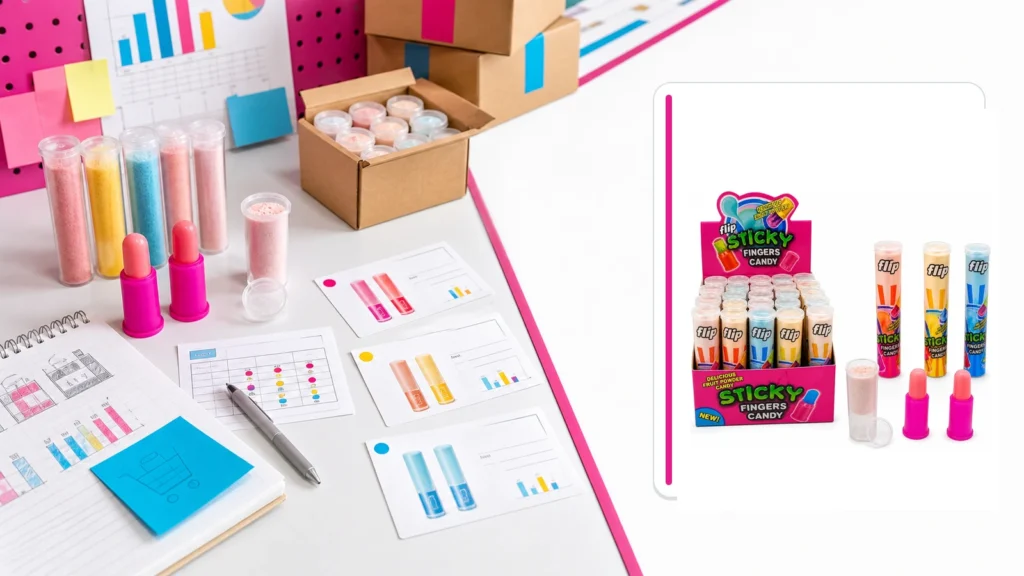
The useful sourcing question is not simply whether powder candy can sell. The better question is whether one exact SKU deserves a place in a buyer’s first commercial trial. KidStar SKU YMX-063 is a practical test case because it is a finger powder candy packed as 6 g × 30 sticks × 24 boxes/carton. That format gives importers, distributors, wholesalers, and private-label buyers a real display-box route to evaluate instead of a vague novelty-candy idea.
Some buyers add a powder line too early because they want one more low-ticket item in the catalog. Others reject it too quickly because they assume the format is only for impulse retail and not serious enough for a first inquiry. Both mistakes come from skipping the commercial role of the product. YMX-063 belongs in a trial lineup when the buyer can explain the sales channel, the handling route, and the reason this SKU helps the first container or pilot order make sense.
Start with the shelf job, not the flavor list
Finger powder candy usually works when the buyer needs a fast-moving, retail-facing line that can sit in value channels, convenience-style counters, mixed candy displays, or general-trade assortments. It is less useful when the buyer is building a premium gifting range, a clean-label adult confectionery line, or a market entry built around large-format family sharing packs.
That is why the first decision should be commercial:
- Is the buyer testing an impulse-price slot?
- Will the original display box go directly into the market?
- Is the market comfortable with novelty or playful candy formats?
- Does the distributor need a low-commitment SKU to test outlet response?
- Will the first order sit alongside other small-count items in a mixed candy plan?
If the answer to most of those questions is yes, YMX-063 becomes a more natural candidate. If the buyer cannot answer them, the product should stay in the conversation as an option rather than being pushed into the first quote as a default line.
The product page helps because it anchors the discussion in one specific display-box route. The buyer can then compare it against the wider product catalog and decide whether YMX-063 is serving a real channel need or just adding noise to the first shortlist.
Use a decision table before adding YMX-063 to the first shortlist
The strongest first lineup is not the biggest lineup. It is the cleanest one. Buyers should therefore decide whether YMX-063 is acting as a channel-fit test, a mixed-container filler, or a line that should wait until later.
| Buyer situation | Add YMX-063 now? | Why | What to tell the supplier |
|---|---|---|---|
| Discount or general-trade pilot with small-ticket checkout items | Yes | The display-box route fits fast trial selling | Ask for the standard YMX-063 route and shelf-facing photos |
| Mixed confectionery program that still needs one novelty/value line | Usually yes | It broadens the assortment without forcing a complex pack change | State where YMX-063 sits inside the wider item mix |
| Premium retail or gift-driven launch | Usually no | The format may not match the shelf position or brand tone | Keep it as a secondary option, not a first quote line |
| Buyer has no clear sales channel yet | Hold | The product may be quoted for the wrong commercial role | Treat the price as directional until the channel is named |
| First project is private label with heavy artwork work already planned | Case by case | The format can work, but artwork and panel choices should be scoped early | Ask whether stock route or custom route is the better first step |
This table is useful because it stops the buyer from treating a low-price item as automatically easy. The right question is not "Can we get a cheap quote?" The right question is "Does this pack route belong in the first commercial test?"
Brief the handling route before asking for price
YMX-063 is not a loose bulk item. It is a retail-facing finger powder candy packed in a display system. That means the first brief should describe how the box will move after arrival, not only how many cartons are wanted.
Before asking for a firm quote, buyers should confirm:
- destination market
- likely outlet type
- whether the display box will stay unchanged in market
- whether the first order is a pilot or a repeat route
- whether mixed-SKU shipment planning is already expected
- whether the buyer wants stock packaging or an adapted route
This is where the packaging customization page matters. A buyer may discover that the standard display route is already enough for the first trial. Another buyer may realize that the first order needs a different panel hierarchy, artwork path, or carton-mark discussion. Both are valid outcomes, but they should be discovered before sample approval turns into a quote rewrite.
The MOQ and lead time page also belongs in the first review because a trial lineup is often judged by unit count and launch speed, not only by product interest. If YMX-063 is being tested as one line inside a broader importer program, the buyer should say that openly. The supplier can then respond with a cleaner pilot logic instead of assuming the product will be scaled immediately.
Treat the first sample as a channel check, not only a taste check
A buyer can like the candy and still make the wrong sourcing decision. The first sample should answer whether YMX-063 behaves correctly for the intended market.
Use this checklist before sample approval:
- Confirm the exact SKU and display count shown in the sample note.
- Ask for photos of the closed display box and opened shelf presentation.
- Check whether the pack feels right for the intended price point and outlet type.
- Confirm whether the importer expects the standard box to be consumer-facing.
- Record whether the buyer is testing novelty appeal, low-price velocity, or mixed-assortment fit.
- Note any artwork or language concerns before treating the route as quote-ready.
This is more disciplined than asking only for "powder candy samples." It creates evidence that helps the buyer decide if YMX-063 belongs in the first RFQ or should wait until the wider range is clearer.
Know when YMX-063 should stay in the pilot stage
Not every promising SKU should move straight into a full commercial brief. Sometimes the right move is to keep YMX-063 inside a small pilot order or mixed trial.
That is usually the better path when:
- the buyer is entering a new outlet type
- the distributor has not tested novelty candy recently
- the importer is unsure whether the original display box fits local shelf practice
- the first shipment combines several low-ticket items with different carton behaviors
- the market team wants sales evidence before approving custom packaging work
In those cases, YMX-063 still has value. It simply has pilot value rather than anchor-SKU value. That distinction helps both sides avoid pretending the product is either perfect for the market or irrelevant to it.
Put YMX-063 in the lineup only when it solves one clear commercial job
The best first lineup has a reason for every SKU. YMX-063 belongs when it gives the buyer one practical advantage: a value-line trial item, a novelty slot for general trade, a mixed-container balance line, or a low-friction display-box test. It should not be added just because powder candy exists in the catalog.
If you want KidStar to check whether YMX-063 fits your first trial lineup or should stay in a later-stage shortlist, send your destination market, outlet type, order scale, and packaging route through the contact page. That makes it easier to reply with a useful shortlist decision instead of a generic novelty-candy quote.