
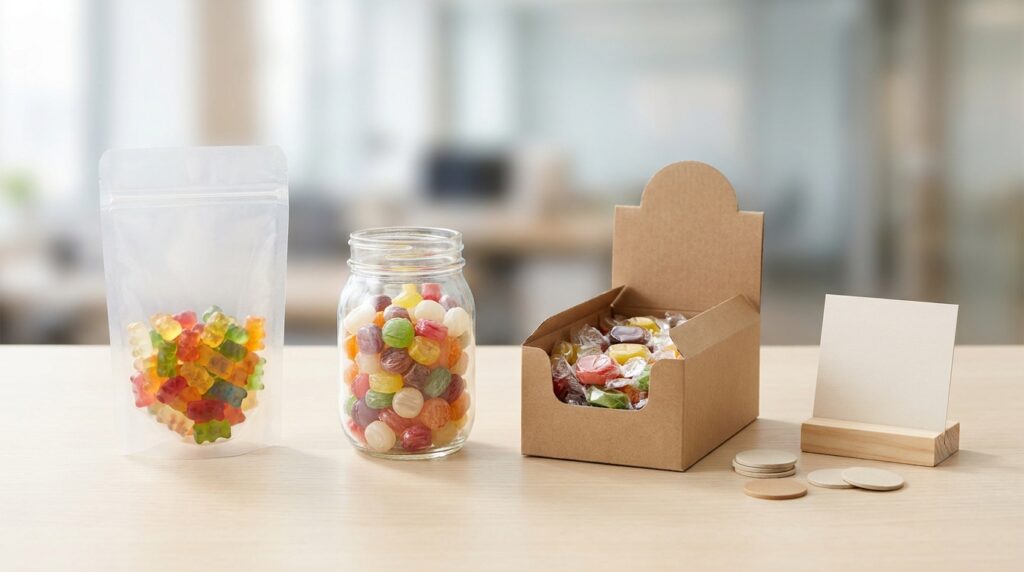
For importers, distributors, wholesalers, and private-label buyers, a candy catalog is useful only when it leads to one structured RFQ. Without that conversion step, the supplier often replies with another broad catalog, a vague quote range, or too many product options to compare. A clear RFQ should narrow the catalog into one buying case the supplier can answer cleanly.
This guide shows B2B buyers how to turn a catalog into one clear candy RFQ. The aim is to shorten the path from browsing products to receiving a response that can actually be reviewed, compared, and approved.
Latest market insight
- Buyers should now specify halal or vegan scope at RFQ stage, because 2026 market-access rules and pectin-gummy demand are already changing which catalog items remain viable.
- Packaging and recyclability expectations should be declared upfront, as mono-material and EPR-linked packaging decisions increasingly affect private-label candy offers.
- Structured RFQs with SKU, quantity, pack route, and Incoterm fields outperform open-ended catalog requests because they let suppliers return one comparable commercial path instead of a product dump.
Sources reviewed: Market Reports World, Chemlinked, IncoDocs, LinkedIn packaging trend summary.
Start with one market, one channel, and one commercial goal
Before selecting SKUs, the buyer should state where the candy will be sold and what the RFQ is meant to achieve. A supermarket shelf test, a wholesale mixed-container program, and a private-label launch should not all live inside the same first RFQ. When the supplier knows the market and commercial goal, they can filter the catalog more intelligently.
That first framing step also tells the buyer which catalog pages should be ignored instead of reviewed "just in case."
Reduce the catalog to a short list with one reason per item
An RFQ should not include every interesting SKU. It should include a shortlist that the buyer can explain. For each item, give one commercial reason it belongs in the RFQ: strong shelf color, low-price entry route, halal fit, private-label potential, or better carton efficiency. That keeps the supplier from returning a generic full-range answer.
If the buyer wants three options, make them three deliberate options. Do not mix ten SKUs across unrelated formats and hope the supplier will choose on the buyer’s behalf.
Convert each shortlisted item into one comparable spec line
Once the shortlist is set, turn each candidate into a structured RFQ line. Include candy type, target flavor or assortment, pack format, expected unit size, quantity band, and any special requirement such as halal, importer label, or display-box need. This is the step that converts browsing into sourcing.
The supplier can only return a comparison-ready quote when each shortlisted item has enough detail to stand on its own line.
Tell the supplier what answer format you want back
Most weak RFQs fail because the buyer asks for "best price" but does not define the response format. A better request tells the supplier to return one line per shortlisted item with pack route, MOQ, unit price basis, lead-time view, and any assumption that still needs confirmation.
That instruction is what turns the RFQ into a working decision document instead of another round of loose product recommendations.
Add one next-step decision so the RFQ does not stay open-ended
End the RFQ with one clear next step: shortlist for sampling, compare two pack routes, validate one target price band, or prepare an internal buying meeting. Suppliers respond better when they know what commercial decision the buyer is trying to unlock.
This also helps the buyer avoid collecting more information than the current stage actually needs.
RFQ checklist for turning a candy catalog into one buying brief
| Area | What to include | Why it matters |
|---|---|---|
| Market goal | Destination country, channel, and commercial objective | Keeps the RFQ tied to one real buying case |
| Shortlist | Only the SKUs the buyer is willing to compare now | Prevents another broad catalog response |
| Spec line | Candy type, pack format, unit size, quantity, and special requirements | Gives the supplier enough structure to quote cleanly |
| Response format | MOQ, price basis, lead time, and open assumptions per item | Makes supplier replies comparable |
| Next step | Sample, quote comparison, or pack-route decision | Stops the RFQ from becoming an open-ended exploration |
Related KidStar pages
- Review suitable products on Product Catalog.
- Compare pack routes on Packaging Customization.
- Use MOQ and Lead Time when turning shortlisted items into quote-ready quantity bands.
- Check Certifications and Compliance if halal or market-label rules affect the shortlist.
Send a clearer RFQ
If you want KidStar to turn a catalog review into a quote-ready RFQ, send the destination market, target channel, shortlisted items, pack route for each option, quantity band, and the exact comparison you want back. That makes the supplier’s reply easier to review and easier to act on.