
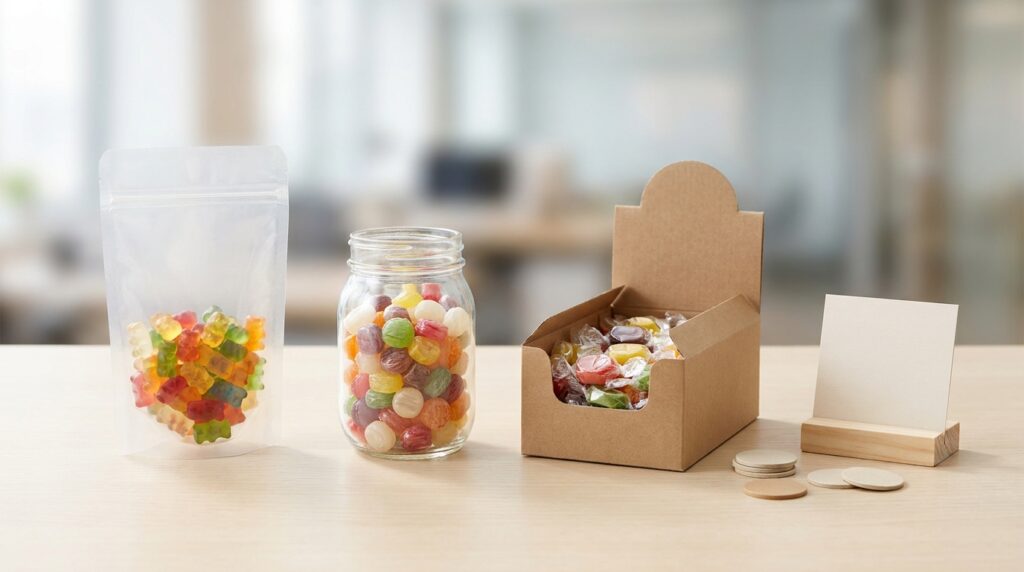
For importers, distributors, wholesalers, and private-label buyers, a large candy catalog only becomes useful when it is reduced to a short list that a supplier can actually quote well. The goal is not to admire dozens of SKUs. It is to select three directions that represent a real buying decision and can be compared without mixing too many formats, pack routes, and commercial assumptions in one thread.
This guide is designed to answer a buyer sourcing question with practical commercial guidance. It is written for B2B teams that want a practical route before starting a detailed quotation discussion.
Latest market insight
- Prioritize halal-certified gummies with BPJPH compliance for Indonesia market access by Oct 2026 deadline.
- Filter for sustainable or flexible packaging options amid 2025-2026 confectionery packaging growth and private label demand.
- Select freeze-dried or sour gummy formats with multi-texture appeal, driven by 2026 viral and mainstream trends.
Start with one channel, one price band, and one buyer use case
Before choosing products, buyers should define the sales route they are targeting. A supermarket pouch line, a convenience impulse pack, a mixed wholesale assortment, and a promotional gift program may all sit in the same supplier catalog, but they should not be shortlisted together unless the buyer wants separate quote paths.
A short buyer brief is usually enough to keep the catalog review focused, as long as it explains the channel, expected price band, and what the buyer wants to test first.
Use each shortlist slot for a distinct product direction
The three shortlist items should not be minor variations of the same idea unless the buyer is truly comparing flavor options. A better structure is one core format per slot, such as one gummy route, one hard-candy route, and one retail-ready packaged route, or one stock item, one private-label route, and one promotional option.
That makes the supplier’s reply easier to compare and prevents the quote from becoming a long menu of half-defined options.
Check packaging fit before the product goes onto the shortlist
Many shortlist mistakes happen because buyers select products by flavor or appearance first, then discover that the required pouch, jar, display box, or compliance route changes the economics. Each candidate should be tied to one realistic packaging route before it is sent for quotation.
When pack fit is clear, the supplier can explain MOQ, artwork effort, and sample planning more precisely.
Ask for three comparable quote paths, not a broad catalog response
Once the shortlist is ready, buyers should tell the supplier exactly what they want back for each item: target pack, quantity band, sample suggestion, and whether the goal is speed, shelf impact, or price competitiveness. This keeps the supplier from replying with another broad catalog instead of three decision-ready paths.
This is also the point where the buyer can decide which item deserves the next sample or detailed packaging discussion.
3-item shortlist checklist before you request a quote
| Area | What to prepare | Why it matters |
|---|---|---|
| Channel | Target market, buyer use case, and shelf route | Stops the shortlist from mixing unrelated commercial goals |
| Product slot 1-3 | One clear format and one reason each item made the list | Makes supplier comparison more disciplined |
| Packaging | Expected pouch, jar, display box, or bulk route for each item | Prevents quote drift after shortlist selection |
| Quantity | Trial order, sample plan, or container ambition per item | Helps the supplier return comparable numbers |
| Decision goal | What the buyer is trying to choose next | Turns the catalog into a quote-ready sourcing discussion |
Related KidStar pages
- Review product families on Product Catalog.
- Compare custom pack routes on Packaging Customization.
- Check MOQ and timing basics on MOQ and Lead Time.
- For documentation questions, visit Certifications and Compliance.
Send a clearer brief
If you are narrowing a catalog into three quote-ready items, send KidStar your target market, channel, shortlist logic, expected pack route, and quantity band for each option. The team can respond with a cleaner comparison instead of another broad catalog dump.