
For importers, distributors, wholesalers, and private-label buyers, freight or FOB pricing is not a number you ask for in isolation. It is the result of a sourcing brief that already makes the supplier’s shipment assumptions visible. If the buyer sends only a candy idea, the first freight line is usually too rough to compare, and the FOB number may also be rewritten after packaging, carton, or destination details become clearer.
This guide is designed to answer a buyer sourcing question with practical commercial guidance. It is written for B2B teams that want a practical route before starting a detailed quotation discussion.
Latest market insight
- Send product specs (SKU details, dimensions, weight per carton, MOQ) + packaging type for accurate volume/weight-based freight quotes.
- Provide target destination, Incoterm (FOB port), volume, and halal/private-label compliance needs amid 2025-2026 regulatory shifts.
- Share label artwork, ingredient/nutrition lists, and certificates (origin, safety) early to speed FOB pricing and avoid delays.
Sources reviewed: 1.
Start with destination, port, and sales route
Before asking for FOB or freight pricing, buyers should state the destination country, preferred port, and the route the goods will follow after arrival. A wholesale container for West Africa, a retail-ready supermarket launch, and a small private-label test order may all use the same candy category, but their carton logic and transport sensitivity can be very different.
A short buyer brief is usually enough, but the supplier still needs to know whether the buyer is comparing port-to-port cost, a landed estimate, or only ex-factory and FOB scenarios.
Lock the pack route before asking for logistics math
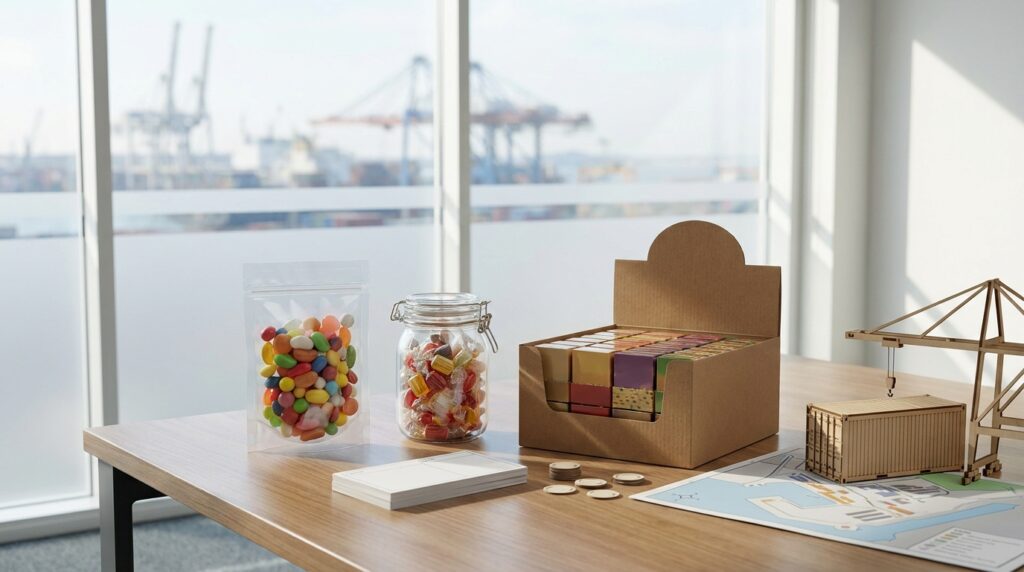
Freight cost depends on how the product is packed, not only on the candy itself. A pouch, jar, display box, or mixed assortment can change carton count, cubic volume, pallet handling, and breakage protection. Buyers who ask for freight too early often receive a number based on the wrong pack route.
The goal is not to finalize every packaging detail on day one. It is to give the supplier one realistic shipment structure instead of forcing them to guess several.
Separate FOB inputs from freight-sensitive inputs
FOB pricing depends on product scope, pack route, quantity, and production assumptions. Freight pricing adds destination, volume, and timing pressure on top. Buyers should tell the supplier which part they need first: a product-only FOB comparison, a carton-based freight estimate, or both in the same reply.
When this is clear, the supplier can explain where the FOB number is stable and where the freight estimate still needs confirmation.
Give one timing checkpoint and one next-step instruction
Timing changes the usefulness of a quote. If the buyer needs a sample first, is preparing a peak-season launch, or wants to compare two shipment windows, that should be stated before the first freight answer is treated as final. It also helps to say what the supplier should return next: FOB only, FOB plus freight estimate, or a sample-and-quote recommendation.
That single instruction makes the response easier to compare and prevents the conversation from falling back into a generic catalog exchange.
Checklist before you ask for FOB or freight pricing
| Area | What to prepare | Why it matters |
|---|---|---|
| Destination | Country, target port, and whether FOB or freight is needed first | Stops the supplier from mixing different logistics assumptions |
| Product | Candy type, size, target pack, and any format exclusions | Keeps the quote tied to the right SKU direction |
| Packaging | Pack route, carton style, unit count, and breakage concerns | Drives cubic volume and handling logic |
| Quantity | Trial MOQ, repeat target, or container ambition | Makes FOB and freight math more realistic |
| Timing | Sample timing, shipment window, and next decision checkpoint | Prevents a rough estimate from being treated as final |
Related KidStar pages
- Review product families on Product Catalog.
- Compare custom pack routes on Packaging Customization.
- Check MOQ and timing basics on MOQ and Lead Time.
- For documentation questions, visit Certifications and Compliance.
Send a clearer brief
If you are preparing a freight or FOB request, send KidStar your destination, target port, candy direction, pack route, quantity range, and timing window. The team can respond with a more useful quote path instead of a rough placeholder number.