
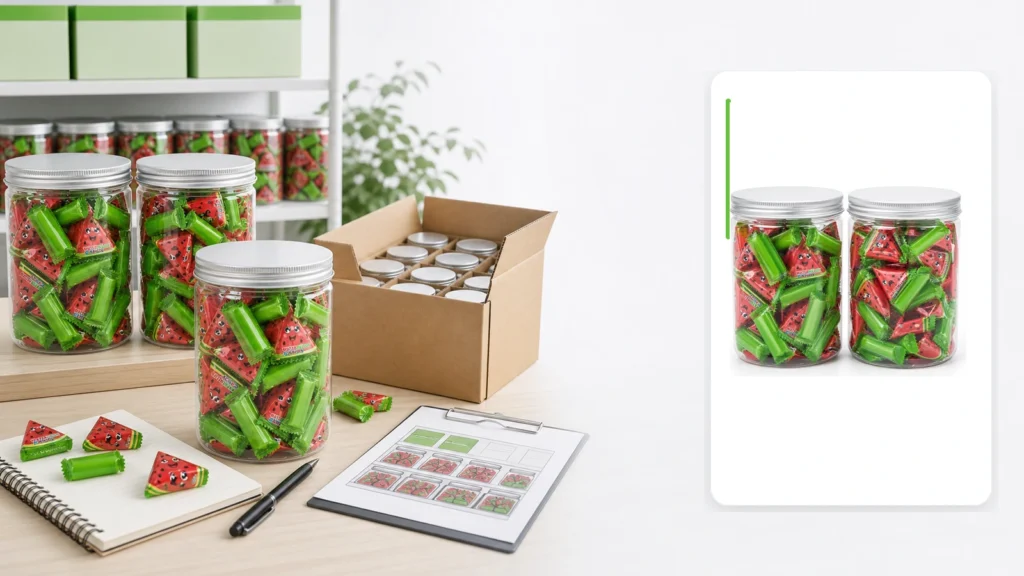
Importers, distributors, wholesalers, and private-label buyers do not choose a hard candy line only because the flavor looks familiar. They choose a route that fits the outlet, the shelf job, and the first order logic. KidStar SKU YMX-017 is a useful example because it is a Watermelon Triangle Hard Candy packed as 10 g × 30 pcs × 20 tubs/carton. That makes it a tub-led retail route, not a loose bulk candy discussion.
The practical question is therefore not just whether the watermelon profile can sell. The better question is when a tub-packed route gives the buyer a cleaner first program than a pouch, a display box, or a mixed hard-candy assortment. That is what determines whether YMX-017 belongs in the first RFQ, a convenience-store test, or a broader hard-candy shortlist.
Read the tub route before you judge the SKU
Tub-packed candy changes the commercial job of the item. The buyer is not only approving taste. The buyer is also approving how the product will be displayed, handled, and replenished after arrival.
For YMX-017, the first review should separate:
- the exact SKU and product link being quoted
- the tub as the retail-facing selling unit
- the candy count inside that unit
- the master-carton route of 30 pcs × 20 tubs/carton
- the channel that will actually move the product after import
That matters because one buyer may need a counter-friendly tub that is easy to open, resell, and refill at small outlets. Another buyer may already know that the market needs individually quoted smaller units or a different outer presentation. Those are different sourcing paths. They should not be hidden inside one vague request for “watermelon hard candy.”
The YMX-017 product page should therefore anchor the first discussion. Once the SKU is fixed, the buyer can compare it against the wider product catalog and decide whether the tub route belongs in a core hard-candy lineup or only in a channel-specific trial.
Use a channel table before asking for the first firm quote
The easiest way to avoid a weak first order is to decide what job the tub is supposed to do.
| Buyer situation | Is YMX-017 a strong fit? | Why | What to confirm before price is treated as firm |
|---|---|---|---|
| Convenience stores and small-format retail | Usually yes | The tub format can support visible shelf or counter presentation | Confirm shelf footprint, opening logic, and expected reorder rhythm |
| Cash-and-carry or wholesale clubs | Maybe | Buyers may like the visible tub, but case logic matters more than novelty | Confirm whether resellers keep the tub intact or break cases down |
| Mixed hard-candy importer assortment | Sometimes | The tub can work if the rest of the shortlist follows a comparable retail route | Align case count, price point, and display logic across the shortlist |
| Private-label development stage | Usually not yet | A stock tub route may not match the future brand plan | Decide whether the project needs a stock test first or packaging customization review |
This table keeps the product decision commercial. It stops the buyer from approving the candy first and only later discovering that the tub route does not fit the real channel.
Decide whether the tub is a retail route or only a test route
Many buyers like a tub format during sample review because it looks easy to sell. The mistake comes when nobody states whether the tub is the actual launch route or only a temporary proof-of-interest route.
Use this sequence:
- If the buyer only wants to test flavor response, YMX-017 is concept-approved.
- If the buyer accepts the tub as the intended selling unit, YMX-017 is format-approved.
- If the buyer also accepts the carton route, outlet plan, and reorder logic, YMX-017 is quote-ready.
That distinction matters because a tub-led candy program often gets judged in real stores by visibility, handling convenience, and refill behavior rather than by flavor alone. A retailer may love the watermelon profile but still dislike how the tub sits on shelf. A distributor may accept the tub but still need a different first-order scale. Those are not failures. They are routing decisions that should be made before the buyer asks for a final price confirmation.
The samples page is useful at this stage because it helps the buyer decide whether the current question is still sample-stage or already commercial-stage. If the supplier and buyer are solving different stages, the quote usually gets rewritten later.
Ask for the evidence that a tub program actually needs
For YMX-017, a useful quote pack should include more than a product photo and a carton count. Buyers should ask for evidence that helps them judge whether the tub route will behave properly after import.
Request:
- one clear image of the closed tub
- one open presentation image that shows how the product is taken out
- one case-level image that shows how tubs sit inside the carton
- confirmation of the exact unit count and the current tub route used for the quoted SKU
- any handling notes that matter for warehouse transfer, shelf refill, or outlet display
This is also where the MOQ and lead time page matters. A tub-led program may look simple on shelf, but the first order still needs a realistic quantity path. If the buyer wants only a pilot route, say so. If the buyer already hopes to repeat the program across several outlets, say that too. The supplier cannot answer with the right operating route when the order scale is still being treated like a secret.
Know when to hold the SKU after a positive review
Positive sample feedback does not always mean “put it into the first PO.” Hold the order when:
- the outlet type is still undecided
- the buyer has not confirmed whether the tub stays unchanged in market
- the first order is supposed to test several hard-candy routes at once
- freight, case-handling, or resale logic is still unclear
- the buyer wants a private-label discussion but is still reviewing a stock-route sample
In those cases, the correct next step is not to reject YMX-017. It is to keep the SKU inside a controlled decision. The buyer should write down whether the hold is about channel fit, pack route, or first-order scale. That prevents the supplier from treating a temporary pause like a lost project and prevents the buyer from treating a positive sample like full launch approval.
The packaging customization page becomes relevant only when the buyer has already decided that the stock tub route is commercially useful. Before that point, the buyer should not mix a stock-route test with a custom-packaging conversation unless the team is prepared for rework.
Keep the next supplier message operational
The strongest follow-up for a tub-packed item sounds like a buying brief, not like a generic candy compliment. A useful message usually says:
- we reviewed YMX-017 for this destination market
- the tub route is acceptable or still under review
- the item is for convenience, wholesale, or assortment testing
- the first order is a pilot or a repeatable route
- please quote the next step on that exact basis
That is much more useful than writing, “The sample looks good, please send price.” It gives the supplier enough commercial context to answer with a usable route instead of a decorative quotation.
Choose YMX-017 only when the tub route helps the business case
Tub-packed Watermelon Triangle Hard Candy works best when the buyer can explain why a tub is the right selling unit for the channel, not only why watermelon is a familiar flavor. KidStar SKU YMX-017 should move into the first quote only when the buyer has fixed the outlet type, the intended retail role, the first-order scale, and the commercial reason for keeping the tub route intact.
If you want KidStar to review whether YMX-017 fits your first channel test or belongs in a wider hard-candy shortlist, send the market, outlet type, quantity idea, and pack-route notes through the contact page. That helps the team respond with a cleaner buying path instead of a generic hard-candy offer.