
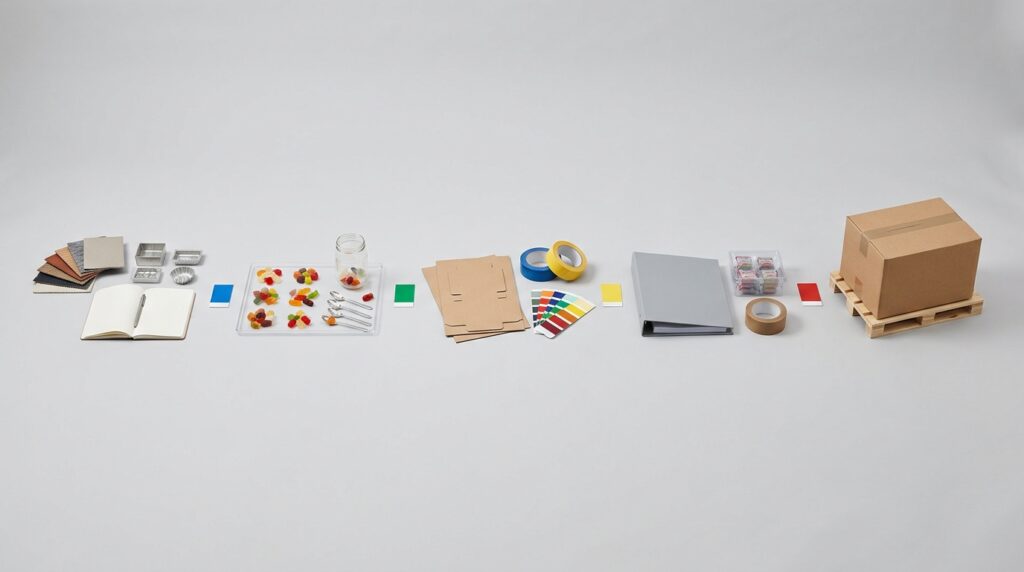
For importers, distributors, wholesalers, and private-label buyers, an OEM candy project moves faster when the buyer knows which inputs belong at each stage. Most delays happen because flavor, packaging, label, compliance, or payment questions are raised in the wrong order.
This guide maps a practical OEM candy project timeline from the first brief to sample approval, artwork, PI, and production booking.
Latest market insight
- OEM timelines average 4-8 weeks for custom gummies vs. 2-3 weeks private label, driven by formulation/R&D needs.
- 2025-2026: Private label candy demand surges with record US sales ($282.8B in 2025); distributors prioritize fast, compliant launches amid value focus.
- Halal certification & sustainable packaging now baseline for imports; plant-based gummies & EPR compliance extend OEM sample-to-order phases.
Stage 1: Freeze the commercial brief before asking for samples
Before a supplier can build the right sample plan, the buyer should lock five basics: destination market, candy category, target pack format, estimated order volume, and timing. Without those inputs, even a capable supplier is likely to answer with a broad catalog instead of a workable OEM plan.
This first stage is also where the buyer should mention whether the project is fully custom OEM, private label on an existing formula, or a hybrid route. That choice changes sample lead time and cost immediately.
Stage 2: Align sample goals before formula and packaging work expand
Samples should answer a specific question: product taste, piece size, texture, pack format, or shelf presentation. If the buyer asks for "samples" without defining the purpose, multiple rounds may be wasted.
At this stage the supplier should confirm what can be tested with stock molds or existing formulas and what requires custom development. That distinction protects the project timeline.
Stage 3: Move to artwork only after pack structure is stable
Artwork work should begin only after the buyer and supplier agree on pack format, size, label panel, barcode route, and required market claims. Starting design too early often causes dieline changes, label resizing, or compliance edits that push the launch back.
For OEM candy projects, this is also the right time to confirm date-code position, carton marks, halal or compliance marks, and who approves final print files.
Stage 4: Use PI and deposit to lock production resources
Once sample direction and artwork are approved, the supplier can issue the PI and reserve production capacity. Buyers should review SKU list, unit count, carton data, payment terms, and requested ship window carefully at this point.
If important details remain open after PI, the production booking becomes unstable and the project may slip.
Stage 5: Confirm final approvals before the ship date
Before shipment, the buyer should confirm final label approval, carton marking, inspection needs, and document package. This is especially important for new markets or first orders where customs and retail teams may ask for extra checks.
Clear sign-off at this stage reduces emergency changes and protects the delivery window.
OEM timeline table for buyers
| Project stage | Buyer inputs | Supplier output |
|---|---|---|
| Brief stage | Market, product category, pack route, volume, timing | Recommended OEM route and first quote assumptions |
| Sample stage | Taste/shape priorities, reference products, approval criteria | Sample plan and development timeline |
| Artwork stage | Final pack structure, label language, compliance marks | Dieline support and artwork approval process |
| PI stage | SKU confirmation, quantity split, payment acceptance | PI issue and production reservation |
| Pre-shipment stage | Final approvals, inspection, shipping docs | Shipment release and document package |
What buyers can prepare to shorten the timeline
The easiest way to shorten an OEM candy project is to send one clear brief, one clear sample target, and one clear approval owner on the buyer side. Delays often come from internal handoffs between sales, packaging, design, and compliance teams after the supplier has already started work.
If that internal alignment is not finished, it is better to say so and ask the supplier for a staged plan instead of pushing for a quote that will be revised repeatedly.
Related KidStar pages
- Review product families on Product Catalog.
- Compare custom pack routes on Packaging Customization.
- Check MOQ and timing basics on MOQ and Lead Time.
- For documentation questions, visit Certifications and Compliance.
Send a brief that matches the project stage
If you are preparing an OEM candy inquiry, send KidStar your market, candy direction, pack route, target quantity, launch timing, and the current stage of your project. The team can then suggest the right next step, whether that is sample planning, packaging discussion, or PI preparation.