For importers, distributors, wholesalers, and private-label buyers, pouch candy fill weight affects more than pack appearance. It changes shelf presence, price point, carton count, freight efficiency, and what kind of quote a supplier can give you on the first round.
This guide is for B2B teams that are comparing stand-up pouch candy programs and want to avoid the usual back-and-forth of "what size pouch?" and "how many grams per bag?" after the quote is already sent.
Latest market insight
- Specify net weights early (e.g., 100-500g common for stand-up pouches) to match pouch size, reduce slack-fill risks, and ensure FDA/NIST-compliant labeling on imports.
- Prioritize halal-certified gummies/sugar confectionery with verified bovine/plant gelatin and marks to meet 2025-2026 import compliance amid tariff shifts and private-label demand.
- Choose resealable, high-barrier stand-up pouches for fragile/multi-texture or freeze-dried candies to improve shelf stability, portion control, and retail presentation for GLP-1/value.
Start with the retail position you need to win
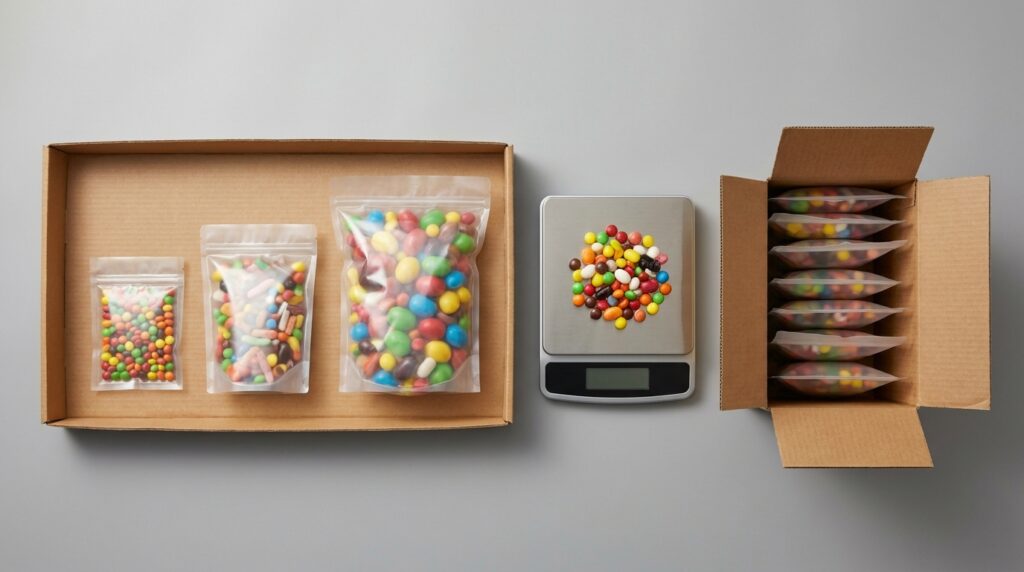
Pouch candy works well when the buyer needs flexible sizing, lighter freight, and a faster route to market. But fill weight should not be chosen in isolation. A 100 g pouch for convenience stores, a 180 g family-share pouch for supermarkets, and a 500 g value pouch for wholesale all create different pouch dimensions, price ladders, and shelf requirements.
Before you ask for a sample or quote, decide where the pack will sit: checkout, peg hook, shelf tray, e-commerce bundle, or discount bin. That one decision helps narrow the right pouch width, gusset depth, and display style much faster than asking for "best-selling pouch candy."
Fill weight must match pouch size and candy piece logic
The supplier needs to know whether the candy is piece count driven, volume driven, or target-price driven. Small hard candy pieces, gummy bears, lollipops, and freeze-dried items all fill space differently. If the buyer only gives a gram target without candy size or piece count intent, the first pouch proposal is often revised later.
For example, two 150 g pouches can look completely different on shelf depending on candy density and whether the buyer wants a fuller front face or a lower-cost compact pouch. Clarifying this early also helps avoid slack-fill issues and label rework.
Shelf presentation depends on pouch shape, not only artwork
Stand-up pouches are common when the product must face forward on shelf. Pillow bags may suit lower-cost bulk display. Resealable zippers usually help for family-share or premium programs, while euro holes or peg options are more useful for hanging formats.
If the buyer already knows the intended shelf position, the supplier can recommend whether the pouch should stand alone, sit inside a display tray, or ship with a shelf-ready outer carton. That changes both presentation and landed cost.
Carton count and freight should be checked before artwork
Many pouch projects slow down because the front-of-pack idea is discussed before carton quantity and shipper dimensions are checked. A pouch that looks right on shelf may create poor carton efficiency, weak outer-carton stacking, or an awkward master carton for supermarket replenishment.
Buyers should ask for an early carton estimate together with pouch recommendation. This helps compare real cost, not only ex-factory unit price.
Buyer planning table for pouch candy programs
| Decision area | What to confirm first | Why it matters |
|---|---|---|
| Channel | Convenience, supermarket, discount retail, wholesale, or e-commerce | Sets the target shelf role and retail price expectation |
| Fill weight | Target grams plus approximate piece count or candy type | Helps the supplier match pouch dimensions and fullness |
| Pouch structure | Stand-up, pillow bag, zipper, window, hanger hole, or tray support | Changes material, presentation, and MOQ |
| Carton logic | Units per carton, target carton size, and pallet preference | Prevents freight surprises after the first quote |
| Compliance | Destination market label language, halal need, barcode, date code | Avoids artwork and approval delays later |
| Launch timing | Sample deadline and requested ship date | Tells the supplier how much flexibility exists for revisions |
What to send with your first inquiry
A strong first inquiry for pouch candy does not need final artwork. It should include the destination market, intended retail channel, target fill weight, candy type, expected order volume, and whether the pack should stand on shelf or work inside a display tray.
If you already have a reference pouch size from another market, add that too. It gives the supplier a practical starting point and usually improves the first recommended SKU set.
Related KidStar pages
- Review product families on Product Catalog.
- Compare custom pack routes on Packaging Customization.
- Check MOQ and timing basics on MOQ and Lead Time.
- For documentation questions, visit Certifications and Compliance.
Send a pouch brief that can actually be quoted
If you are preparing a pouch candy inquiry, send KidStar your market, candy type, target fill weight, shelf route, carton expectation, and launch timing. That gives the team enough information to recommend pouch formats, sample directions, and a more realistic quote path instead of a generic catalog reply.