A windmill lollipop sample should be treated as two connected items: an edible candy and a moving novelty component. For KidStar SKU YMX-047 Windmill Hard Candy, the current product record lists a 3 g candy, 30 pieces per display box, and 24 display boxes per carton. Import buyers should inspect the exact sample, pack separation, moving parts, unit count, labels, and carton before asking for a production offer.
The direct answer is to use one eight-point inspection sheet and photograph every result. A good-looking sample is not proof of compliance, production consistency, or destination acceptance. The importer, distributor, wholesaler, or private-label buyer must still decide which food, toy, children’s-product, labeling, and import rules apply in the target market with the responsible local specialists.
Start with the exact YMX-047 reference
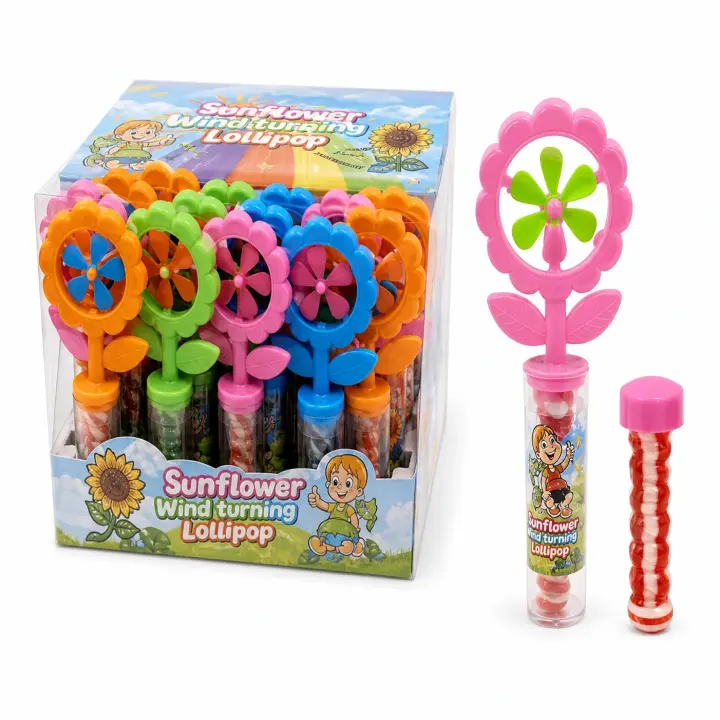
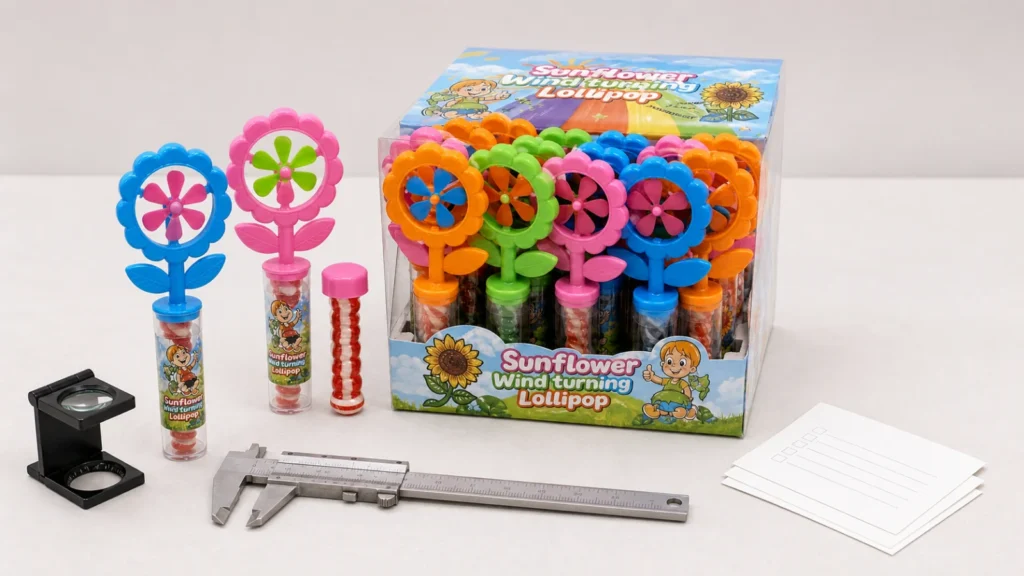
The library image shows a transparent display box, colorful flower-shaped windmill tops, clear candy tubes, and striped hard-candy pieces. Those visible features are useful for identification, but they do not prove material composition, age grading, mechanical safety, or a final assortment rule.
Put these facts at the top of the sample sheet:
- SKU: YMX-047
- listed product: Windmill Hard Candy
- listed edible unit: 3 g
- display route: 30 pieces per display box
- carton route: 24 display boxes per carton
- sample received date and courier reference
- buyer’s destination country and intended channel
Link the sheet to the live YMX-047 product page so the supplier and buyer are discussing one identifiable item. If the sample differs from the current page or quotation, stop and record the difference instead of assuming it is a harmless update.
Run eight checks on the physical sample
The sample inspection should separate observable evidence from documents that still need confirmation.
| Check | What to inspect on YMX-047 | Evidence to keep | Do not assume |
|---|---|---|---|
| 1. Product identity | Windmill top, clear tube, striped candy, colors, and pack artwork | Front, back, side, and open-pack photos | A similar shape is the same SKU |
| 2. Food separation | How the edible piece is enclosed and separated from non-food parts | Close-up before and after opening | Separation automatically satisfies every market |
| 3. Moving parts | Rotation, looseness, sharp edges, breakage, and detachable pieces | Short video plus defect notes | One working sample proves batch consistency |
| 4. Unit count | 30 pieces in the display box and the quoted assortment | Count sheet and color tally | Image colors equal a fixed packing ratio |
| 5. Net content | The 3 g listed candy basis and the declared unit on the sample | Label photo and buyer’s sample measurement | A catalog value replaces final specification |
| 6. Consumer information | Ingredients, allergens, warnings, age statements, lot/date coding, and language | Full label scan | Existing artwork is ready for the destination |
| 7. Display performance | Box opening, upright presentation, refill handling, and shelf footprint | Store mock-up photos | The box fits every counter or shelf |
| 8. Transit protection | Movement, crushing, loose pieces, and carton condition | Drop/handling notes and carton photos | A courier sample predicts container performance |
Record pass, fail, or open for every row. “Open” is a valid result when a document or local decision is still missing. It is safer than turning a visual impression into a certification claim.
Keep food and play-component review separate
Novelty candy can trigger more than one review route. The exact classification depends on the product design, intended user, packaging, target market, and current rules. Buyers should not ask a candy supplier to provide one generic statement that supposedly settles every country.
For the European Union, the European Commission explains that the new Toy Safety Regulation entered into force on January 1, 2026 and generally starts applying on August 1, 2030 after a transition period. The regulation includes specific provisions for toys contained in or co-mingled with food, including packaging and warning requirements. That is a reason to obtain a destination-specific review; it is not evidence that YMX-047 is already compliant.
In the United States, FDA guidance and Import Alert 34-02 discuss confectionery containing non-nutritive objects and possible adulteration or choking concerns. The design shown for YMX-047 is not enough to reach a legal conclusion from a photograph. A U.S. buyer should give the exact sample and construction to its responsible food and consumer-product specialists before committing to an import program.
Use the wider candy toy manufacturer guide to organize questions, then ask the destination-market team which files, testing, warnings, or registrations are actually required. Never convert a supplier’s generic certificate from another item into evidence for this SKU.
Turn defects into measurable acceptance rules
“Looks good” is not an inspection standard. Convert the first sample into a short list of features that can be checked again on a pre-production sample and shipment inspection.
A practical acceptance list may include:
- windmill top turns without visible cracking or a loose central part
- no sharp edge, burr, or exposed broken plastic is observed on the checked sample
- food remains enclosed as shown in the approved reference
- display box contains the approved number of pieces
- approved colors or assortment rule are written rather than inferred
- label version, language, lot/date code position, and warnings match the buyer-approved file
- display box closes, stands, and protects the units during the buyer’s handling test
- carton mark and pack hierarchy match the quotation and packing list draft
These are buyer-defined inspection points, not universal tolerances. If the buyer needs numerical defect limits, test methods, or legal pass criteria, those must come from the agreed inspection plan and responsible specialists.
Separate the stock sample from requested changes
Private-label artwork, another candy flavor, a different windmill color mix, a changed tube, or a revised display count creates a new review version. Do not approve a stock sample and then let the final quotation quietly substitute a custom version.
Use a simple change table:
| Requested change | Evidence to refresh | Commercial effect to confirm |
|---|---|---|
| Artwork or language | Label proof and product photos | MOQ, setup, approval timing |
| Color or assortment | Written packing rule and new sample | Production basis and sell-in file |
| Candy weight or formula | Specification and label review | Price, count, documentation |
| Plastic component | Exact construction sample and relevant review | Testing, timing, and destination acceptance |
| Display or carton count | Pack hierarchy and carton data | Quote denominator and freight planning |
The packaging customization page is useful after the stock route passes the first product decision. Before that, keep the standard sample and every requested change in separate columns.
Use the sample to decide the next buying action
The inspection should end with one of four decisions:
1. Reject: identity, construction, separation, or condition is visibly wrong. 2. Resample: the product is promising but a defect or changed version needs another physical check. 3. Document review: the physical sample is acceptable, but labels, test files, or destination decisions remain open. 4. Quote-ready: the exact version, pack hierarchy, destination, quantity direction, and open requirements are clear enough for a controlled offer.
If tasting, construction, or transit behavior still needs evidence, use the samples route and name the decision the sample must answer. Avoid requesting a mixed bag of attractive items that cannot be traced back to one specification.
Send one controlled windmill-lollipop brief
YMX-047 is ready for a serious buyer conversation when the exact 3 g item, 30-piece display box, 24-box carton, sample version, intended market, channel, and open review questions are all visible in one file. The sample does not need to answer everything, but it must expose what is still unknown.
To review this route, send the destination, outlet type, sample goal, intended resale unit, quantity direction, artwork scope, and required document list through the contact page. KidStar can then respond against the exact YMX-047 version instead of a generic novelty-candy request.
Sources reviewed
- KidStar YMX-047 Windmill Hard Candy product record, reviewed August 27, 2026.
- European Commission: Toy safety in the EU, reviewed August 27, 2026.
- EUR-Lex: Regulation (EU) 2025/2509 on toy safety, reviewed August 27, 2026.
- FDA Import Alert 34-02, reviewed August 27, 2026.