Candy pack size trends in 2026 do not point to one universal winner. Convenience buyers are balancing entry price, immediate consumption, perceived value, and retailer margin. The practical response is a two-size test with one small, portable route and one larger value route—not a full assortment commitment based on a trend headline.
KidStar SKU YMX-219 Original Finger Biscuit Sticks can serve as the controlled small-format reference. Its current record lists 15 g per unit, 30 pieces per display box, and 20 display boxes per carton. Importers, distributors, wholesalers, and private-label buyers should test that exact route against one larger comparison pack in the same outlet cohort, then decide with buyer-owned sell-through and margin rules.
Read the 2026 signal as a portfolio question
NACS reported in June 2026 that convenience retailers remain concerned about wallet pressure and are looking at price-point-friendly pack sizes or offers. The same coverage describes convenience stores as discovery and trial destinations for new candy products. This supports a test of accessible formats; it does not prove which SKU, price, or size will win in another country.
NACS also reported that packaged sweet-snack suppliers entering convenience are working with multiple pack sizes to support immediate consumption and trial. The National Confectioners Association’s State of Treating 2026 adds another useful tension: when money is tight, 64% of surveyed consumers said they would rather have less but keep a favorite, while 36% would rather explore different brands or types. Those U.S. signals suggest two buyer hypotheses:
- a smaller pack may lower the cash barrier and support portable trial
- a larger pack may communicate value per unit or serve a different occasion
These are hypotheses for a local test, not global demand forecasts.
Define the job of each pack before comparing
Pack size should answer a channel job. If the two test cells serve different jobs, their results should not be collapsed into one average.
| Test cell | Buyer hypothesis | Placement to test | Metric the buyer owns |
|---|---|---|---|
| Small immediate-consumption unit | Lower entry price and portability can support trial | Checkout, snack shelf, or grab-and-go zone | Units per outlet per review period |
| Larger value or sharing pack | Better value perception can support basket size or sharing | Main candy/snack shelf or take-home section | Gross margin and sell-through per facing |
| Mixed display | Choice can capture two missions | Only where shelf space allows a fair comparison | Share of sales by size and stockout rate |
| Single-size control | A known incumbent establishes the baseline | Matched outlets | Change versus the buyer’s own baseline |
Do not compare only revenue. A larger pack can produce more revenue per transaction while moving fewer units. A small pack can move quickly but create more replenishment work. Record units, gross margin, stockouts, waste or damage, and shelf space together.
Use YMX-219 as one controlled small-format reference
The YMX-219 record provides a useful denominator for the small test cell:
- 15 g listed unit
- 30 pieces per display box
- 20 display boxes per carton
- original finger biscuit stick format
- quote-ready status in the current product library
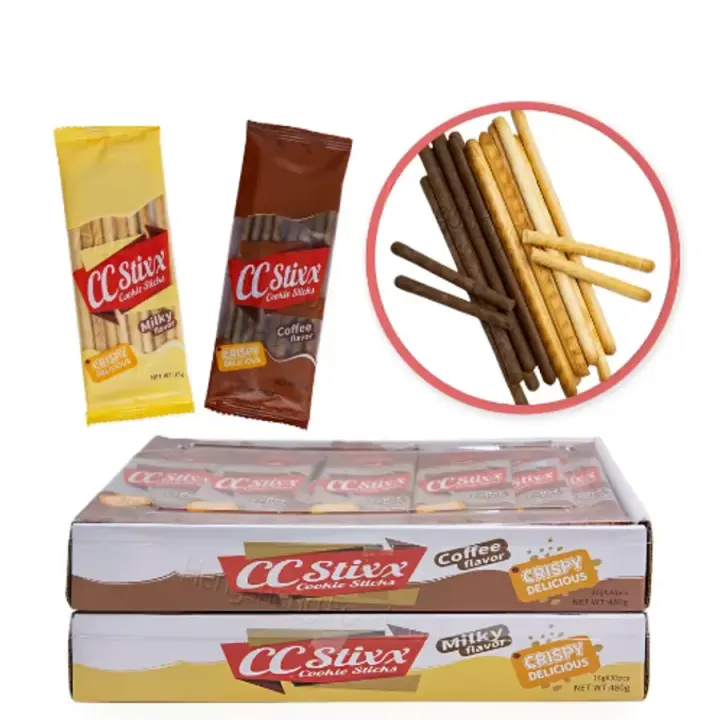
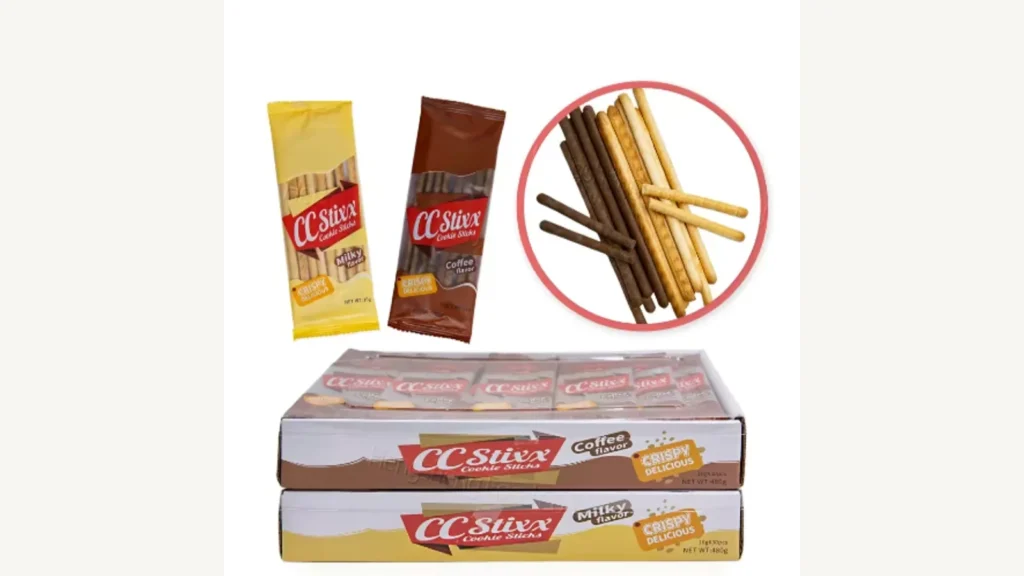
The image shows individual biscuit-stick packs and display cartons. It may help a buyer discuss immediate consumption and counter or snack-shelf presentation, but it does not confirm flavor assortment, local sell-through, allergen suitability, or the final artwork for a destination.
Keep the live YMX-219 product page in the test brief. If a supplier offers a different weight, flavor, display count, or carton route, treat it as another test cell instead of silently replacing the reference.
Build matched outlets and a fixed review window
A useful pack-size trial needs comparable outlets. Choose stores with similar traffic, shopper mission, shelf position, and replenishment discipline. If the small format goes beside the till in high-traffic stores while the larger pack sits on a low shelf in slower stores, the buyer has tested placement as much as size.
Before launch, write down:
- market and outlet type
- number of outlets in each cell
- exact SKU or comparison product in each cell
- retail or wholesale selling unit
- intended price point and margin calculation
- facings and placement
- opening inventory and refill rule
- trial start and end date
- stockout, damage, and markdown logging
- reorder, expand, revise, or stop threshold
Use the retail-ready confectionery pack guide to review presentation questions. The buyer still owns the local price, tax, promotion, and shelf decision.
Keep price architecture separate from product cost
Entry price is not the same as low supplier price. A 15 g unit may create an accessible shelf price, but the full business case also depends on display utilization, carton handling, freight, duties, local costs, and the number of sellable units.
Build one line for each size:
| Input | Small YMX-219 cell | Larger comparison cell |
|---|---|---|
| Exact sellable unit | 15 g listed unit; confirm quote version | Buyer-defined comparison |
| Units per display/carton | 30 × 20 listed route | Supplier-confirmed route |
| Product and pack cost | Quoted, with currency | Quoted, with currency |
| Freight/border/local cost | Estimated or confirmed and labeled | Same treatment |
| Shelf price | Buyer-owned | Buyer-owned |
| Gross margin method | Same formula | Same formula |
| Shelf space and refill labor | Recorded | Recorded |
The MOQ and lead time page helps frame quantity and timing questions. Do not assume the same MOQ, lead time, or price basis will apply if the buyer changes weight, artwork, or pack hierarchy.
Decide what would prove or disprove each hypothesis
Avoid declaring a winner because one format sells out once. A stockout may indicate demand, weak opening inventory, or slow replenishment. A slower large pack may still contribute more margin or suit a different occasion.
At the end of the fixed window, review:
- units sold per matched outlet
- revenue and gross margin per facing
- stockout hours and replenishment frequency
- discount or markdown units
- visible pack damage
- repeat orders from wholesale customers or stores
- feedback tied to price, size, flavor, or placement
- whether the result changes across outlet types
Then choose one action: expand the winning cell, run a corrected test, keep both for distinct missions, or stop. The trend evidence justifies the experiment; the buyer’s local data justifies the next purchase.
Do not confuse discovery with proven demand
The NCA reports that discovery happens both online and in stores, including a strong TikTok discovery signal among Gen Z. That helps explain why novel formats get attention. It does not mean a social post proves wholesale reorders, and today’s public TikTok Shop candy query did not provide a reliable product-level signal for this specific SKU.
If the buyer wants to test social discovery, define it as a separate acquisition input: content views, clicks, store requests, or coupon redemption. Keep those measures beside—rather than in place of—sell-through and margin.
Send a two-size trial brief
A 2026 pack-size decision becomes actionable when the buyer names two hypotheses, matched outlets, the exact small and larger units, shelf positions, prices, margins, review window, and stopping rule. YMX-219 provides one traceable 15 g route; the buyer must define the larger comparison fairly.
Send the target market, outlet cohort, YMX-219 role, comparison size, trial quantity, planned price points, placement, and decision rule through the contact page. KidStar can then answer against a controlled test rather than a broad request for one universal pack size.
Sources reviewed
- NACS Magazine: Candy Rises Despite Challenges, June 2026; reviewed August 27, 2026.
- NACS Magazine: Winning with Bakery, February 2026; reviewed August 27, 2026.
- National Confectioners Association: State of Treating 2026, reviewed August 27, 2026.
- KidStar YMX-219 Original Finger Biscuit Sticks, reviewed August 27, 2026.