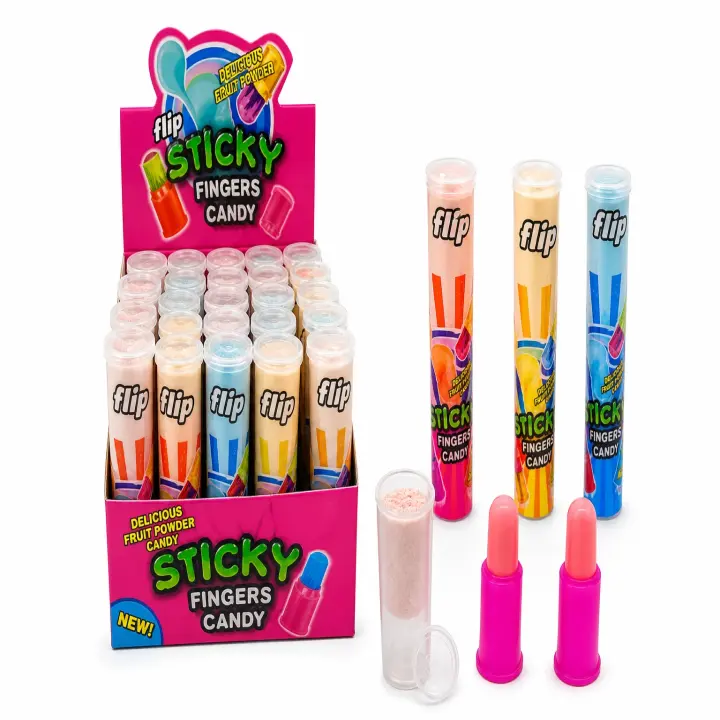
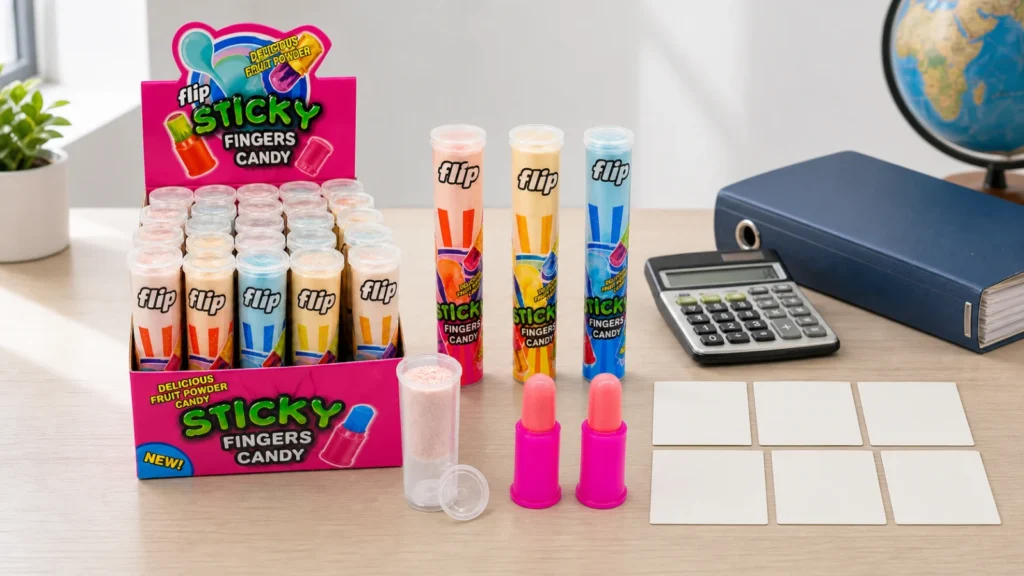
A candy landed cost worksheet is useful only when every supplier route uses the same product, quantity denominator, trade term, destination, and cost boundary. For KidStar SKU YMX-063 Finger Powder Candy, the listed pack baseline is 6 g × 30 sticks × 24 boxes/carton. Buyers can use that baseline to structure a comparison, but they must obtain actual freight, customs, tax, brokerage, and local handling inputs from the responsible providers.
The safe method is to compare six labeled input groups: product and pack, quantity, Incoterm and named place, international transport and insurance, border charges, and destination handling. Mark each number as quoted, estimated, or excluded. Do not insert a universal candy duty rate or assume that FOB, CIF, and DDP offers cover the same costs. ICC rules allocate tasks, costs, and risks between seller and buyer; the destination authority and broker determine the applicable entry treatment.
Lock the YMX-063 denominator first
The current product record gives three useful levels:
- one 6 g finger powder candy stick
- one listed 30-stick display box
- one master carton containing 24 listed boxes
That implies 720 listed sticks per master carton before any supplier-confirmed change, shortage allowance, sample deduction, or destination-specific pack work. Use the arithmetic as a worksheet baseline, then ask the supplier to confirm the quote’s actual pack and carton data. Do not treat the public listing as a final packing list.
A buyer that sells by the display box should calculate landed cost per sellable box. A wholesaler that sells sealed cartons should calculate per carton. A retailer that breaks boxes into sticks may also calculate per sellable stick. The denominator must match the unit that generates revenue.
Build the worksheet around six controlled inputs
| Input group | Record this | Owner or verification route | Status label |
|---|---|---|---|
| 1. Product and pack | YMX-063, 6 g × 30 sticks × 24 boxes, standard or changed pack | Supplier quote and confirmed pack data | Quoted / changed / open |
| 2. Quantity | Cartons, display boxes, and sellable sticks | Buyer order plan plus supplier confirmation | Confirmed / trial estimate |
| 3. Incoterm and named place | Exact rule, version, and named port/place | Sales contract and ICC terminology | Quoted / missing |
| 4. International transport and insurance | Origin, main carriage, insurance where applicable | Forwarder or responsible contracting party | Quoted / estimated / excluded |
| 5. Border charges | Classification-dependent duty, tax, government fees, inspection or filing costs where applicable | Customs authority and qualified broker | Confirmed / estimated / unknown |
| 6. Destination handling | Brokerage, terminal, storage, local delivery, and other market-specific charges | Broker, terminal, warehouse, and local carrier | Quoted / estimated / excluded |
This structure does not tell the buyer what every charge will be. It shows where each charge belongs and whether the figure is reliable enough for a decision.
Put the Incoterm and named place on every row
ICC explains that Incoterms rules clarify the tasks, costs, and risks involved in delivery between sellers and buyers. They do not replace the sales contract, product specification, payment terms, customs classification, or destination tax advice.
Write the rule with its named place, for example “FOB [named port], Incoterms 2020” or another route actually offered and agreed. “FOB price” without a named port is incomplete for a controlled comparison. “Delivered price” without a named destination and cost boundary is also incomplete.
The existing KidStar guide on aligning FOB price, freight, and carton assumptions helps buyers normalize the offer before it enters the worksheet. The ICC source should be used for official terminology, while the actual contract should state the selected rule and place.
Keep customs value separate from landed cost
Landed cost is a commercial planning total. Customs value is a legal valuation concept applied under the destination jurisdiction. They are not interchangeable.
For a U.S. example, CBP says the commercial invoice should generally show the price the U.S. buyer paid for the goods, with specified additions handled under valuation rules. CBP also says freight and insurance are not included in the declared transaction value when they are separately identified under the cited guidance. Other countries can use different valuation, tax, and fee rules.
Therefore:
- do not use this article to select a tariff classification
- do not copy a duty rate from another confectionery product
- do not assume one country’s valuation rule applies elsewhere
- ask a qualified broker or authority to verify classification, value, rate, and entry requirements
- keep estimated border costs visibly separate until verified
This is especially important for novelty or interactive formats. The image and name “finger powder candy” are not enough to determine legal classification in a destination market.
Calculate three outputs instead of one attractive total
Once the six input groups are populated, calculate:
1. Landed cost per master carton for procurement and cash planning. 2. Landed cost per display box for wholesale or distributor resale. 3. Landed cost per sellable stick for retail economics.
Use formulas, not sample prices:
`landed route total = product amount + included transport/insurance + verified border charges + destination handling`
`cost per sellable unit = landed route total ÷ confirmed sellable units`
The numerator must not count the same charge twice. The denominator should exclude non-sellable samples, known damage, or promotional allocations only when the buyer has a documented basis. If those quantities are not known, keep them as a sensitivity row rather than presenting them as facts.
Compare suppliers with an exception log
Price comparison becomes actionable when differences are visible. For each offer, log:
- pack or weight differs from YMX-063 baseline
- carton count is unconfirmed
- currency or exchange-rate date differs
- Incoterm or named place differs
- freight is estimated rather than quoted
- border charge is copied from an unverified source
- local delivery ends at a different point
- artwork, label, or sample work is included in only one route
The existing supplier comparison guide provides the broader evaluation context. The mixed confectionery container questions page is useful when several SKUs share freight or container charges; the buyer should record the allocation method instead of spreading costs arbitrarily.
Send one normalized cost request
A useful YMX-063 request names the product, baseline pack, carton quantity, destination, preferred Incoterm and named place, standard-versus-changed pack scope, and which costs the buyer expects the supplier to quote. It also identifies which figures will come from the forwarder or broker.
Ask KidStar to flag exclusions and assumptions rather than forcing every destination cost into a factory quotation. This produces a more auditable worksheet and reduces the chance that a cheap-looking route hides missing carriage, border, or local handling.
Use landed cost as a decision control, not a promise
The worksheet should expose uncertainty. It should not manufacture precision. Anchor the product side to the exact YMX-063 route, mark every external charge by source and status, and compare suppliers only after the same six input groups are present.
To build a normalized YMX-063 request, send the destination, quantity, selling unit, preferred Incoterm and named place, pack changes, and known freight or broker inputs through the contact page. KidStar can clarify the product-side quotation while your logistics and customs providers verify the external cost rows.
Sources reviewed
- KidStar SKU YMX-063 product record, reviewed August 26, 2026.
- International Chamber of Commerce: Incoterms rules, current Incoterms 2020 framework reviewed August 26, 2026.
- U.S. Customs and Border Protection: Commercial invoice value, updated July 12, 2026; reviewed August 26, 2026.
- U.S. Customs and Border Protection: Duty and CIF, updated February 13, 2026; reviewed August 26, 2026.