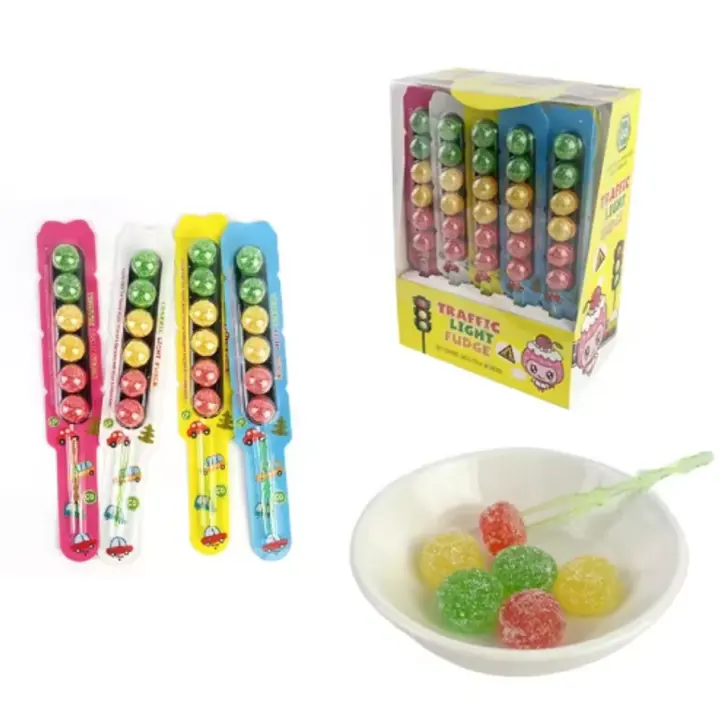
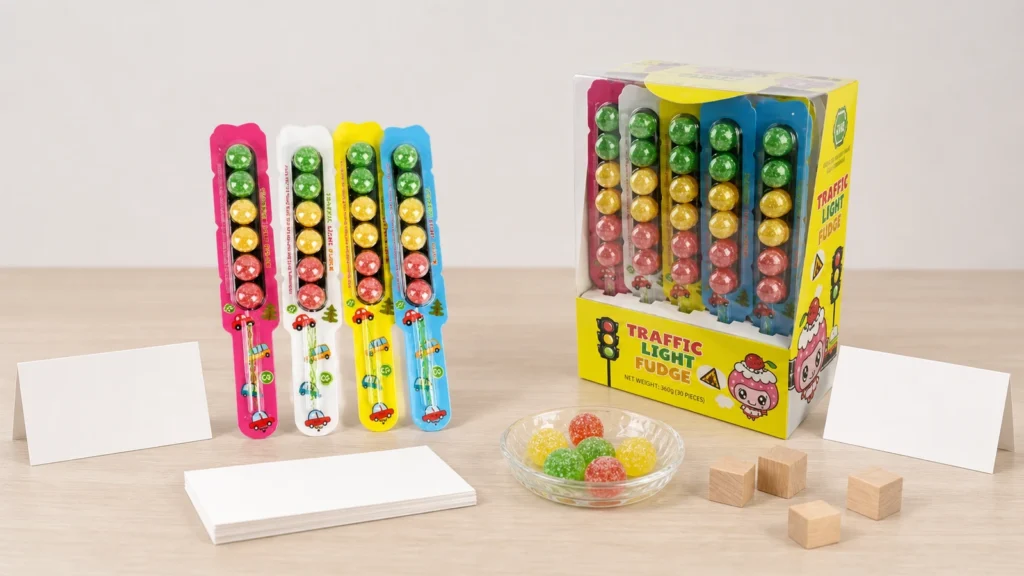
A traffic light gummy wholesale buyer should evaluate the complete display route, not ask for a price on one 10 g stick in isolation. KidStar SKU YMX-241 is packed as 10 g × 30 sticks × 20 boxes per carton, so one quoted carton represents 600 retail sticks and 20 display boxes.
The direct answer is to lock three numbers before comparing offers: 30 sticks per display, 20 displays per carton, and the number of displays each outlet can realistically place. Those figures let an importer, distributor, wholesaler, or private-label buyer turn a colorful novelty concept into a measurable trial without confusing nominal candy weight, display count, and shipping weight.
Read YMX-241 as a display system
The YMX-241 product record gives buyers a fixed starting point:
- SKU: YMX-241
- product: Traffic Light Gummy
- unit weight: 10 g
- inner presentation: 30 sticks per display box
- export presentation: 20 display boxes per carton
The pack arithmetic is straightforward. One display contains 300 g of nominal candy content, and one carton contains 600 sticks or 6 kg of nominal candy content. These are calculated product-content figures, not carton gross weight, dimensional weight, or a freight quotation. Buyers should request the actual carton measurements and gross weight for the version being quoted before using the carton-data guide for loading work.
That distinction matters. A supplier can confirm the product pack while the freight file is still incomplete. Combining those two stages too early produces a landed-cost sheet that looks precise but rests on missing transport inputs.
Choose the outlet job before the quantity
YMX-241 is a novelty display product. Its commercial job should therefore be named before a buyer sets a trial quantity. A checkout counter, school-adjacent general store, novelty shelf, and online bundle do not use the same number of display boxes or the same replenishment rhythm.
Start with an outlet map:
1. Count the outlets included in the first test. 2. Decide how many 30-stick displays each outlet receives. 3. Add a clearly stated reserve for replacement or replenishment. 4. Convert the resulting display count into cartons of 20 displays. 5. Keep any leftover displays visible in the trial file instead of hiding them through rounding.
For example, 10 outlets receiving two displays each require exactly 20 displays, or one carton, before any reserve is added. Twenty-five outlets receiving two displays each require 50 displays, which is two and a half cartons; the buyer must then choose whether to reduce the test, add outlets, or accept a three-carton plan with 10 displays reserved.
Decision table for a first wholesale test
| Buyer situation | Practical starting calculation | What to verify | Hold signal |
|---|---|---|---|
| Ten outlets, two displays each | 20 displays = 1 carton | Shelf position and replenishment owner | No outlet-level sales record |
| Twenty-five outlets, two displays each | 50 displays = 2.5 cartons | How the extra 10 displays will be used if ordering 3 cartons | Quantity rounded with no reserve plan |
| Cash-and-carry trial | Work in full 20-display cartons | Whether customers buy displays or individual sticks | Buyer assumes every display sells as one unit |
| Online bundle test | Convert 600 sticks into the exact bundle size | Pick-and-pack method and unit protection | Bundle count does not divide cleanly into carton quantity |
| Private-label discussion | Screen the stock route first | Artwork scope, language, destination file, and quantity | Custom work begins before the base pack is accepted |
The table is a planning tool, not a sales forecast. It defines what the buyer intends to test and how leftover stock will be handled.
Separate product approval from freight approval
The first sample review should confirm that the actual product version, stick format, colors, display loading, and product presentation match the buyer’s intended route. A sample does not establish carton gross weight, freight cost, import eligibility, or local label compliance.
The freight stage needs a second file with:
- actual carton length, width, and height
- actual carton gross and net weight
- order quantity in cartons and displays
- origin and destination points
- requested Incoterm and named place
- pallet or floor-loaded preference when relevant
- any handling limits set by the buyer or carrier
The MOQ and lead-time page can frame the next discussion, but the exact commercial answer must follow the approved YMX-241 version, quantity, packaging route, and destination.
Lock the display version before artwork work
Private-label buyers should keep the base display approval separate from later packaging customization. The 30-stick display and 20-display carton are the current comparison baseline. If the artwork, language, assortment, unit count, or display construction changes, the buyer should treat it as a new controlled version rather than assume the original pack arithmetic still applies.
A useful version line can be short: “YMX-241, 10 g, 30 sticks per display, 20 displays per carton, stock-pack review, destination pending.” Every later change should be dated against that line. This keeps the product image, quotation, sample, artwork, and freight inputs attached to the same version.
Checklist before requesting a YMX-241 quote
- Link the exact YMX-241 product page.
- State the target market and outlet type.
- Confirm that 30 sticks per display is the comparison unit.
- State the number of displays per outlet and the number of outlets.
- Show the reserve plan and leftover-display plan.
- Keep 6 kg as nominal candy content only, not shipping weight.
- Request actual carton measurements and weights for freight work.
- Separate stock-pack screening from custom artwork.
- Name the sample decision and the person who records it.
- Use the product catalog only to compare alternatives with a different, named channel job.
If you want KidStar to check a YMX-241 trial, send the destination, outlet count, displays per outlet, reserve plan, requested quantity, stock-or-custom route, and open freight inputs through the contact page. The team can then respond to one defined wholesale case instead of a generic gummy price request.
Sources reviewed
- KidStar SKU YMX-241 Traffic Light Gummy product record — first-party product library; reviewed 1 September 2026.
- KidStar carton data for 50 candy SKUs — first-party loading reference; reviewed 1 September 2026.
- KidStar samples — first-party sample process reference; reviewed 1 September 2026.