A candy sample shipment needs a complete customs invoice file even when the goods are not being sold. The shipper and importer should follow the carrier and destination instructions, describe the physical goods precisely, use a supportable non-zero value, and state the genuine export reason rather than writing only “sample” or “candy.”
For YMX-049 Paintbrush Candy with Popping Candy, a useful file should identify the 3.5 g candy plus 1 g popping-candy unit and the actual sample quantity being sent. It should not copy the full 30-piece × 20-display commercial hierarchy into the shipment quantity field unless that is what the parcel physically contains.
Decide which invoice file the route requires
DHL’s global customs guidance tells shippers to provide complete and accurate commercial or proforma invoice data and notes that country requirements vary. The correct document route can depend on the destination, carrier service, importer, purpose, and local rules.
Before dispatch, ask:
- Does this carrier route call for a commercial invoice, proforma invoice, or another customs file?
- Who is the exporter or shipper of record for the parcel?
- Who is the importer, receiver, or consignee?
- Which identifier fields apply to those parties?
- Who will confirm the goods classification and destination requirements?
- Which value basis, currency, Incoterm, and named place should be stated?
Do not assume that “free sample” means “no customs information.” Free of charge describes the commercial arrangement; it does not make the physical goods disappear from customs review.
Lock ten customs-invoice field groups
The following table adapts the information groups in DHL’s published guidance into a buyer-supplier control sheet. The responsible parties still need to confirm the destination-specific route.
| Field group | What to enter for the actual parcel | YMX-049 control question |
|---|---|---|
| 1. Shipper/exporter | Full legal name, address, and contact details | Which KidStar or shipping entity is shown? |
| 2. Receiver/importer | Full legal name, delivery address, and contact details | Is the receiver also the importer? |
| 3. Party identifiers | Tax, registration, or other IDs when applicable | Which ID does the destination or carrier require? |
| 4. Goods description | Precise product description in plain language | Does it say paintbrush-shaped candy with a separate popping-candy component? |
| 5. Classification and origin | HS code route and country of origin as determined by responsible parties | Who confirmed both entries? |
| 6. Values and currency | Supportable unit and total values with currency | Is the value non-zero and documented? |
| 7. Weight and quantity | Actual net or gross weight, units, and number shipped | Does it match the parcel, not the sales carton? |
| 8. Incoterm and place | Agreed rule and named place when used | Is responsibility clear at the named location? |
| 9. Origin evidence | Proof or statement when applicable | Is any claimed preference supported? |
| 10. Export reason and other requirements | Truthful reason such as sample, plus applicable destination data | Does “sample” describe the purpose without replacing the product description? |
This is a completeness framework, not a customs ruling. A buyer should not ask the supplier to guess an HS code, preferential origin claim, importer ID, or local requirement that belongs to the importer, broker, carrier, or authority.
Describe YMX-049 as a real product
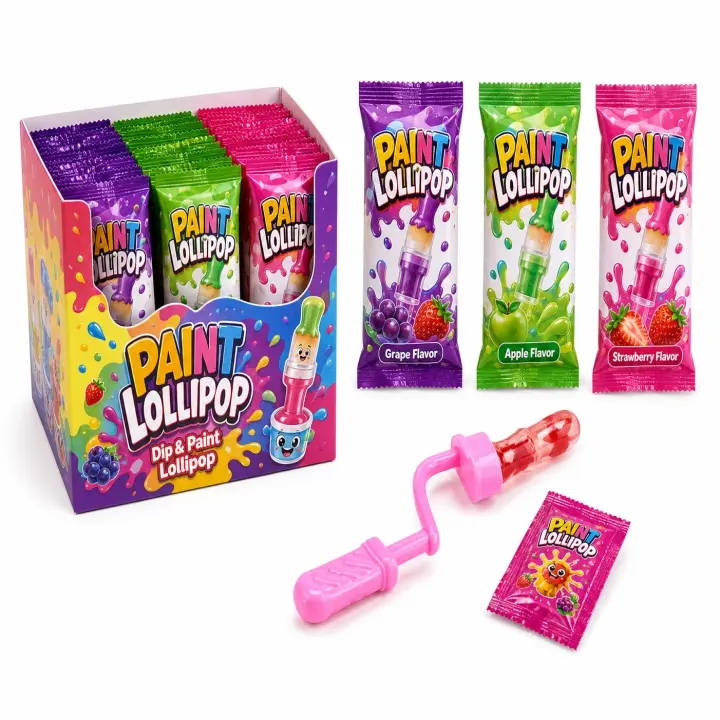
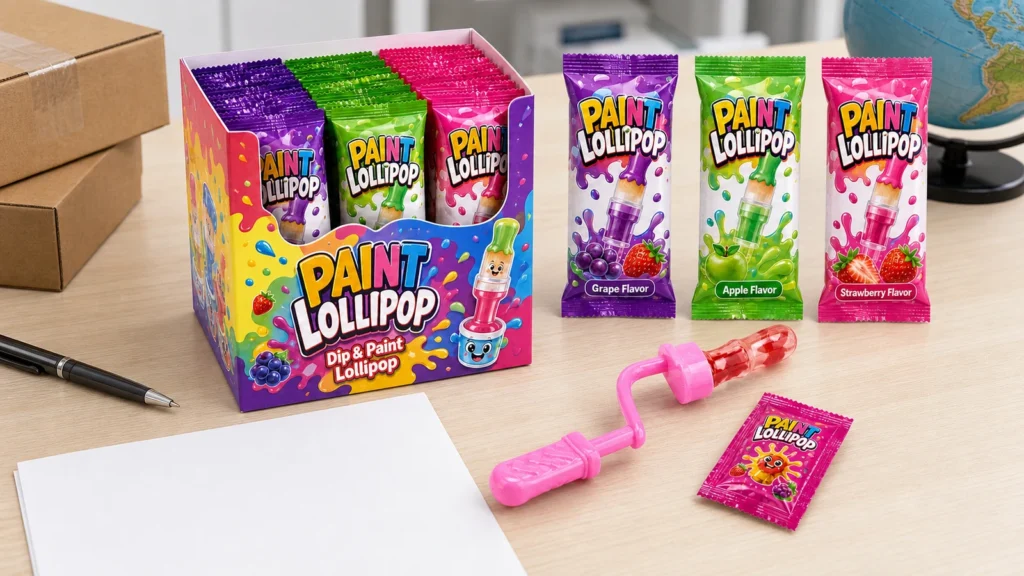
“Candy samples” is too broad for a parcel containing a two-part novelty item. The product record lists YMX-049 as Paintbrush Candy with Popping Candy, with a 3.5 g candy plus 1 g popping-candy unit and a commercial route of 30 pieces × 20 display boxes.
A working description should be factual and limited to what the shipper can support. It may include the product type, component format, unit basis, number of units actually shipped, intended sample purpose, and country of origin. The final description should match the current formulation and shipping documents; do not add an ingredient, flavor, material, claim, certification, or legal classification merely because it seems likely from the image.
Keep these records together:
- live product link and SKU
- dated sample request
- current product specification supplied for the version
- parcel packing list
- customs invoice file
- carrier waybill or shipment reference
- value basis note
- photos of the actual sample units and closed parcel
The samples route can start the product conversation. The customs file should be built only after the buyer and supplier agree what will physically be sent.
Use an actual, supportable value
DHL’s guidance states that zero values are not acceptable on the commercial or proforma invoice. That does not tell a buyer which valuation method a particular customs authority will accept. It tells the team to stop and establish a supportable value rather than typing zero because the sample is free of charge.
Record the value method, unit value, quantity, total value, currency, and person who approved the entry. Keep supporting records available. If the destination, broker, or carrier requires a particular valuation treatment for free samples, follow that current instruction.
Do not confuse:
- sale price with customs value
- “no charge to receiver” with zero value
- retail price with an automatically acceptable customs basis
- nominal wording with evidence
The responsible importer or broker should resolve uncertainty before dispatch, not after the parcel is held.
Match weight and quantity to the parcel
YMX-049’s product page provides a commercial pack reference, but a sample parcel may contain only a few units. The invoice, packing list, and physical parcel should agree on the shipped quantity.
Check the number of individual units, number of inner packs if any, total net weight where required, gross parcel weight where required, and measurement unit. If one sample unit includes both the 3.5 g candy and 1 g popping-candy component, make that relationship clear in the controlled product note.
Avoid copying “30 pieces × 20 display boxes” into a sample invoice unless the shipment truly includes that amount. A commercial specification can identify the product route; it cannot replace the parcel count.
State the export reason without hiding the goods
DHL lists “Sample” as one possible reason for export. Use it when it truthfully describes the shipment, but retain the precise product description, quantity, value, origin, and other required data.
For buyer control, define what happens after arrival:
| Sample purpose | Evidence on receipt | Next decision |
|---|---|---|
| Product identity review | Photos and SKU/version match | Accept identity or request clarification |
| Sensory or internal evaluation | Controlled review record where lawful and appropriate | Continue, revise, or stop |
| Packaging review | Unit, seal, print, and component presentation | Approve or request a new version |
| Commercial assessment | Pack denominator and target quantity | Request a matched quotation |
| Destination-file review | Current documents requested by responsible importer | Resolve gaps before an order |
The candy import document guide helps organize later document requests. It does not make a small sample exempt from the actual shipment route.
Run a pre-dispatch reconciliation
Before collection, have one owner compare the sample request, product version, invoice, packing list, label, and parcel. Confirm that names and addresses match, phone or email contacts are usable, descriptions are consistent, quantities and weights reconcile, values are non-zero and supportable, origin and classification have an identified decision owner, the export reason is truthful, and the carrier route has no unresolved data request.
If any field is unknown, pause dispatch and resolve it. Replacing a missing fact with a guess can create a customs delay and an unreliable buyer record.
Send one sample-shipment brief
Send KidStar the destination, receiving company, named contact, requested YMX-049 version, actual sample quantity, required arrival window, carrier or account instructions, invoice route, importer or broker data, and open customs-file questions through the contact page.
KidStar can then prepare the product side of a controlled sample request. The importer, carrier, and other responsible parties can complete the destination-specific decisions before the parcel leaves.
Sources reviewed
- DHL Express Global Customs Customer Guidelines, reviewed August 31, 2026.
- KidStar YMX-049 Paintbrush Candy with Popping Candy product record, reviewed August 31, 2026.