For importers, distributors, wholesalers, and private-label buyers, retail-ready confectionery pack planning is not only a product question. It is a sourcing workflow question. The buyer needs enough information to compare options, request samples, and receive a quote that will not be rewritten after packaging, quantity, or market details become clearer.
This guide is designed to help buyers connect candy packaging decisions with shelf presentation, channel fit, and quote readiness. It is written for B2B teams that want a practical route before starting a detailed quotation discussion.
Latest market insight
- Axios reported on April 15, 2026 that store-brand sales reached $330 billion in 2025, so retail-ready candy packs need shelf discipline closer to real private label, not temporary OEM mockups.
- Food & Wine’s June 23, 2026 Sweets & Snacks Expo recap highlighted bold textures, peelable formats, and high-visual candy launches, raising the bar for shelf-ready presentation.
- The White House moved to suspend duty-free de minimis treatment for all countries on July 30, 2025, so buyers should compare case-pack efficiency and replenishment logic before choosing a display-heavy route.
Sources reviewed: Axios, Food & Wine, The White House.
Start with the shelf mission, not the pack style
Retail-ready packaging should start with one question: what does the pack need to do on shelf? A value line, an impulse line, a premium jar program, and a seasonal display do not use the same front-panel story, footprint, or replenishment logic.
A short channel brief is usually enough to stop the supplier from recommending the wrong presentation route.
Match pouch, jar, or display box to the channel model
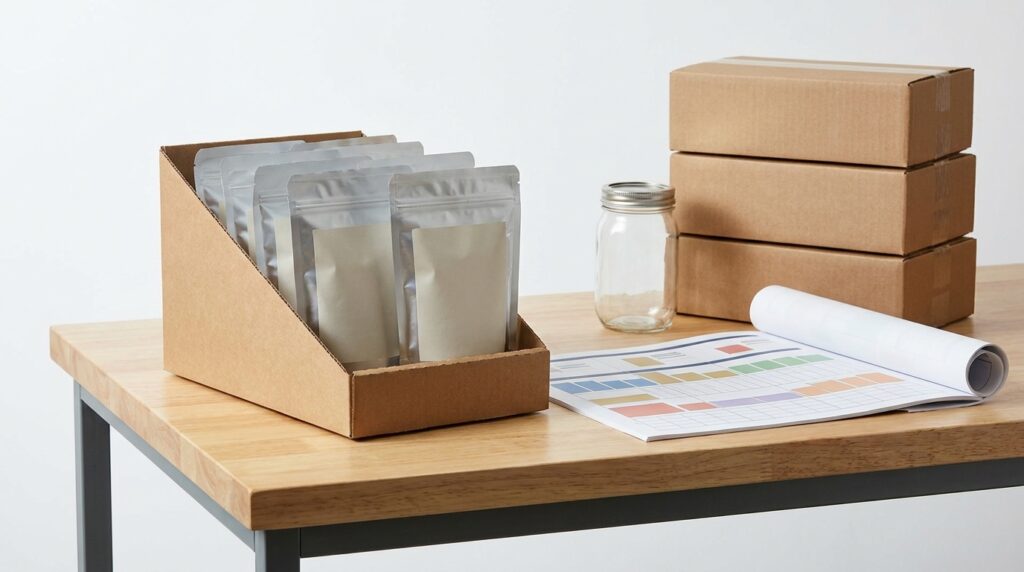
Pouches usually work well for flexible assortment and easier freight. Jars can create stronger shelf identity but need more space, more label planning, and better breakage control. Display boxes can help novelty or checkout programs, but they require earlier decisions on structure, case count, and replenishment.
The goal is not to over-design the pack too early. It is to match the format to how the buyer expects the product to be sold and restocked.
Build the front panel for fast scanning
Retail-ready candy packs usually get judged in seconds. Flavor hierarchy, net weight, count, age-positioning, and visual differentiation should be readable quickly. If a buyer needs the pack to win against store brands or seasonal launches, the front-of-pack message cannot be left until after the structure decision.
When the scan path is clear, artwork reviews and shelf mockups move faster.
Plan carton and display logic before the quote is final
Shelf-ready work is not only about the consumer-facing pack. Buyers should confirm case count, display assembly, pallet behavior, and whether the retailer expects pre-built trays or simple shelf refill. A visually strong display route can still be commercially weak if it wastes cube or complicates replenishment.
This is also the point where buyers can separate a realistic retail program from a decorative concept board.
Quick checklist before you ask for a quote
| Pack route | Best fit | What to lock before the quote |
|---|---|---|
| Pouch / bag | Flexible assortment, easier freight, faster retail testing | Fill weight, zipper or window need, case count, and target price point |
| Jar / tub | Premium shelf identity, club or family-size presentation | Breakage protection, label wrap area, cap style, and pallet stability |
| Display box | Impulse, novelty, mixed assortment, or checkout route | Display footprint, tray structure, case-pack logic, and refill plan |
| Box / carton | Gifting, chain retail, or clearer front-of-pack story | Board structure, window need, inner pack layout, and stacking limits |
| Bulk-to-repack | Importer repack or local private-label finishing | Carton count, local packing plan, and landed-cost assumptions |
Related KidStar pages
- Review product families on Product Catalog.
- Compare custom pack routes on Packaging Customization.
- Check MOQ and timing basics on MOQ and Lead Time.
- For documentation questions, visit Certifications and Compliance.
Send a clearer brief
If you are preparing a retail-ready packaging inquiry, send KidStar your channel, pack route, target price band, case-pack expectation, and launch timing. The team can respond with a more focused shelf-ready recommendation instead of a generic packaging reply.