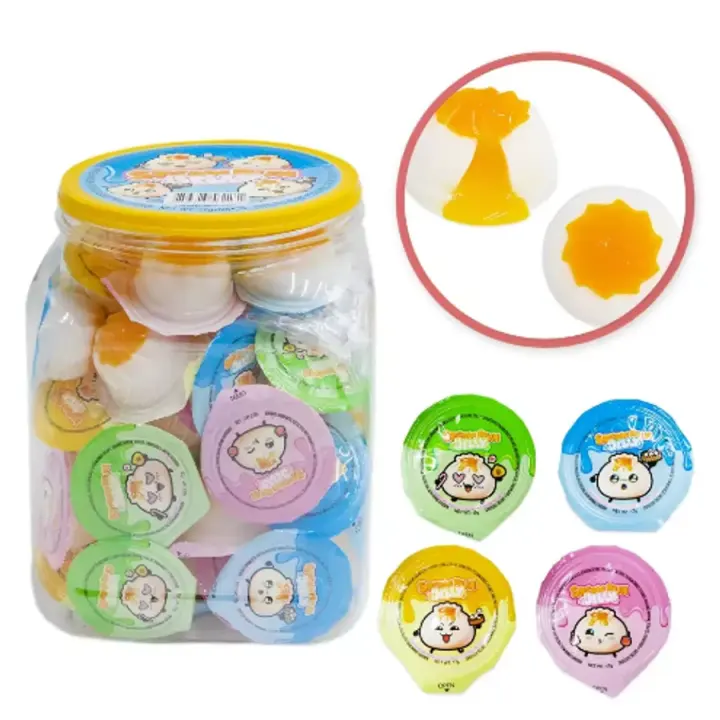
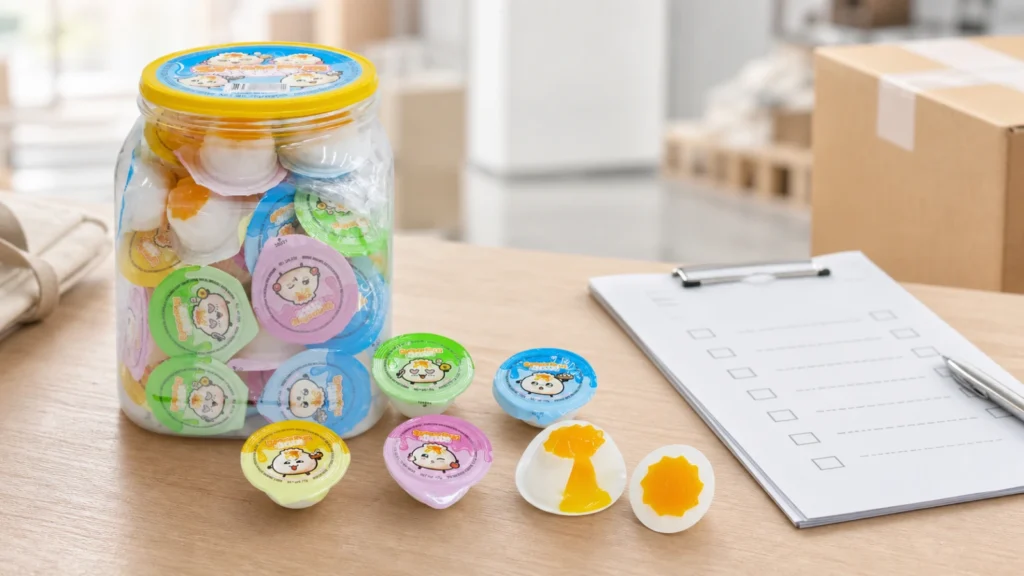
Filled jelly projects often look easier than they really are. The jar is familiar, the product is visually friendly, and the first conversation quickly turns toward price. But a filled jelly line can become fragile when the buyer has not described the actual transport and storage route early enough. That problem shows up most often in warm markets, long transit windows, mixed inland delivery chains, or wholesale environments where stock may sit longer than the buyer first expected.
KidStar SKU YMX-153 is a useful example. It is a Filled Jelly line packed as 17 g x 60 pcs x 12 jars/carton. That means the buying decision is not only about flavor or jar appearance. It is also about whether one exact jar route can move through the buyer’s real heat and handling conditions without being described too vaguely in the first brief.
The right workflow is not to wait for a problem and then ask the supplier what went wrong. The better workflow is to send one heat-and-transit brief before the first quote hardens.
Treat heat and handling as part of the first sourcing brief
Many buyers separate the conversation into three different messages:
- one message about the product sample
- one message about price
- one later message about weather, storage, or transport concerns
That sequence invites rework. The supplier may quote against a standard stock route while the buyer is silently planning a hotter inland route, a longer last-mile chain, or a slower wholesale turnover pattern. The result is not necessarily a bad supplier. It is often a weak first brief.
For YMX-153, the first file should already say whether the buyer is planning:
- fast distributor turnover
- wholesale storage with uncertain temperature control
- long transit plus inland redistribution
- a short pilot with limited exposure risk
That is why the exact YMX-153 product page matters. The supplier needs to know which real SKU and which real jar route the transport question is attached to.
Put the heat-transit facts into one decision table
The most useful brief is not the longest one. It is the one that makes the route visible.
| Brief field | What buyers should define for YMX-153 | Why it matters |
|---|---|---|
| SKU scope | Confirm the product is exact SKU YMX-153 in the 60 pcs x 12 jars route | Prevents transport comments from drifting into another jelly format |
| Market and season | State where the item will land and whether the route includes hot-season exposure | The same jar route may face very different stress by market and season |
| Storage reality | Say whether storage is temperature-controlled, partly controlled, or mostly ambient | Helps the supplier understand the real risk profile |
| Delivery chain | Note whether the line goes direct to distributor stock, wholesale resale, or mixed inland delivery | Different handling routes create different stress points |
| Pilot versus repeat | State whether this is a trial shipment or a repeat-minded line | The tolerance for uncertainty is different in each case |
| Open concerns | List visible risks such as long port dwell, inland transfer, or shelf exposure | Keeps the quote from looking firmer than the route knowledge actually is |
This table gives the supplier enough context to answer intelligently without pretending every downstream detail is already solved.
Separate sample liking from route acceptance
Buyers often say a jelly sample is approved when they really mean the candy tastes acceptable and the jar looks commercial enough. That is not the same as route acceptance.
For YMX-153, a sample may prove:
- the filled jelly concept fits the market
- the jar format is commercially interesting
- the visual presentation works for the target outlet
It does not automatically prove:
- the route is stable in the buyer’s real heat profile
- the storage conditions are acceptable for the planned turnover speed
- the shipment logic is mature enough for a firm first-order assumption
This is why samples and MOQ and lead time belong in the same working conversation. A buyer who only asks for taste and price is still missing the route reality. A buyer who names the transport conditions early gives the supplier a much cleaner problem to solve.
Use the jar route to describe risk, not to hide it
Jar-packed jelly can feel safer because the format looks substantial. That visual confidence can hide unresolved routing risk. Buyers should explicitly write down what the jar must survive.
For example:
- Will the jars sit in non-air-conditioned wholesale stock?
- Will they move quickly after arrival or wait through a long selling window?
- Is the first order meant to test the category or build a repeat route?
- Does the buyer want stock packaging first, or is a broader packaging customization discussion already starting?
Answering those questions does not make the brief heavy. It makes it honest. If the buyer is still uncertain, the brief should say so. It is far better to name that uncertainty than to force a supplier to answer a stability question that was never properly asked.
Know when the route is stable enough for the first order
YMX-153 is usually ready for a stronger first-order conversation when the buyer can show:
- exact SKU and jar route
- target market and expected temperature exposure
- basic storage reality after arrival
- whether the program is a fast pilot or a repeat-minded line
- whether the current stock route is still the intended first step
At that point, the supplier can respond with a cleaner commercial path. If those items are still missing, the buyer should resist treating the first quote as a final operational answer.
The wider product catalog is still useful here because it helps the buyer decide whether YMX-153 is the right jar route at all. But that comparison should happen after the route question is framed clearly, not instead of framing it.
Filled jelly heat-transit checklist before asking for price
- Tie the brief to exact SKU YMX-153 and its 17 g x 60 pcs x 12 jars route.
- State the destination market and whether hot-season exposure is part of the route.
- Describe the real storage and inland handling conditions, even if they are only partly controlled.
- Separate sample approval from heat-route approval.
- Use MOQ and Lead Time to frame whether the first order is a pilot or a repeat-minded route.
- Use Contact to send the market, storage reality, and open transport questions in one buyer brief.
If you want KidStar to review whether YMX-153 is being briefed cleanly for a warm-market or long-transit route, send the destination market, storage conditions, expected turnover speed, and first-order goal through the contact page. That makes it easier to respond with a practical sourcing route instead of a generic jelly quote.