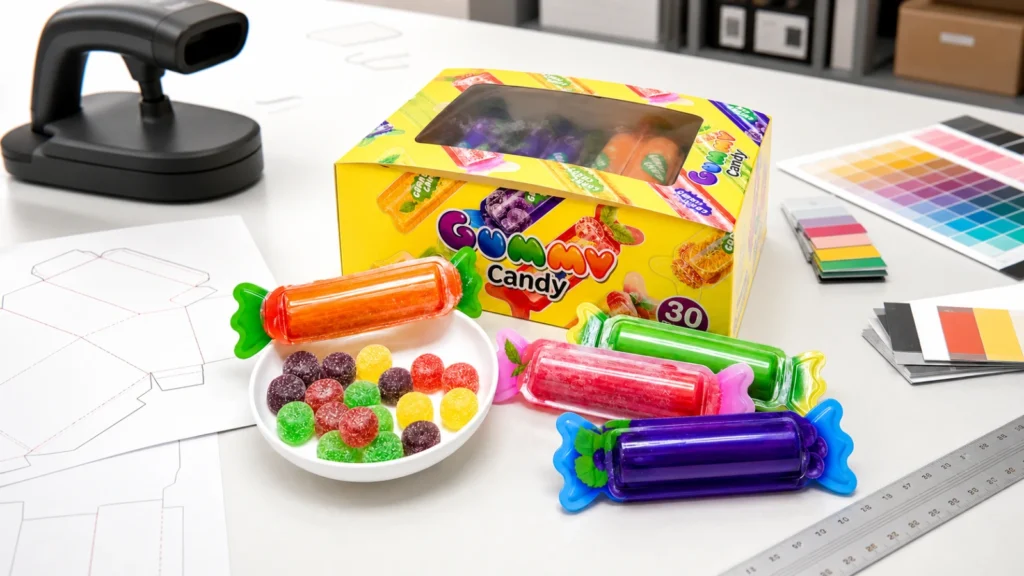
As of Thursday, July 23, 2026, GS1 is still describing Sunrise 2027 as a transition milestone rather than a one-day packaging reset. That distinction matters for importers, distributors, wholesalers, and private-label buyers working on small candy packs. KidStar SKU YMX-128 is a useful example because it is a 10 g gummy unit packed as 30 pcs × 24 boxes/carton. In other words, the project is not only about one gummy piece. It is about the artwork of a small consumer unit, a display-box presentation, and the barcode logic that retailers and distributors will need to scan cleanly.
The buyer question is therefore practical: what should change in a gummy display-box artwork brief now that GS1 is pushing brands and retailers toward 2D barcode readiness for Sunrise 2027? The answer is not “replace every UPC tomorrow.” The answer is to stop treating barcodes as the last line added to artwork after everything else is already fixed.
What the official GS1 sources say right now
The official language matters because many teams still speak about Sunrise 2027 as if it were an overnight barcode swap.
The GS1 global retail POS implementation guideline, ratified in December 2025, says the initial goal is for retail point-of-sale scanning to be capable of reading and processing the GTIN from both existing linear and 2D barcodes by the end of 2027. The same guideline says that during the transition phase, products are expected to be dual-marked, meaning they carry the current retail linear barcode plus an eligible 2D barcode. It also notes that linear barcodes may continue to coexist with 2D codes.
GS1 US says something equally important on its Sunrise 2027 page: as of July 23, 2026, it is not necessary to implement all 2D capabilities by that date, and brands should take a crawl-walk-run approach. In the “crawl” stage, GS1 US tells brands to add 2D barcodes to existing packaging and ensure any existing QR codes are updated with GS1 Digital Link standards and include the GTIN.
For a buyer, that means Sunrise 2027 is an artwork-planning issue now, even when the project is still a normal display-box gummy line rather than a full digital-transformation program.
The same barcode and sell-in-file logic applies to other KidStar pack types: Soft Candy, Glow Stick Lollipop, Biscuit Sticks with Fruit Jam Dip, Crispy Biscuit Bar, and Filled Jelly. The SKU changes; the requirement to plan dual-marking and GTIN ownership before artwork is frozen stays the same.
Why the change shows up early on small gummy display boxes
YMX-128 is the kind of SKU where barcode planning becomes visible faster than on a large outer pack. The consumer unit is small. The selling face is limited. The display box also needs its own hierarchy. If a brand waits until the end of the packaging process to ask whether it wants a 2D code, the answer may be “yes, but now there is no clean place to put it.”
That is why this topic is more than a technical trend. For YMX-128, barcode planning affects:
- front-panel space on the small gummy unit
- whether any shopper-facing QR code should also serve as a compliant GS1 Digital Link route
- how much design space remains for flavor, brand, and legal text
- whether the display box and the individual pack are telling the same data story
The product catalog helps buyers compare small-unit products, but Sunrise 2027 changes the comparison standard. A display-box gummy program that looked fine with “barcode later” thinking may need a cleaner artwork brief now.
Use a barcode decision table before artwork is frozen
The buyer does not need a giant standards meeting to make progress. One simple route table is enough to keep the artwork conversation honest.
| Artwork route | When it fits YMX-128 | What it means in practice | Main risk if ignored |
|---|---|---|---|
| Keep linear UPC only for now | Only for short internal mockups or very early concept layouts | Useful for concept review, not for final production artwork planning | The real barcode redesign gets delayed until the pack is already crowded |
| Add a 2D code without GTIN discipline | Rarely a good long-term route | Creates a shopper code but may not support Sunrise-aligned POS goals | The pack gains a QR code but not a usable standards path |
| Use dual-marking with linear + GS1-aligned 2D | Best default for a live program entering artwork review | Keeps the current retail scan path while preparing for 2D transition | Requires early layout and testing decisions |
| Delay 2D planning until private label rollout | Acceptable only if the first route is clearly temporary | Works when the buyer is explicitly running a short stock test before rework | The team may accidentally treat a temporary layout as final |
| Build 2D and scanner testing into the first artwork cycle | Strongest route for serious distributor or retailer programs | Aligns barcode, data ownership, and pack space before approval | Needs more cross-functional discipline from the start |
For YMX-128, the third or fifth route is usually the most realistic commercial answer.
Put GTIN and code purpose into the brief before design starts
GS1 US is explicit that the first brand step is to ensure existing QR codes are updated with GS1 Digital Link standards and include the GTIN. That matters because candy teams often treat QR as a marketing object and UPC as the only real scan object. Sunrise 2027 pushes those conversations closer together.
Before the artwork team starts, the buyer should state:
- whether the 2D code is intended only for future readiness or also for consumer engagement
- which party owns the GTIN structure and barcode data
- whether the current linear barcode will remain during the transition
- whether the same barcode logic must work across stock and later private-label routes
The packaging customization page becomes more useful when those points are visible early. Without that discipline, the pack design may look finished while the barcode logic is still unresolved.
Separate shopper QR expectations from point-of-sale readiness
Another common mistake is to assume that any QR code automatically solves Sunrise 2027. It does not. The official GS1 sources make clear that the transition is about point-of-sale systems being able to read and process GTIN from both linear and 2D barcodes, not merely about adding a decorative scannable square.
For YMX-128, the buyer should separate two questions:
1. Does the code need to support future POS-readiness and standards-based identification? 2. Does the code also need to take shoppers to web content such as flavor details or product information?
Those can be aligned, but they should not be confused. A display-box gummy line is too small to waste artwork space on a code that does not have a defined commercial purpose.
The certifications and compliance page is also relevant here because barcode placement competes with other mandatory or market-specific information. On a small candy unit, every late label change makes barcode planning harder.
Add testing dates to the artwork timeline, not only file-approval dates
GS1’s transition language also implies a process change. Brands and retailers are being told to prepare scanners, packaging, and data structures together. That means the artwork calendar should no longer stop at “designer sends final PDF.”
For YMX-128, the brief should include:
- the date when barcode content is locked
- the point when the linear and 2D positions are reviewed together
- whether the display box needs separate barcode treatment from the unit
- who checks scan readiness before print approval
- whether the first run is a stock program or a bridge to private label
This works well with samples and MOQ and lead time because the team can separate concept sampling from production-ready artwork. A buyer does not need every advanced 2D use case in 2026, but the buyer does need to stop treating scan logic as an afterthought.
Let YMX-128 move into artwork only when the barcode route is named
Sunrise 2027 does not force every gummy display box to become fully advanced overnight. It does force better discipline. As of July 23, 2026, the official GS1 message is that companies should begin the transition now, use a phased approach, and expect dual-marking to be part of the journey.
For YMX-128, that means the right next step is usually simple: name the barcode route, protect space for it on the small unit, keep the current linear path during transition, and schedule scan review before final print approval. That is enough to make the artwork brief stronger without pretending the whole retail ecosystem is already finished.
If you want KidStar to review whether YMX-128 should stay on a temporary stock layout or move into a Sunrise-ready artwork brief, send the market, channel, branding stage, and barcode questions through the contact page. That makes it possible to answer with a pack-ready route instead of a generic gummy packaging file.