
The direct answer: a 20-foot container fits roughly 28 CBM of usable cargo and a 40-foot container roughly 58 CBM, so the number of candy cartons depends entirely on each SKU’s carton dimensions. A carton of 0.035 CBM fits about 800 cartons in a 20ft container; a carton of 0.06 CBM fits about 460. That gap is why loading math matters before you compare prices — the same candy can look cheap per unit and expensive per container if the carton is inefficient.
This guide shows importers and distributors how to calculate carton count, CBM, and container fit using real candy carton sizes, with worked examples from KidStar SKUs.
Key numbers at a glance
- A 20ft container fits about 28 CBM of usable cargo; a 40ft container fits about 58 CBM.
- A 0.034 CBM candy carton fits about 816 cartons in a 20ft container and about 1,690 in a 40ft.
- A 0.061 CBM lollipop display carton fits about 460 cartons in a 20ft container.
- Candy is a volume-driven cargo: carton size, not weight, decides how many cartons fit.
Latest market insight
- Low-MOQ and fast-delivery candy sourcing is a growing B2B demand pattern on Alibaba, which pushes more first orders toward LCL and small mixed loads instead of full-container planning.
- Freight cost and tariff pressure make carton efficiency part of the quote decision: two suppliers can quote similar FOB prices while delivering very different landed cost per carton.
- More importers are planning smaller, faster assortment tests, so knowing exact carton CBM per SKU is becoming a first-inquiry skill rather than a late logistics task.
Sources reviewed: Alibaba.com Seller Blog — Low MOQ Candy Sourcing.
Container capacity basics
Use planning numbers, then confirm with your freight forwarder because usable CBM varies by container line and loading method:
| Container | Internal volume (approx.) | Usable cargo (approx.) | Typical use |
|---|---|---|---|
| 20ft standard (20GP) | 33 CBM | 28 CBM | Trial orders, 10–14 pallets, one SKU family |
| 40ft standard (40GP) | 67 CBM | 58 CBM | Repeat programs, large single-SKU loads |
| 40ft high cube (40HC) | 76 CBM | 68 CBM | Light, bulky candy packs that fill by volume before weight |
Candy is usually a volume-driven cargo: most confectionery cartons weigh far less than the container’s weight limit, so the limiting factor is CBM, not kilograms. That is why carton size is the number to lock before comparing offers.
Real carton loading examples from KidStar SKUs
These are planning examples based on current KidStar carton dimensions; the supplier should confirm exact carton sizes, loadability, and pallet patterns before the order is approved.
| KidStar SKU | Product | Carton size (cm) | Carton CBM | Approx. cartons per 20ft | Approx. cartons per 40ft |
|---|---|---|---|---|---|
| AF-002 | Mini Cola Sour Powder | 45.5 × 29 × 26 | 0.034 | ~816 | ~1,690 |
| YMX-002 | Soft Candy | 52.5 × 28 × 26 | 0.038 | ~732 | ~1,517 |
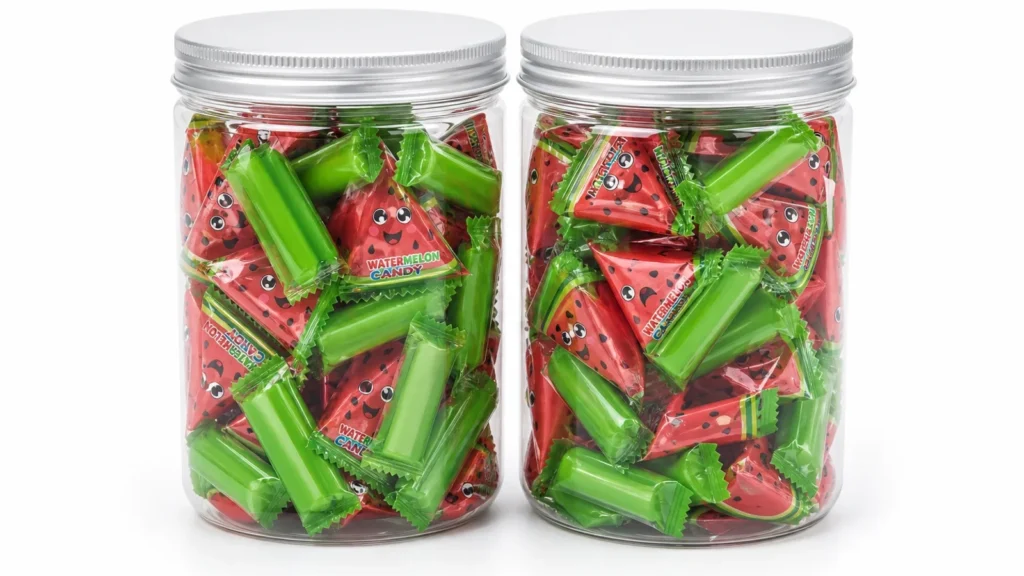
| YMX-017 | Watermelon Triangle Hard Candy | 50.5 × 20.5 × 36 | 0.037 | ~751 | ~1,556 |
| YMX-004 | Powder Candy | 48.5 × 33 × 26 | 0.042 | ~672 | ~1,393 |
| CN-039 | Traffic Light Gummy | 44 × 30.5 × 42 | 0.056 | ~496 | ~1,029 |
| YM-011 | Lollipop | 61.5 × 29.5 × 33.5 | 0.061 | ~460 | ~954 |
The practical takeaway: a gummy or lollipop carton takes almost twice the container space of a sour powder or hard-candy carton. Two SKUs with the same unit price can have very different landed cost per carton.
Calculate your own carton count in three steps
1. Get the exact carton size (length × width × height in metres) from the supplier’s spec sheet. Never assume from the pack size. 2. Compute CBM per carton: length × width × height. A 45.5 cm × 29 cm × 26 cm carton = 0.455 × 0.29 × 0.26 = 0.034 CBM. 3. Divide usable container CBM by carton CBM: 28 ÷ 0.034 ≈ 816 cartons per 20ft. Round down, then subtract 5–10% for loading gaps, pallet loss, and carton overhang.
The container-ready shortlist guide explains how to build a mixed list that stays inside one container scenario.
Common loading mistakes that change the price
- Comparing unit prices without carton math: two suppliers can quote the same unit price while one carton carries half the units, doubling your freight per unit.
- Using gross carton size instead of loadable size: inner liners, trays, and shrink wrap add millimetres that matter across 800 cartons.
- Ignoring pallet loss: palletized loads lose 10–20% of floor space; hand-stacked floor loading fits more cartons but raises damage and handling risk.
- Forgetting weight and axle limits: candy is light, but very dense jar or bottle packs can approach weight limits in a 40ft before the CBM is full.
- Mixing carton sizes in one load without a plan: random mixed sizes leave voids that reduce the total by more than buyers expect.
Checklist before you book the container
| Item | What to confirm | Why it matters |
|---|---|---|
| Carton spec | Exact outer dimensions per SKU | CBM math is only as good as the carton size |
| Units per carton | Piece count and pack configuration | Determines freight cost per unit, not only per carton |
| Loading method | Floor-loaded or palletized | Changes usable carton count by 10–20% |
| Container type | 20GP, 40GP, or 40HC | Sets the usable CBM planning number |
| Mixed plan | Which SKUs share the load | Voids from mixed carton sizes reduce total fit |
| Weight check | Gross weight per carton and total | Candy is usually volume-limited, but verify |
| Forwarder sign-off | Loadability confirmation | The forwarder’s number is the number to trust |
Related KidStar pages
- Plan a mixed load: Mixed Confectionery Container Checklist
- Compare FOB and freight assumptions: FOB and Freight Comparison
- Full import sequence: How to Import Candy from China
- Review carton marks and labels: Carton Marks and Shipping Labels
- Check MOQ and timing: MOQ and Lead Time
Get a loading plan with your quote
If you want a container-ready loading plan, send KidStar your target market, shortlisted SKUs, carton quantities, and destination port. The team can confirm carton sizes, CBM, and a realistic loading plan before you compare freight offers.