
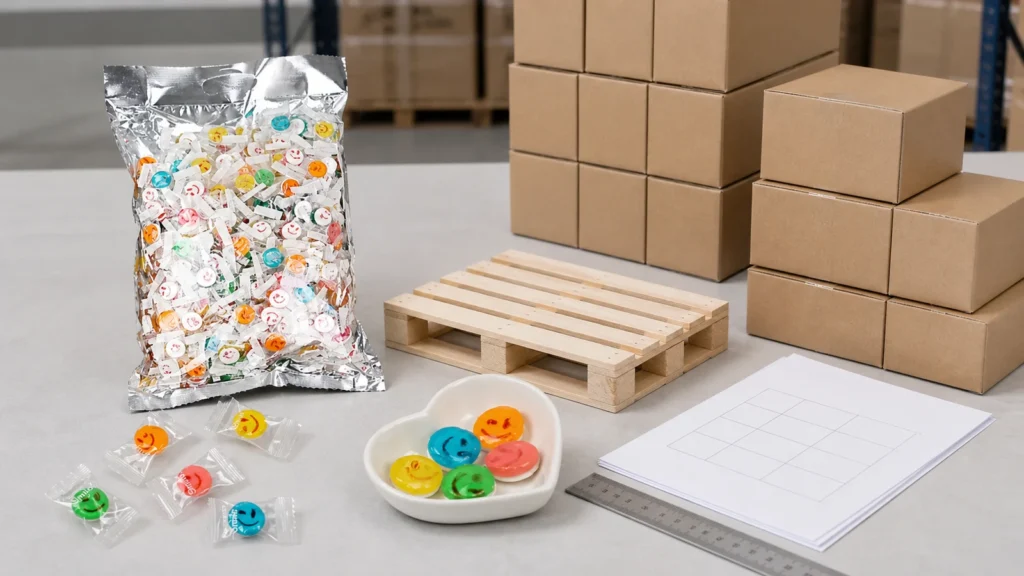
A candy pallet pattern approval should lock nine inputs before freight booking: carton dimensions, carton gross weight, cases per layer, number of layers, total case count, loaded height, loaded gross weight, overhang rule, and unitization/label method. Without those fields, the forwarder cannot quote one controlled load and the warehouse cannot approve one repeatable build.
Use KidStar SKU YMX-174 Smiley Candy as the working example. Its current record lists 3 g per piece, 500 g per bag, and 30 bags per carton. That is enough to identify the product and carton count route, but not enough to invent a pallet pattern. The buyer and supplier still need measured carton and pallet data for the exact shipment.
Start from one exact carton version
Pallet planning fails when the product team, supplier, and forwarder use different carton versions. Put the following identity fields on the first page:
- SKU and product name
- consumer or wholesale unit
- 500 g bag basis and 30-bag carton route for YMX-174
- carton version or packing-list reference
- measured outer length, width, and height
- measured net and gross carton weight
- destination, warehouse, and transport mode
- mixed-SKU or single-SKU load
- pallet type supplied or required
If any value is estimated, mark it as estimated. Do not turn a catalog dimension or quotation note into a final shipping declaration before the packed carton is measured.
Lock nine pallet-pattern inputs in one table
Use one controlled sheet rather than spreading data across a quotation, packing list, and chat history.
| Input | Supplier provides | Buyer/forwarder confirms | Readback evidence |
|---|---|---|---|
| 1. Carton dimensions | Packed outer L × W × H | Measurement unit and tolerance | Photo with ruler or measured report |
| 2. Carton gross weight | Packed-carton weight | Booking and warehouse basis | Scale photo or inspection record |
| 3. Cases per layer | Proposed footprint | No overhang and handling fit | Top-view pattern diagram |
| 4. Number of layers | Proposed stack | Height and compression limit | Side-view diagram |
| 5. Total cases | Layer count × layers | Order and packing-list match | Calculation check |
| 6. Loaded height | Pallet plus load | Carrier/DC maximum | Measured build photo |
| 7. Loaded gross weight | Pallet plus all cartons | Carrier, floor, and equipment limits | Calculation and scale record |
| 8. Overhang/gap rule | Proposed edge alignment | Buyer/DC acceptance | Four-side photos |
| 9. Unitization and label | Wrap, straps, boards, labels | Route and receiver rules | Approved photos and label proof |
Do not copy universal height, weight, wrap-layer, or pallet-size limits from the internet. Those values vary by destination, carrier, warehouse, retailer, pallet pool, and product.
Calculate the build before asking for a freight rate
The calculation should be visible and reproducible:
Total cases = cases per layer × number of layers
Product gross weight = total cases × measured carton gross weight
Loaded gross weight = product gross weight + pallet and unitization materials
Loaded height = pallet height + stacked carton height, including top protection if used
These formulas are simple, but they prevent a common commercial mistake: quoting freight from a case count while the warehouse is planning from a different layer pattern. Keep the carton orientation on the diagram so rotating a case cannot silently change the result.
The carton data guide helps buyers see why exact outer-case fields matter, while the container loading guide is the next step after the pallet unit is stable.
Separate pattern approval from transport testing
A neat pattern diagram does not prove that the load will survive distribution. The buyer should decide whether the shipment needs a physical trial build, handling check, compression review, or a formal transport test.
ISTA Procedure 3E is an official test procedure for unitized loads of similar retail or institutional packaged products moving through a full-truckload distribution system. Its 2026 overview describes a sequence that can include atmospheric conditioning, shock, compression, vibration, and other hazards. It is not automatically required for every candy shipment, and it should not be cited as a passed test unless the exact load has actually been tested under an agreed protocol.
For YMX-174, the buyer may want to observe carton movement, bag compression, edge crushing, stretch-wrap performance, and the condition of the 500 g bags after handling. Define damage and acceptance criteria before the test, not after seeing the result.
Define the unitization method without invented limits
The pattern sheet should show how the cartons become one handling unit. Record:
- pallet material and exact dimensions
- carton orientation and any interlocking or column pattern
- anti-slip sheet, tier sheet, corner board, top cap, strapping, or wrap route if used
- how the wrap is anchored to the pallet
- whether the load may be double stacked
- fork-entry direction and warehouse handling constraints
- temperature or humidity controls specified by the buyer or route
- photo angles required for release
Those are design fields, not claims that every load needs every material. The supplier should propose a build and the buyer, forwarder, and receiver should approve what applies.
Approve logistic-unit identification separately
If the buyer or receiver uses GS1 logistic labels, the GS1 Logistic Label Guideline says the Serial Shipping Container Code (SSCC) is the mandatory element on a GS1 logistic label and uniquely identifies the logistic unit. Other data can be added when the trading partners need it.
The pallet approval should therefore state:
- whether GS1/SSCC identification is required
- who allocates the SSCC
- barcode type and human-readable fields
- lot, date, GTIN, quantity, or weight data requested by the receiver
- label size and placement
- number of labels and the sides on which they appear
- scan verification before dispatch
Do not generate or reuse an SSCC without the responsible company’s numbering process. If GS1 is not the receiver’s route, record the alternative pallet-label specification instead.
Use a four-result approval gate
End the review with one explicit state:
1. Data hold: packed-carton measurements or weights are missing. 2. Pattern revision: overhang, height, weight, stability, or handling needs a new build. 3. Test/document hold: the pattern is defined, but testing, label proof, or receiver sign-off remains open. 4. Booking-ready: the exact carton, pattern, loaded dimensions/weight, unitization, label route, and receiver approval are locked.
The booking-ready state should point to the same controlled version used in the quotation, packing list, warehouse instructions, and freight request. If quantity or pack count changes, recalculate rather than editing only the commercial invoice.
Send one pallet-ready YMX-174 brief
To build a controlled YMX-174 logistics plan, send the destination, transport mode, order quantity, exact carton version, measured carton data, pallet requirement, warehouse constraints, label route, and open test questions through the contact page.
KidStar can then respond against the real 500 g bag × 30 bags per carton route while the buyer and logistics partners retain control of the final pallet and booking decision.
Sources reviewed
- KidStar YMX-174 Smiley Candy product record, reviewed August 28, 2026.
- GS1 Logistic Label Guideline, Release 1.3, reviewed August 28, 2026.
- ISTA Procedure 3E 2026 Overview, reviewed August 28, 2026.