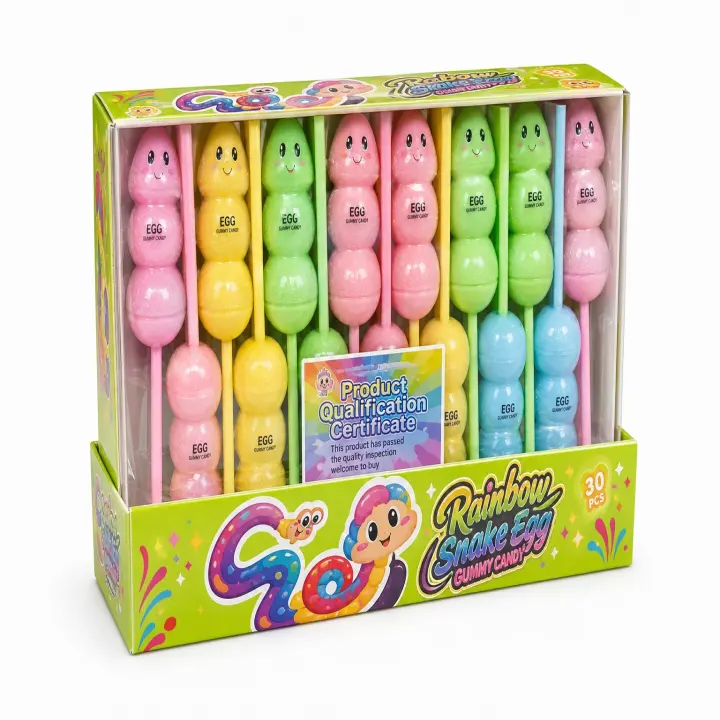
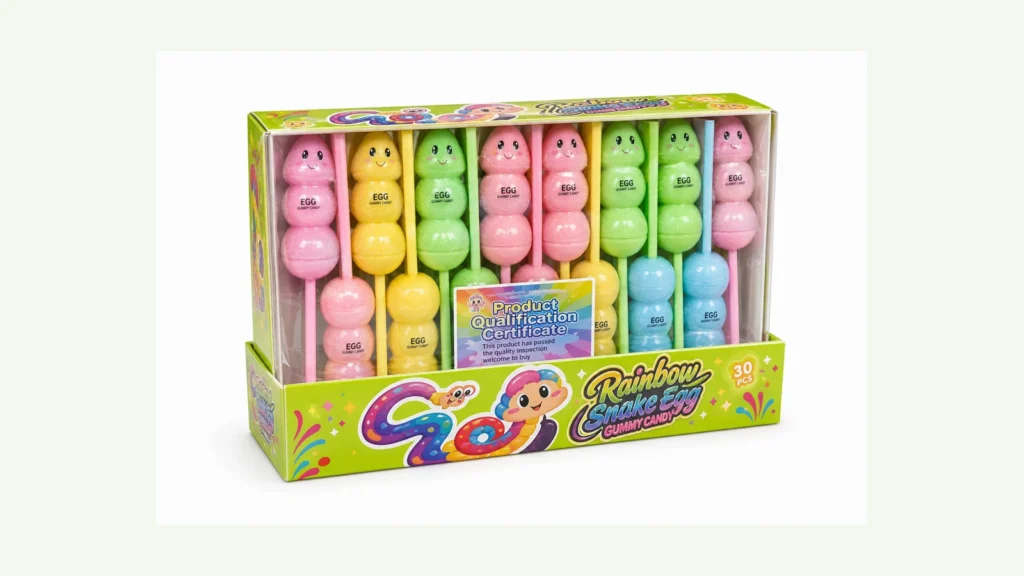
If you are preparing a snake egg candy trial brief before sending an RFQ, the most useful move is to decide what the first sample is supposed to prove. KidStar SKU YMX-178 is the practical case: 4 g candy packed as 30 pieces × 20 display boxes per carton in a value-line novelty route. That means the buyer is not only checking whether the product looks fun. The buyer is deciding whether the stock display-box route is ready for a first quote, a mixed-load trial, or only a concept review.
The direct answer is simple: a useful YMX-178 brief should name the exact SKU, the intended outlet, the sample question, the display-box acceptance point, and the first-order direction before price is requested. Importers, distributors, wholesalers, and private-label buyers often create extra RFQ cycles because the sample is asked to answer everything at once. When the sample has no single job, the quote usually comes back with too many open assumptions.
Start with the exact YMX-178 route
The current YMX-178 product page already gives the buyer a stable starting point:
- exact SKU: YMX-178
- category: Novelty Candy
- subcategory: Value Line
- specification: 4 g candy × 30 pcs × 20 display boxes
- carton route: 30 pcs × 20 display boxes/carton
That should be enough for a first trial file. Use the exact product page so everyone is reading the same stock route. Then keep the broader product catalog as a comparison tool only if the buyer wants to test YMX-178 against other novelty or display-box lines later.
For RFQ work, this matters because a novelty-candy sample is only useful when it proves one business question clearly.
Separate the sample question from the order question
The biggest workflow mistake is to treat one sample as if it should settle taste, channel fit, packaging strategy, carton economics, and final approval at the same time.
For YMX-178, the first sample usually works best when it answers one of these questions:
- Does the current stock display-box route fit the intended outlet?
- Does the novelty concept belong in the buyer’s first trial lineup?
- Should YMX-178 stay a support SKU in a mixed offer, or move toward a more active quote?
That is why the samples page and MOQ and lead time should be connected, but not confused. A sample checks route fit and decision readiness. MOQ and lead time help once the route is already clear enough to quote.
Decision table: what the first trial should actually prove
| Trial situation | What the sample should prove | What the buyer should not force yet | Best next step |
|---|---|---|---|
| Counter or value-outlet test | Whether the stock display box works in the target outlet | Do not force custom packaging questions yet | Review the stock route and then request a route-specific quote |
| Mixed novelty assortment screen | Whether YMX-178 deserves a slot in the first offer | Do not treat it as the lead SKU before assortment role is clear | State how YMX-178 sits beside the other SKUs |
| General-export trial with limited first order | Whether the value-line route is acceptable for phase one | Do not overbuild the sample into a final commercial approval | Use the sample to confirm stock-route usefulness first |
| Team already discussing custom branding | Whether the stock route is still worth testing at all | Do not mix stock screening and final custom-route decisions in one file | Separate stock trial from later packaging customization |
| Buyer only asking for “best novelty candy quotation” | Nothing clear yet | The trial still has no defined job | Name the outlet, route, and sample question first |
This table keeps the sample from becoming a catch-all task.
What to put in a snake egg candy trial brief
A working YMX-178 brief usually includes:
- exact SKU YMX-178
- destination market
- outlet or channel type
- whether the 30-piece display box is accepted as the first route
- the one question the sample must answer
- first-order direction in cartons or mixed-load role
- who will approve the next step
That last point matters more than many buyers expect. A sample may be liked by sales, but still be blocked by purchasing or channel teams if the route is not written clearly. One trial brief helps those teams approve the same commercial question instead of reviewing different versions of the project.
The packaging customization page can help later if the stock route proves useful and the buyer wants a more developed pack discussion. It should not interrupt the first trial if the buyer still needs a basic yes-or-no answer on the stock route.
Signs the RFQ is still too early
Hold the RFQ when:
- the outlet type is still unclear
- the sample purpose is still written as “general review”
- the team has not said whether the display box is acceptable
- quantity direction is still too vague to judge the carton route
- the project is mixing stock-route screening with full custom ambitions
Holding is not lost time. It is what prevents a weak first quote from becoming a second quote made mostly of corrections.
The better route is to keep the first brief narrow: exact SKU, stock-route question, channel, carton direction, and one named approval goal. Once those are stable, the RFQ becomes much more useful.
Checklist before you send the RFQ
- Fix the exact SKU: YMX-178.
- Name the one question the sample must answer.
- State whether the 30 pcs × 20 display boxes route is acceptable for phase one.
- Put the first-order direction into carton or assortment terms.
- Use samples before you treat the route as quote-ready.
- Bring in MOQ and lead time only after the route is clear.
- Keep packaging customization as a later-stage discussion if the stock route proves useful.
If you want KidStar to review whether YMX-178 is ready for a real RFQ or still needs a narrower trial brief, send the market, outlet type, sample purpose, carton direction, and next-step question through the contact page. That helps the team answer with the right commercial route instead of a generic novelty-candy quotation.