The direct answer: importing candy from China works when the buyer locks the market, product direction, pack route, and quantity before asking for price — then moves through samples, MOQ confirmation, PI and payment terms, documentation, and shipping as one controlled sequence. Most first-time importers fail not because China factories are unreliable, but because they start with price before the commercial basis is stable.
This guide is written for importers, distributors, wholesalers, and private-label teams preparing their first candy container from China. It walks the full route in eight steps, with the exact questions to answer at each stage and the documents you will need before the goods leave the port.
Key numbers at a glance
- Sugar confectionery is classified under HS 1704 and chocolate-based candy under HS 1806.
- Typical candy MOQs from Chinese factories run 500–5,000 kg or 1,000–10,000 units depending on product complexity.
- The common first-order payment structure is a 30% deposit with the balance before shipment.
- Ocean transit from China to North America typically takes 25–40 days, and 30–45 days to Europe.
Latest market insight
- Sugar confectionery is classified under HS 1704 and chocolate-based candy under HS 1806; getting the HS code and destination tariff right is the first cost-control step.
- FOB (Free On Board) is the most common trade term from Chinese ports: the buyer takes over freight, insurance, and destination costs once goods are loaded at Shanghai, Ningbo, or Shenzhen.
- Typical factory MOQs run 500–5,000 kg or 1,000–10,000 units depending on product complexity and customization; samples of 2–5 units are the standard starting point.
- The suspended duty-free de minimis treatment and tighter food-import traceability rules make documentation discipline more important than ever for low-value first orders.
Sources reviewed: FDA — Importing Food Products, US CBP — Basic Import Guidance, Trade.gov — China Import Requirements.
Step 1: Lock your market, channel, and product direction
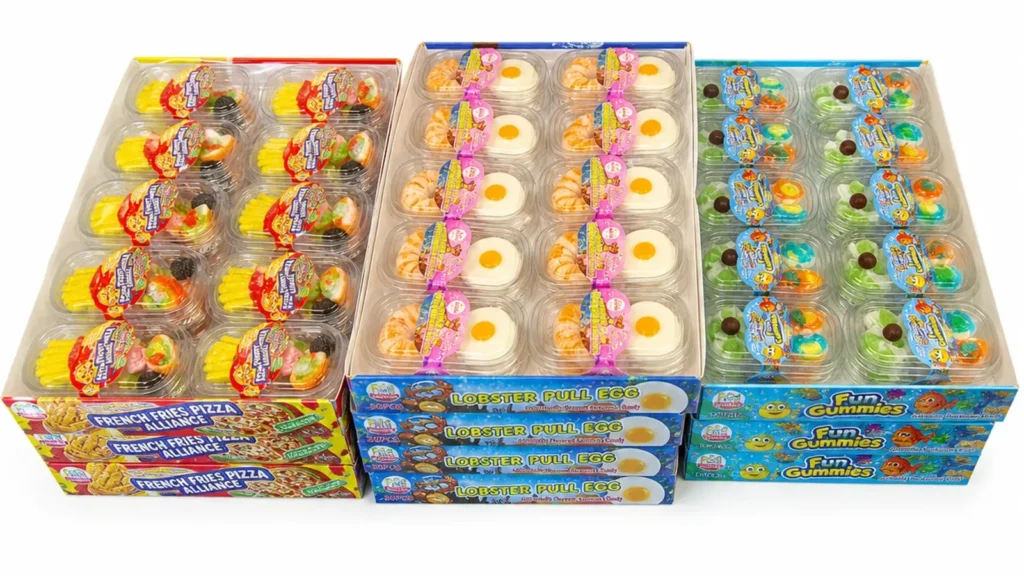
Before any supplier conversation, define the destination country, sales channel, and the candy formats you actually want. A supermarket jar program, a wholesale pouch line, a display-box counter line, and a private-label launch all start from the same candy type but lead to different packaging, MOQ, and compliance assumptions.
Send these five inputs first — the first-brief guide explains exactly why this prevents quote rewrites:
- destination market and target channel
- candy category and approximate size/flavor direction
- preferred pack format
- trial quantity and repeat-order target
- timing and document questions
Step 2: Choose the supplier route that matches your project
Not every China candy factory fits every buyer. Compare suppliers on product fit, ingredient route, pack capability, MOQ basis, sampling, artwork inputs, and documentation — not on unit price alone. The candy supplier comparison guide shows the decision table, and the private label checklist covers the brand-owner route.
If you are still working from a broad catalog, narrow it first: pick one buying case, then shortlist three or fewer SKUs that share one pack route and carton logic. The container-ready shortlist guide walks that narrowing step.
Step 3: Send one quote-ready RFQ
A supplier cannot quote comparable numbers if the RFQ only says "send your best price." Structure the RFQ with product scope, packaging route, quantity tiers, destination market, and timeline on the same table — the candy RFQ guide gives the five fields that change a candy quote fastest.
Remember that the first price reply is often a placeholder. If the number changes or stalls after MOQ, packaging, or destination details arrive, that is normal — why quotes change or stall explains which input was probably still loose.
Step 4: Understand FOB pricing and landed cost
FOB is the price of the goods loaded at the Chinese port. The buyer then pays ocean freight, insurance, and destination charges. The full landed cost also includes duties, customs brokerage, inland transport, and any tariffs that changed after the quote. Compare offers only after locking the same product, pack format, carton quantity, MOQ, and shipping assumptions — the FOB and freight comparison guide shows how to keep the comparison honest.
Step 5: Confirm MOQ, packaging, and samples
Factory MOQs typically run 500–5,000 kg or 1,000–10,000 units depending on complexity. MOQ is calculated by SKU, pack format, or artwork version — ask which basis applies before comparing numbers. Packaging choices (pouch, jar, display box, flow wrap) change MOQ, carton logic, and freight efficiency, so lock the pack route before sampling. Request 2–5 sample units and use them to check taste, fill weight, seal quality, label space, and shelf presentation — not only flavor. See the MOQ and lead time page for the timing logic.
Step 6: Approve the PI and payment terms
The proforma invoice should confirm the commercial agreement already reached: SKU list, pack route, quantity, unit price, Incoterm, and document scope. A 30% deposit plus balance before shipment is the common structure; confirm the balance trigger, bank details, and any sample or tooling charges before the first transfer. The payment and PI guide includes the full pre-deposit checklist.
Step 7: Prepare the document set
Before the goods ship, collect and review the document set so destination customs does not stall:
| Document | What it proves | Notes for candy imports |
|---|---|---|
| Commercial invoice and packing list | Value and contents of the shipment | Must match the PI and the bill of lading |
| Bill of lading | Title to the goods and shipping route | Request a copy before the vessel departs |
| Certificate of Analysis (COA) | Product spec and test results | Factory-issued; third-party testing may be required |
| Health/sanitary certificate | Export clearance by Chinese authorities | Required for food shipments in most markets |
| Certificate of Origin | Country of origin for tariff purposes | Needed for preferential duty rates where applicable |
| Factory certifications | HACCP, ISO 22000, BRC, or IFS | Evidence of the production standard behind the product |
| Destination compliance files | FDA registration, EU labeling, halal certs, allergen data | Confirm before production, not after arrival |
Step 8: Shipping, customs, and delivery
Book ocean freight after production confirmation — FCL (full container load) for larger volumes, LCL (less than container load) for smaller first tests. Arrange a pre-shipment inspection if your volume justifies it, track the shipment by bill of lading, then file the import entry, pay duties, and clear customs at the destination port before inland transport to your warehouse. A customs broker or freight forwarder familiar with food cargo is worth the fee on the first order.
First-order checklist before you commit
| Stage | Key question | Why it matters |
|---|---|---|
| Market | Country, channel, and price band defined? | Sets every downstream assumption |
| Product | SKU direction and format locked? | Prevents re-quotes and wrong samples |
| Supplier | Same RFQ sent to all candidates? | Makes offers comparable |
| Price | FOB vs landed cost separated? | Avoids "cheap" quotes that cost more later |
| MOQ/pack | Quantity basis and pack route confirmed? | MOQ and freight math depend on it |
| Sample | Commercial pack approved, not just taste? | Cuts retail-approval delays |
| PI/payment | Deposit, balance trigger, and bank details clear? | Keeps the order moving |
| Documents | Full set mapped to destination rules? | Prevents customs and label surprises |
| Shipping | FCL/LCL decision and broker arranged? | Controls cost and clearance risk |
Related KidStar pages
- Compare suppliers fairly: Candy Supplier Comparison
- Build one clean RFQ: Candy RFQ Guide
- Lock FOB and freight assumptions: FOB and Freight Comparison
- Prepare payment and PI: Payment and PI Guide
- Review product families: Product Catalog
- Check MOQ and timing: MOQ and Lead Time
Start your import with one clear brief
If you are planning a candy import from China, send KidStar your target market, product direction, pack route, quantity range, and timing. The team can respond with a focused product, sample, quotation, and document path — instead of a generic catalog reply.