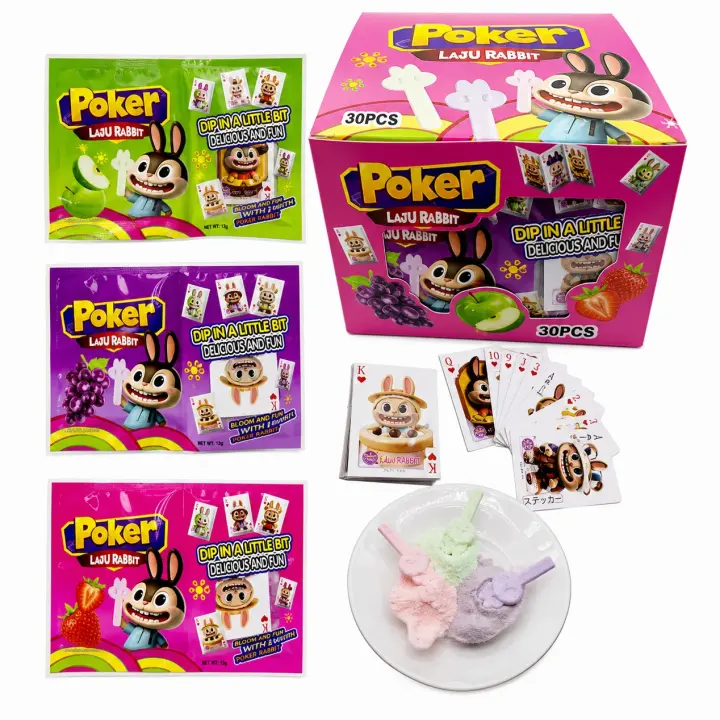
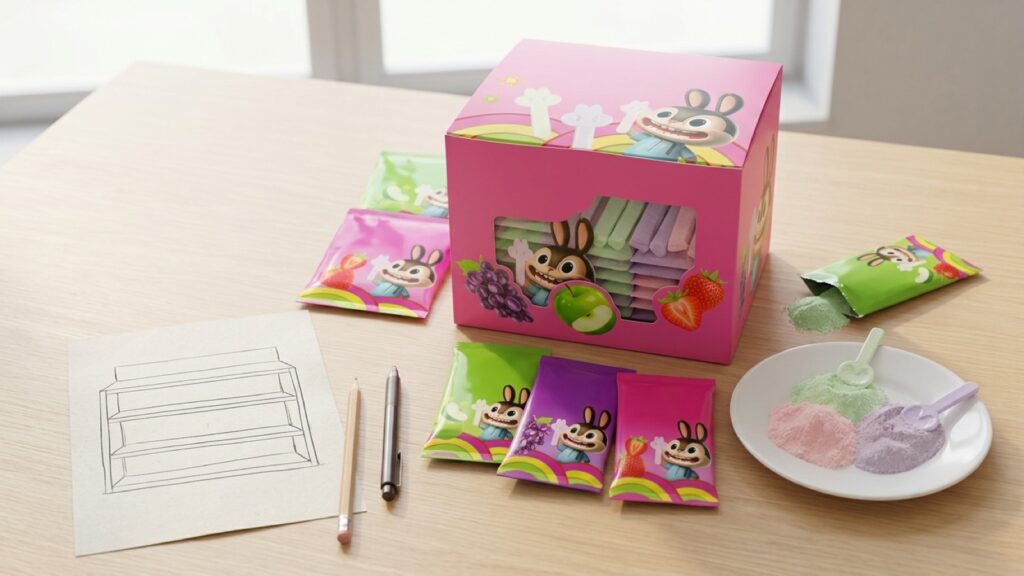
If you are planning a bunny sour powder stick display program, start with the outlet and the dipping moment before you ask for a price. Exact KidStar SKU YMX-130 is a 10 g powder stick packed 30 pcs x 20 display boxes per carton, which means the line is designed to sell from a retail-facing display box rather than as an abstract powder candy.
The direct answer is that a useful display program brief names the outlet, the resale unit, and the reorder route, then locks the powder handling and carton math before quoting. Importers, distributors, wholesalers, and private-label teams lose time when they treat a bunny sour powder stick line like any other candy and skip the display logic.
Start with the outlet and the dipping moment
A bunny sour powder stick is a dipping product: the buyer needs to know who dips, where the dip happens, and how the display box earns its shelf slot.
For YMX-130, the first planning questions are:
- Is the line for a novelty aisle, a candy store counter, a checkout display, or a value-retail shelf?
- Is the resale unit the stick, the display box, or a mixed carton?
- Does the dipping format match the market’s impulse behavior or a planned promotion?
- What happens at reorder time — does the display box refill cleanly?
The exact YMX-130 product page should anchor the discussion, and the product catalog is the right place to compare related powder and novelty lines. But the program decision should start with the shelf or counter where the product will be sold.
What the YMX-130 display record tells a buyer
The product record for YMX-130 gives the buyer a concrete starting point:
- unit: 10 g candy per stick
- display: 30 pieces per display box
- carton: 20 display boxes per carton
- category: powder candy line with a bunny sour concept
- status: quote-ready in the current product library
Each fact answers a different program question. The 10 g unit tells you the stick is an impulse size. The 30-piece display box tells you the box is meant to sit on a shelf or counter and sell as a unit. The 20-box carton tells you how the line arrives at the warehouse and how reorder math works.
Use a decision table to lock the display program
The fastest way to test the program is to map the buyer scenario against what must be locked for YMX-130.
| Buyer scenario | Display role that usually fits | What to lock for YMX-130 | Verdict signal |
|---|---|---|---|
| Novelty aisle | Display box | 30-piece box presentation, shelf fit | Choose display when the box sells the theme |
| Candy store counter | Small counter display | Unit format, counter fit, refill logic | Choose counter when staff sells the dip moment |
| Value-retail shelf | Display box | Carton count, shelf rotation, reorder route | Choose display when rotation matters |
| Promotion or event | Mixed carton trial | Timing, quantity, sample evidence | Choose trial only when the outlet is named |
| Repack or private-label bridge | Hold until stock route proves useful | Stock evidence, sample feedback, later packaging needs | Keep the route simple before customization |
The same discipline applies to the MOQ and lead time page: a display program quote only stays stable when the buyer has locked the box count, carton count, and timing window.
Confirm powder handling and reorder logic
Powder candy adds two operational checks that hard candy programs do not have.
- Leakage and seal risk: the stick, the dip tip, and the outer pack should be reviewed in the sample before the display box is approved.
- Reorder discipline: a display program lives on refills, so the buyer should know the carton count per store and the reorder lead time before the first order.
The practical checklist for a first YMX-130 order should cover five items:
- sample condition: stick seal, dip tip, powder texture, and box presentation
- display math: boxes per store, shelf or counter fit, and carton breakdown
- reorder route: who refills the display and from which carton level
- timing: the production window that fits the planned promotion or launch date
- stock versus custom: keep the stock display route until the line proves itself
The strongest first step is a sample review that covers the product, the display box, and the carton together, using the samples page route. Custom packaging and artwork questions belong to a later conversation with the packaging customization team, once the stock display route has proved itself.
Turn the program into a cleaner buying brief
The final step is writing the brief in one file: exact SKU YMX-130, the 10 g stick and 30-piece display box, the named outlet, the resale unit, and the quantity direction. That file is what makes supplier answers comparable and keeps the program from drifting into a generic candy order.
Start a Buying Brief with the market, channel, display role, quantity direction, and timing, and the KidStar team can review YMX-130 against the program you actually plan to run.