
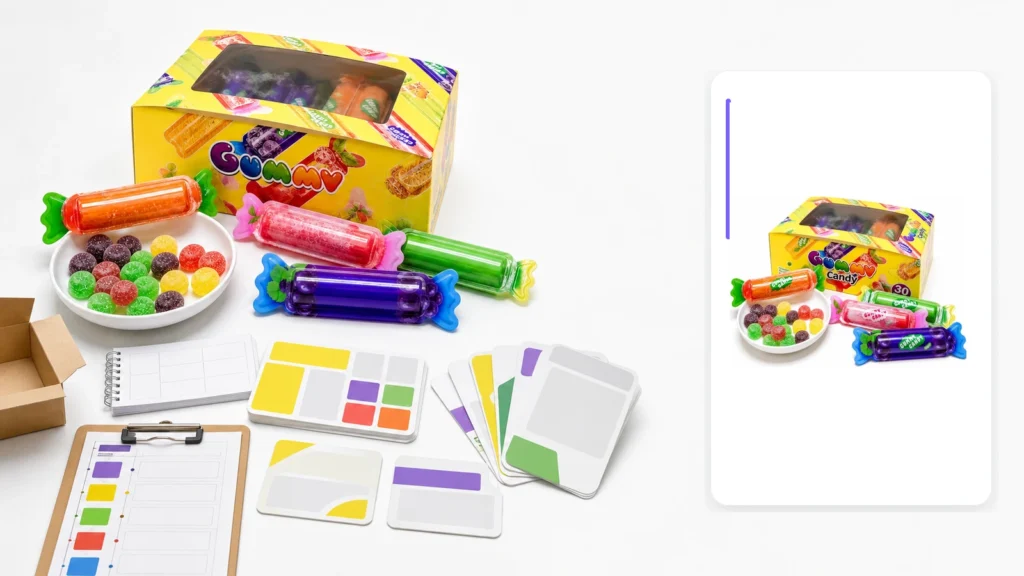
Buyers often think a gummy RFQ goes wrong because the supplier quoted the wrong flavor or did not move fast enough. In practice, the more common problem is that the buyer asked for price before the selling unit, display route, carton logic, and pilot scale were fixed. KidStar SKU YMX-128 is a useful example because it is a Gummy Candy line packed as 10 g × 30 pcs × 24 boxes/carton. That is already a display-box route with an export carton behind it, not just a vague “gummy candy” concept.
The practical sourcing question is therefore not “Can you quote gummy candy?” The better question is what a buyer should lock before asking for the first firm RFQ on one exact display-box SKU. That is what keeps the first answer usable and keeps the second answer from turning into a rewrite.
Fix the exact product route before you ask for price
A gummy RFQ becomes unstable when the buyer changes the product meaning halfway through the conversation. One team says it wants a standard stock SKU. Another teammate means a custom assortment. A third person is already thinking about a wider mixed order. The supplier then answers one question while the buyer is silently solving another.
For YMX-128, the first brief should separate:
- the exact SKU being reviewed
- the display-box route of 30 pcs × 24 boxes/carton
- the intended outlet type
- the first-order scale
- whether the quoted route is stock, pilot, or a bridge to a later custom program
The YMX-128 product page should anchor the discussion so the buyer is not drifting back into general gummy language. Once the SKU is fixed, the buyer can compare it with the broader product catalog and decide whether this display-box format belongs in the first quote or only in a later shortlist.
Use one RFQ table before the first quotation is frozen
The easiest way to reduce rework is to write one short RFQ table that both sides can point to.
| RFQ area | What the buyer should lock for YMX-128 | Why it matters |
|---|---|---|
| SKU scope | Confirm that the quote is for YMX-128 and not a generic gummy substitute | Prevents a display-box gummy line from being replaced with a different route |
| Selling unit | State whether the current display-box route stays unchanged | The supplier cannot price shelf-facing work properly if the selling unit is still flexible |
| Outlet type | Name the intended channel: convenience, wholesale, value retail, or mixed distribution | Display logic and first-order advice change by outlet |
| Quantity logic | Define whether this is a pilot order, repeat route, or mixed-container test | MOQ and carton planning depend on the real order purpose |
| Open decisions | Mark what is still under review instead of hiding it | It keeps the next quote from being treated as final too early |
This table does not need to be complex. Its value is that it turns “please quote gummy candy” into a commercial instruction.
Decide whether YMX-128 is a fixed SKU or an assortment placeholder
Buyers often misuse a standard gummy line by treating it like a placeholder for a future assortment. That creates confusion because the supplier is pricing one SKU while the buyer is mentally comparing several directions at once.
Use this rule:
- If the buyer wants one fixed stock route, YMX-128 is a single-SKU RFQ.
- If the buyer wants to compare a few display-box gummy directions, YMX-128 is a shortlist anchor, not a final route.
- If the buyer is already thinking about a custom program, YMX-128 may only be a reference point before packaging customization becomes the real next step.
That distinction matters because price stability depends on what the supplier thinks it is solving. A fixed-SKU RFQ can move quickly. A shortlist request needs comparable options. A custom route needs more controlled assumptions. Mixing those stages is the fastest way to trigger a quote rewrite.
Align the display box, carton route, and first-order scale
YMX-128 is not only a candy unit. It is also a case-packed export route. That means the buyer should align shelf and carton logic before asking the supplier to treat the first quote as commercially meaningful.
Ask:
- Will the display box go directly to shelf?
- Will downstream resellers keep the box format or break it into smaller retail handling?
- Is the first order testing one SKU only or a wider gummy lineup?
- Does the buyer need standard export handling only, or channel-specific presentation evidence too?
The MOQ and lead time page helps here because the first order should be described honestly. A pilot route should be called a pilot route. A repeat route should be treated like a repeat route. If the buyer hides that difference, the supplier often sends a number that looks useful but does not actually match the launch path.
Ask for the evidence that makes a gummy RFQ usable
Before the first firm quote is frozen, a buyer should request enough evidence to judge whether the display-box route fits the intended market.
Request:
- one clear image of the box front
- one image of the opened display presentation
- one case-level image showing the box route inside the carton
- confirmation of the exact product count and carton route
- any sample notes that affect handling, shelf presentation, or local resale logic
This is where the samples page matters. If the buyer still needs to decide whether the format works in market, the project is still in a sample-led stage even if a price is being discussed. Admitting that early is much cleaner than pretending the first RFQ is final.
Know when to hold the RFQ instead of forcing the supplier to guess
Hold the RFQ when:
- the buyer is still comparing several gummy routes
- the outlet type is not fixed
- the display box may change before launch
- the first order is being described as both a pilot and a repeat program
- the team wants a custom-packaging conversation but is still reviewing a stock SKU
In those cases, the right action is not to keep asking the supplier to “update price again.” The better action is to freeze the open assumptions first. That protects both sides from treating a moving target like a finished RFQ.
The certifications and compliance page may also matter when destination-market documentation or label questions are part of the hold. It is better to mark that as an open review line than to let the commercial team assume it has already been solved.
Send the next message like an RFQ owner, not a catalog browser
The strongest next message for YMX-128 usually says:
- we are quoting KidStar SKU YMX-128
- the current display-box route is accepted or still under review
- this is a pilot, repeat route, or shortlist-comparison request
- the target channel is stated clearly
- please quote or update the file on that exact basis
That is much more useful than saying, “Please send your best gummy price.” It gives the supplier the commercial frame needed to respond with a cleaner route and gives the buyer a file that can actually be reviewed internally.
Lock YMX-128 only after the RFQ meaning is clear
KidStar SKU YMX-128 works best when the buyer treats it as one exact display-box program with one exact commercial job. The price conversation becomes cleaner once the buyer has fixed the product meaning, the outlet type, the first-order scale, and the point at which a stock route stops and a custom route begins.
If you want KidStar to review whether YMX-128 is ready for a first RFQ or still belongs in a gummy shortlist, send the target market, outlet type, quantity plan, and open questions through the contact page. That helps the team answer with a workable RFQ path instead of a generic gummy quotation.