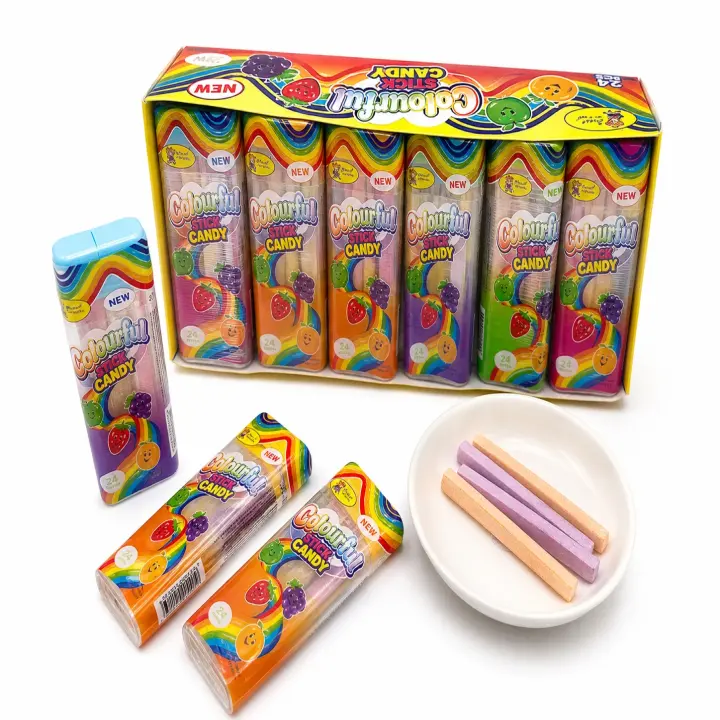
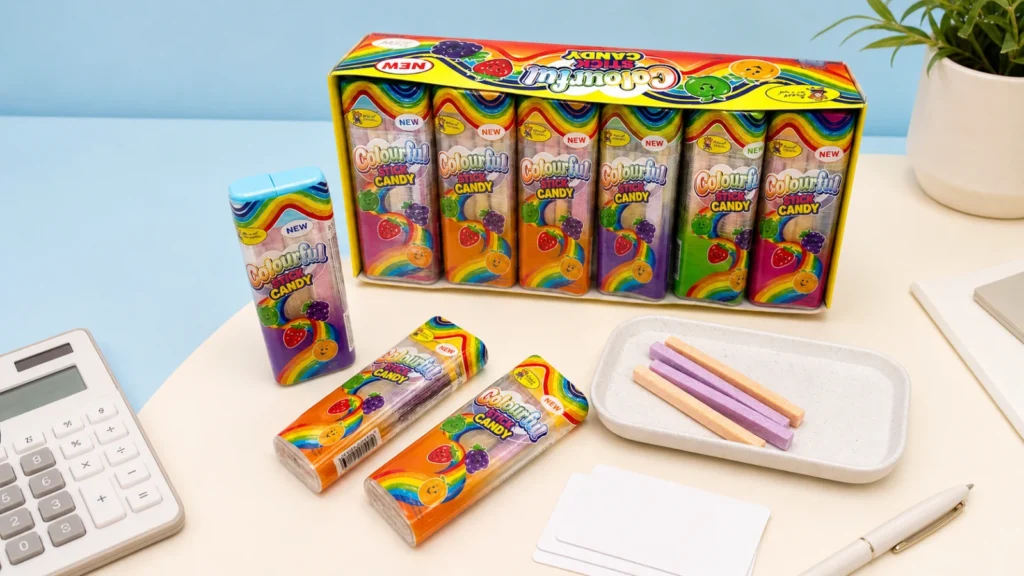
For pressed candy wholesale, compare the same commercial route from the consumer unit through the display box and export carton. KidStar SKU YMX-165 is listed as 12 g per jar, 30 pieces per display box, and 20 display boxes per carton. A quote that changes any one of those levels is not yet a like-for-like offer.
The practical answer for importers, distributors, wholesalers, and private-label buyers is to normalize five fields before discussing the lowest price: exact SKU, 12 g unit, 30-piece display, 20-display carton, and requested quantity in cartons. This article is not a repeat of a general sourcing guide; it focuses on the pack hierarchy that makes a YMX-165 offer commercially comparable.
Start with one exact pressed candy wholesale route
The live YMX-165 product record provides the starting specification:
- product reference: YMX-165 Pressed Candy
- consumer unit: 12 g per jar
- display level: 30 pieces per display box
- export level: 20 display boxes per carton
- listed carton size: 40 × 23 × 31 cm
These are reference fields, not a complete quotation. They let a buyer state which route is under review before quantity, destination, labels, samples, or private-label questions are added. They do not prove a final MOQ, price, loading quantity, lead time, or destination-market compliance position; those items need written confirmation for the actual inquiry.
Use the SKU in the subject line and repeat the full pack hierarchy in the body of the request. “Pressed candy price” is too broad because public supplier pages show that the category appears in multiple pack shapes and formats. That public variation is useful as a comparison warning, but another supplier’s claims should never be treated as KidStar specifications.
Convert the pack hierarchy into comparable quantities
A buyer can describe demand at several levels: consumer units, displays, cartons, or a mixed-container allocation. The supplier needs to know which level controls the request.
For example, one YMX-165 carton contains 20 displays, while each display contains 30 individual 12 g jars. That means one carton represents 600 consumer units according to the listed hierarchy. This multiplication is useful for commercial normalization; it is not a loading promise or a final shipping calculation.
| Comparison level | YMX-165 reference | What the buyer should write | Common source of confusion |
|---|---|---|---|
| Consumer unit | 12 g jar | Required resale unit and target outlet | Comparing a jar with a sachet or different weight |
| Display box | 30 pieces | Whether the display is sold intact or opened by the retailer | Treating “30 pcs” as the carton total |
| Export carton | 20 displays | Trial and repeat quantity in cartons | Asking for units while the supplier prices cartons |
| Carton dimensions | 40 × 23 × 31 cm | Request confirmation for the quoted version | Using dimensions from another pressed candy SKU |
| Commercial version | Exact YMX-165 route | Stock route first; list any requested change separately | Mixing standard and custom assumptions in one price |
The purpose of the table is simple: make every offer use the same denominator. If a buyer later compares another pressed candy format, the pressed candy versus hard candy channel guide helps separate category choice from pack-level price comparison.
Decide whether the display is part of the resale plan
The 30-piece display should have a named job. A distributor may ship the display intact to a general-trade outlet. A cash-and-carry buyer may sell by display. Another retailer may open it and sell jars individually. Those are different commercial routes even though the product SKU is the same.
Before requesting samples or pricing, answer these questions:
1. Is the individual jar, the full display, or the carton the buyer’s operating unit? 2. Will outlets place the supplied display directly on shelf or transfer the jars? 3. Does the buyer need to review display readability as well as the candy itself? 4. Is YMX-165 a standalone trial or one allocation inside a mixed order? 5. What result would justify a repeat order: outlet acceptance, sell-through, reorder requests, or another defined measure?
The retail-ready pack guide gives a useful framework for checking whether a supplied display actually supports the intended shelf task. It does not replace a physical sample review.
Separate the standard route from requested changes
Price drift often starts when a buyer discusses the listed product and a changed product in the same sentence. Keep the live YMX-165 route as the baseline. Then list any requested change—label language, display artwork, outer-carton marks, barcode handling, or another pack request—as an open feasibility question.
Do not assume that every change is available, that the MOQ stays the same, or that a document applies to the exact product version. The safer sequence is:
- quote the listed YMX-165 route as the baseline
- name each requested change separately
- ask which changes affect MOQ, price, sample approval, or timing
- confirm the final approved specification in writing
For a project that may move beyond the listed route, use KidStar’s packaging page to organize the discussion, then ask for product-specific feasibility instead of inferring a capability from a general service page.
Use a short comparison checklist before choosing price
An offer is ready for comparison only when the following points are aligned:
- exact YMX-165 product reference
- 12 g jar × 30 pieces × 20 displays per carton baseline
- intended resale level: jar, display, or carton
- trial quantity and repeat direction stated in cartons
- destination country and outlet type
- trade term and named place requested clearly
- sample purpose and approval owner
- standard route separated from every proposed pack change
- carton dimensions reconfirmed for the quoted version
- unanswered label, document, and timing questions kept open rather than assumed
This checklist prevents a low unit number from winning before the buyer knows what that number includes. It also gives a supplier enough context to flag a mismatch early.
Send a normalized YMX-165 request
If YMX-165 fits your pressed candy shortlist, send the destination, outlet type, resale unit, trial quantity in cartons, sample goal, trade term, delivery window, and any requested pack changes through the contact page. Ask KidStar to answer against the 12 g × 30 pieces × 20 displays baseline so the response remains comparison-ready.
Sources reviewed
- KidStar YMX-165 product record — first-party SKU and pack reference, reviewed 2026-08-25.
- KidStar pressed candy versus hard candy channel guide — related category decision context, reviewed 2026-08-25.
- CNIVY public pressed candy supplier page — supplier-page observation that pressed candy is offered in varied formats; no marketing or capability claim from this page is attributed to KidStar, reviewed 2026-08-25.