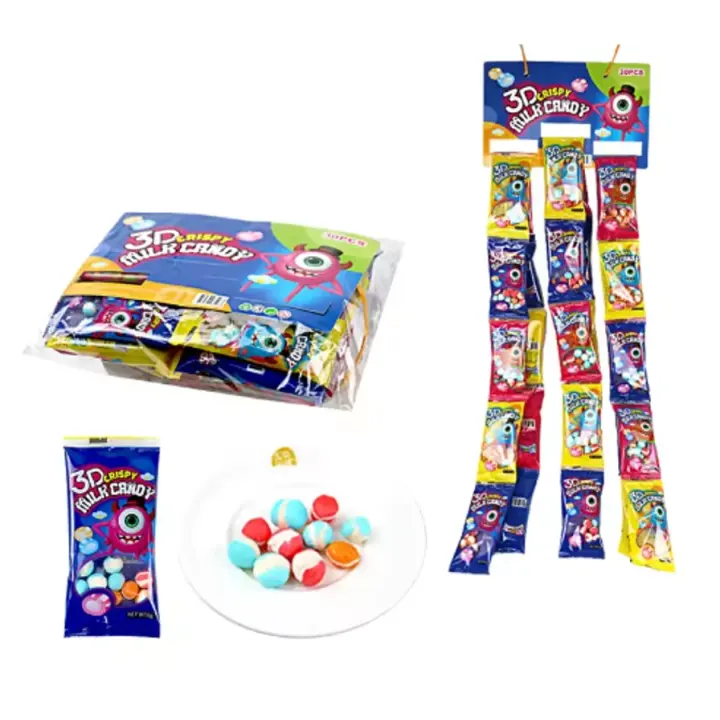
If you are weighing the freeze dried candy trend for 2026 as an import buyer, the first check is not the trend headline. It is whether a freeze-dried candy line fits your channel, your price point, and your evidence requirements. KidStar SKU YMX-226 is a useful example because it is a freeze-dried milk candy with a crispy, airy texture, packed as 6 g pieces × 30 pieces × 24 inner bags/carton, and it is quote-ready in the current product library.
The direct answer is that freeze-dried candy demand is growing through 2026, so add YMX-226 freeze-dried milk candy only after checking the crispy texture claim, the 30-piece inner-bag pack route, shelf-life evidence, and a sample plan. Importers, distributors, wholesalers, and private-label buyers who skip those checks end up comparing trend stories instead of comparable product programs.
What the 2026 freeze-dried candy signal actually says
Trade press coverage through 2026 shows freeze-dried candy moving from a niche curiosity into a named category segment. ConfectioneryNews reported in January 2026 that the global freeze-dried candy market was valued at approximately USD 1.36 billion in 2023 and projected to grow at a compound annual growth rate of 8.3 percent, reaching roughly USD 2.38 billion by 2030, citing Grand View Research data. The same article notes that Mars gave its freeze-dried M&M’s POP’d Caramel a soft launch on TikTok Shop and MMS.com in early November 2025 before rolling the product out to stores nationwide in January 2026, and that Ferrara announced freeze-dried versions of SweeTARTS, Lemonheads, and Spree in August 2025.
A July 2026 ConfectioneryNews analysis adds that global confectionery revenues are expected to exceed USD 648 billion in 2026, that nearly half of Gen Z consumers (48 percent) discover new confectionery products through TikTok, and that freeze-dried confectionery has become one of the category’s hottest segments because of its crunchy texture, intensified flavors, and unique eating experience. The lesson for buyers is not that every freeze-dried product wins. The same January article shows a freeze-dried leader, Sow Good, struggling financially in 2025 despite the category buzz, which is a useful reminder that a trend does not replace assortment, price, and sell-through evidence.
What a freeze-dried candy line means for import buyers
Freeze-dried candy changes the sourcing conversation in three ways that matter more than the texture story.
First, the pack route becomes part of the product claim. A freeze-dried or crispy milk candy line needs to arrive with the crisp texture intact, so the inner bag, the carton, and the transit plan are commercial facts, not packaging details. Second, shelf-life and storage evidence become selling questions: buyers and retailers will ask how the texture behaves after shipping, warehousing, and shelf time. Third, the trend is discovery-driven, which means the product needs a format that works on social media and at the shelf, not just a flavor that sounds interesting.
For YMX-226, the product record gives the buyer a concrete starting point:
- unit: 6 g freeze-dried milk candy piece
- inner bag: 30 pieces per inner bag
- carton: 24 inner bags per carton
- category: milk candy line with a crispy, airy texture
- status: quote-ready in the current product library
The exact YMX-226 product page should anchor the discussion, and the product catalog is the right place to compare related milk candy and novelty lines.
The YMX-226 check: what the product record can and cannot prove
A market trend is evidence about the category, not about one stock line. Separate the two when you brief a supplier.
| Check | What the buyer should ask | What YMX-226 shows today |
|---|---|---|
| Texture claim | How does the crispy, airy texture hold after transit and shelf time? | Product record confirms the freeze-dried milk candy format; sample test needed |
| Pack route | Is the inner bag the resale unit or a repack input? | 30 pieces per inner bag, 24 inner bags per carton |
| Shelf life | What date-code and storage evidence supports the program? | Confirm via sample and documentation request |
| Market fit | Does the channel want freeze-dried, crispy, or milk candy formats? | Category trend supports demand; channel test needed |
| Quote scope | Is the program stock, private label, or custom packaging? | Quote-ready stock line today |
This table keeps the trend and the product separate. The buyer should be able to say which check the first sample actually answers, and the MOQ and lead time page is the right place to confirm quantity and timing assumptions before anything is quoted.
Decision table: where a crispy milk candy line fits
The fastest way to test the route is to map the buyer scenario against what must be locked for YMX-226.
| Buyer scenario | Route that usually fits | What to lock for YMX-226 | Verdict signal |
|---|---|---|---|
| Trend-test assortment | Small inner-bag trial | Bag count, carton math, sample evidence | Choose a trial when the channel is still unproven |
| Retail shelf program | Full bag route | Shelf presentation, date-code plan, reorder logic | Choose bags when the bag is the resale unit |
| Repack or trade mixing | Loose pieces for repacking | Unit format, repack quantity, packaging plan | Choose repack when the buyer builds own packs |
| Social or impulse launch | Discovery-friendly small format | Shareable pack, outlet placement, timing | Choose a small format when discovery is the job |
| Private-label bridge | Hold until stock route proves useful | Stock evidence, sample feedback, later packaging needs | Keep the route simple before customization |
The same discipline applies to quantity and lead time: a quote that looks cheap for inner bags may not survive repack assumptions, and a quote built for shelf placement assumes different carton handling.
Checklist: five checks before the first freeze-dried candy order
Before any freeze-dried candy order becomes a real program, confirm these five checks in writing:
- The texture evidence, meaning how the crispy, airy format behaves after shipping and shelf time, tested through samples.
- The resale unit, meaning whether the 30-piece inner bag is the unit the retailer receives intact.
- The carton math, starting with 24 inner bags per carton for YMX-226 and the pallet quantity you need.
- The shelf-life and date-code story, because freeze-dried texture claims depend on storage conditions.
- The market and outlet plan, because the 2026 trend is discovery-driven and needs a named channel.
Use the samples page to test the freeze-dried milk candy piece, the inner bag, and the texture after transit. If the program later moves toward custom packaging or a private-label shape, that belongs in a separate conversation with the packaging customization team, once the stock route has proved itself.
Turn the trend into a buying brief
The final step is writing the brief in one file: exact SKU YMX-226, the 6 g freeze-dried milk candy piece and 30-piece inner-bag format, the named outlet, the resale unit, the shelf-life questions, and the quantity direction. That file is what makes supplier answers comparable, and it turns a trend story into a real sourcing decision.
Start a Buying Brief with the market, channel, pack route, texture evidence needs, quantity direction, and timing, and the KidStar team can review YMX-226 against the freeze-dried candy program you actually plan to run.