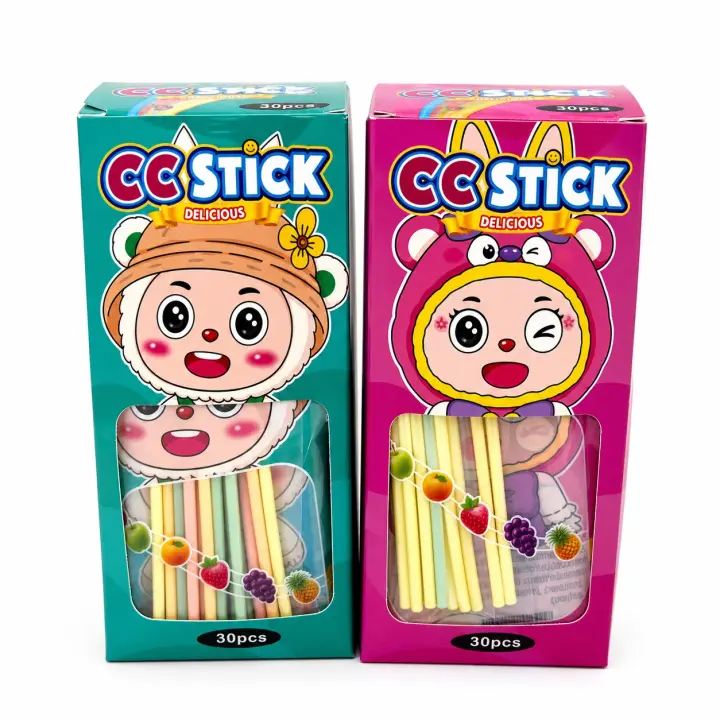
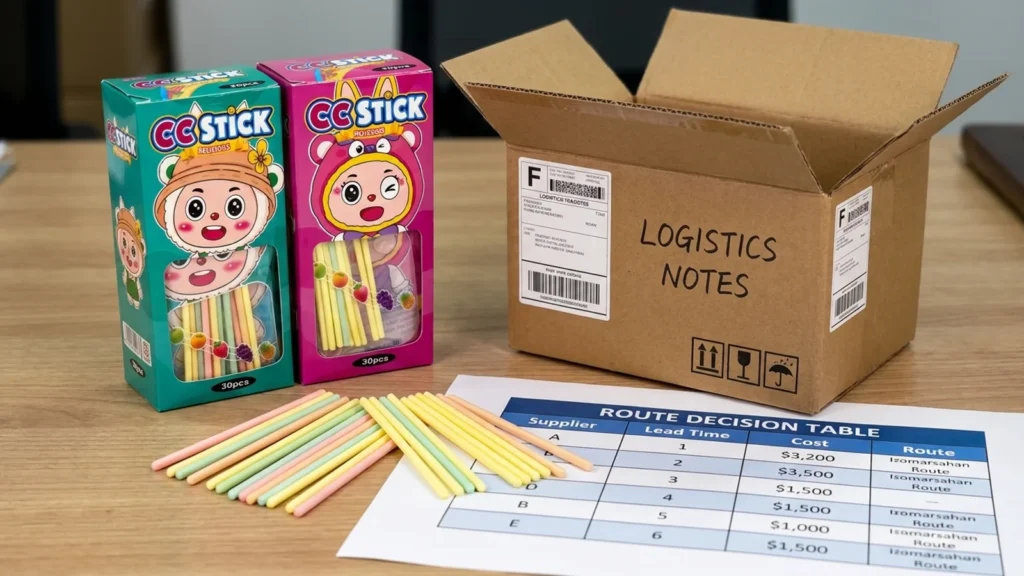
Choosing the YMX-011 pack route starts with outlet and resale logic: display boxes suit impulse and value-retail shelves while loose bulk suits repack and trade mixing; lock carton and sample facts before quoting. KidStar SKU YMX-011 is a useful example because it is a 15.5 g hard candy packed as 30 pcs x 20 display boxes/carton with carton dimensions listed as 44 x 26 x 38.2 cm in the current product library. That means the line ships as a retail-facing display program, and the buyer who treats it as loose bulk is already changing the commercial route without saying so.
Importers, distributors, wholesalers, and private-label buyers usually hit the same wall: they ask for a price before deciding whether the product should move as display boxes, as loose bulk for repacking, or as part of a mixed program. The supplier then guesses, and the first quote does not match the real route. The fix is to name the outlet and resale job first, then choose the pack route, then quote.
Start with the outlet and resale job
The display box and the loose-bulk route are not two versions of the same candy. They are two different commercial products with different carton logic, different sample questions, and different quote assumptions.
- an impulse checkout program needs the display box to do the selling
- a value-retail shelf program needs a clean display and reorder logic
- a cash-and-carry route needs the carton to break down easily for resale
- a repack or trade-mixing buyer may want loose bulk to build own packs
- a future private-label program is a separate conversation until the stock route proves useful
The exact YMX-011 product page should anchor the discussion, and the product catalog is the right place to compare related hard candy value lines. But the route decision should not start with the catalog. It should start with the shelf, the counter, or the repack room where the product will be sold.
Use a decision table before you choose the route
The fastest way to test whether YMX-011 should ship as display boxes or loose bulk is to map the buyer scenario against the facts that must be locked.
| Buyer scenario | Route that usually fits | What to lock for YMX-011 | Verdict signal |
|---|---|---|---|
| Impulse checkout | Display box | 30 pcs per box, box presentation, counter fit | Choose display when the box does the selling |
| Value-retail shelf | Display box | Display logic, reorder route, carton count per store | Choose display when shelf rotation matters |
| Cash-and-carry | Display box with easy breakdown | Carton breakdown, case count, resale units | Choose display when resellers resell the box as-is |
| Repack / trade mixing | Loose bulk | Unit format, repack quantity, packaging plan | Choose bulk when the buyer builds its own packs |
| Private-label bridge | Hold until stock route proves useful | Stock evidence, sample feedback, later packaging needs | Keep the route simple before adding customization |
This table keeps the route decision honest. A buyer does not need to solve every scenario in the first email, but the supplier should know whether YMX-011 is being tested as a display program or as loose product for repacking.
Why carton facts change between display and bulk planning
YMX-011 is packed as 30 pcs x 20 display boxes/carton with carton dimensions of 44 x 26 x 38.2 cm. Those facts do not automatically tell the buyer how many cartons fit a pallet or a container, because gross weight, pallet pattern, and market handling rules still need confirmation. But they do tell the buyer something more important: the standard route is display-led.
When the buyer switches to loose bulk, the conversation changes. Unit format still matters, but the display box, the box presentation, and the shelf logic become less relevant, and repack, protection, and carton handling become more relevant. The buyer should decide which route is being quoted before asking for carton or freight assumptions. The packaging customization page is useful only after the stock route question is answered, not before.
Lock samples and quote assumptions before the route choice
Samples should answer a defined route question, not a vague taste check. For a display-box program, the sample should confirm the box presentation and the unit in context. For a loose-bulk program, the sample should confirm the unit format and the repack plan. If the buyer cannot say which route the sample is testing, the sample answer will be too weak to justify the quote.
The samples page and the MOQ and lead time page work together here. Samples should prove the route, and MOQ and timing should confirm whether the project is a low-risk test or a repeatable buying path. Quote assumptions should match the named route, so the buyer should state the route before asking for price.
Signals that the route decision is too early
Sometimes the correct move is to stop and fix the brief before choosing display or bulk. The buyer should pause when:
- the outlet type is still vague
- the resale job is not named, such as "we will decide at retail"
- the buyer asks for both routes in one quote without saying which is primary
- the sample request does not say which route it tests
- the buyer is drifting into private-label wording before the stock route has proven itself
None of these signals mean YMX-011 is weak. They mean the route decision is still under-briefed, and quoting both routes now would only add noise to a commercial plan that cannot yet be held stable.
Turn the route decision into one next action
The strongest YMX-011 conversation ends with one precise move:
1. confirm that YMX-011 is the exact SKU under discussion 2. name the outlet and resale job 3. choose display box or loose bulk as the primary route 4. request a sample or quote update only for that named route 5. move to contact once the route brief is clear enough for a focused reply
That is what makes a pack-route decision useful. The goal is not to collect more hard candy options than the team can evaluate. The goal is to decide whether one exact stick candy route can move forward without being rewritten in the next round.
YMX-011 pack route decision checklist
- Anchor the route decision to exact SKU YMX-011.
- Keep the 30 pcs x 20 display boxes/carton and 44 x 26 x 38.2 cm carton visible in the discussion.
- Name the outlet and resale job before choosing display or bulk.
- Use the decision table to separate impulse, value-retail, cash-and-carry, and repack scenarios.
- Use samples to prove the chosen route, not only the flavor.
- Confirm MOQ and timing on the MOQ and lead time page after the route is named.
- Move to packaging customization only after the stock route has proved useful.
If you want KidStar to review whether YMX-011 fits your display-box or loose-bulk program, send the market, outlet type, resale job, quantity direction, and timing through the contact page. That helps the team answer with a cleaner pack route instead of a generic hard candy quotation.