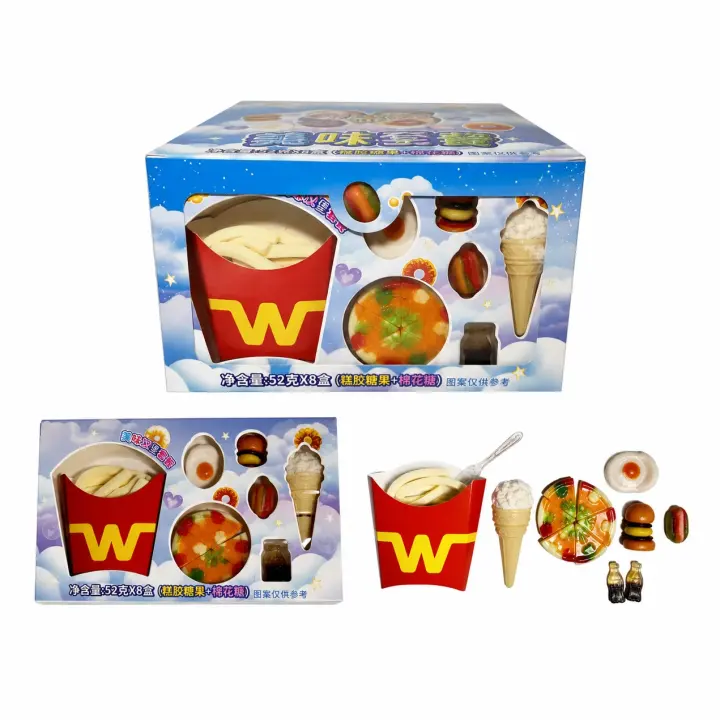
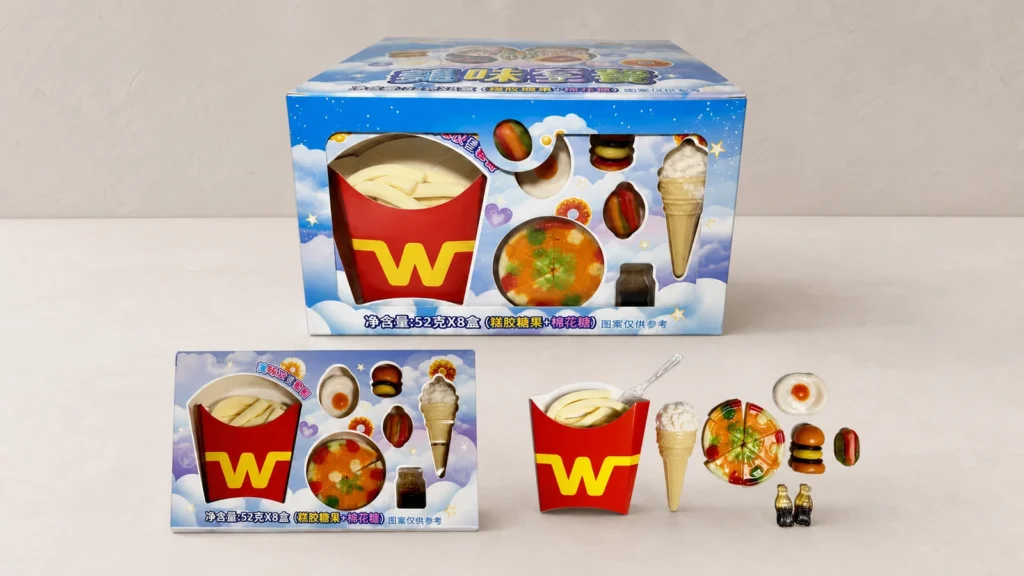
A food-shaped candy assortment should be approved as eight controlled component slots, not as one attractive product photo. KidStar YMX-166 Novelty Candy Set is listed as 52 g × 8 pieces × 12 display boxes, giving importers and distributors a concrete set structure to sample, count, document, and quote.
The direct answer is to match every component slot to the same dated product version, then approve the set weight, component identity, artwork, display loading, destination file, and substitution rule. The current product image is useful identification evidence, but it does not by itself prove a fixed flavor list, ingredient file, retail claim, certification, or private-label capability.
Start with the exact YMX-166 set version
Create one version code that follows the product from inquiry through sample, quotation, artwork, and purchase order. At minimum, record:
- SKU YMX-166 and the listed name Novelty Candy Set
- listed 52 g set basis
- eight-piece set structure
- 12-display-box carton route
- sample date and sample photographs
- component map revision
- destination country and sales channel
- stock-artwork or requested-artwork route
- reviewer and approval date
Do not carry an approval forward when the image, assortment, component weight, display, or artwork changes. A buyer may still decide that the revised set is commercially suitable, but it should receive a new version code and a new evidence file.
Approve eight component slots separately
The safest way to review a mixed set is to give each physical position a temporary slot number. The slot is an approval device; it does not claim that a particular shape or flavor will always occupy that position.
| Slot | Buyer should record | Evidence to retain | Hold condition |
|---|---|---|---|
| 1 | Visible form, color, individual wrap, and sampled identity | Closed and opened photos | Identity cannot be matched |
| 2 | Visible form, color, individual wrap, and sampled identity | Closed and opened photos | Unapproved substitution appears |
| 3 | Visible form, color, individual wrap, and sampled identity | Closed and opened photos | Damage affects presentation |
| 4 | Visible form, color, individual wrap, and sampled identity | Closed and opened photos | Component is missing |
| 5 | Visible form, color, individual wrap, and sampled identity | Closed and opened photos | Version differs from the quote |
| 6 | Visible form, color, individual wrap, and sampled identity | Closed and opened photos | Ingredient file is unresolved |
| 7 | Visible form, color, individual wrap, and sampled identity | Closed and opened photos | Artwork file is not controlled |
| 8 | Visible form, color, individual wrap, and sampled identity | Closed and opened photos | Set cannot be repeated as approved |
After the slot check, reconcile the complete set to the quoted 52 g basis and the agreed packing method. A component photo should never be treated as a weight certificate or a final formulation record. Ask KidStar to confirm the current commercial version against the physical sample and quote.
Pair every product image with usable data
GS1’s current Product Image Specification describes product images and their associated metadata as part of consistent digital commerce information. That principle matters to a wholesale assortment: an image helps the buyer recognize the set, while the accompanying data tells the team which version, view, pack level, and item the image represents.
Build a simple evidence index with:
- one full-set front view
- one full-set reverse view where relevant
- one image of all eight pieces together
- one numbered component map
- one loaded display-box view
- one shipping-carton view when available
- file names tied to the YMX-166 version code
- date, owner, and approval status for each file
This prevents a frequent sourcing error: approving one photo, pricing another pack, and receiving artwork for a third version. The same discipline is useful when comparing a simpler single-format item such as the YMX-165 pressed candy buyer guide with a multi-component novelty set.
Separate set integrity from flavor and compliance files
Set integrity asks whether all eight approved components are present and presented correctly. Product and destination review asks what each component contains, how it is labelled, and what the responsible importer needs for the target market. Those are related but different decisions.
Before release, the buyer should request the current applicable files for the exact sampled version, then review them with the importer, broker, retailer, or qualified adviser as appropriate. Do not infer ingredient suitability, allergen status, shelf life, certification, legal classification, or destination compliance from the novelty shapes.
Use the candy import document guide to organize document requests. It is a request framework, not proof that a particular product already meets an unseen market requirement.
Lock the display and carton hierarchy
The listed route is 52 g × 8 pieces × 12 display boxes. A quotation should state exactly what each number means in the approved version. Confirm whether 52 g refers to the complete consumer set, how the eight components are arranged, how the display box is counted, and whether the carton quantity is 12 display boxes.
Then check the physical route:
- eight components are present in every checked set
- components remain in their intended positions after transit handling
- the consumer unit opens and closes as expected
- the display is stable, accessible, and countable
- outer markings match the commercial documents
- carton measurements and gross or net weight used for logistics are current
The retail-ready confectionery pack guide can help the team distinguish consumer unit, display unit, and shipping carton instead of collapsing them into one ambiguous pack description.
Define substitutions before the quotation
For an assortment, “mixed” is not a complete purchasing instruction. The buyer should choose one of these rules in writing:
| Assortment rule | Meaning | Commercial consequence |
|---|---|---|
| Fixed eight-slot map | Every set follows the approved map | Any change requires buyer approval |
| Controlled alternatives | Named alternatives may replace named slots | Quote and evidence must list the allowed substitutions |
| Production mix | Components may vary within an agreed boundary | Buyer accepts variation only inside that written boundary |
| New custom assortment | Buyer requests a different component or artwork plan | Treat as a new version and reconfirm feasibility |
This table does not promise that every rule is available. It gives the buyer a precise way to ask KidStar which route is feasible for the requested quantity and production plan.
Run a measurable sample and shelf decision
Use the samples route to obtain physical evidence before a wholesale decision. On receipt, count complete sets, record component exceptions by slot, check display condition, and keep photos tied to the sample date.
For a retail test, define the outlet group, test period, price, placement, displays received, complete sets sold, damaged sets, component complaints, and replenishment events. End with one decision: repeat the approved version, revise one controlled variable, request a new sample, or stop the trial. Do not present one buyer’s test as a general market trend.
Send one controlled YMX-166 brief
YMX-166 is ready for a focused discussion when the buyer provides the destination, channel, 52 g × 8 × 12 reference, sample version, eight-slot component rule, artwork route, requested quantity, evidence needs, and open destination questions.
Send that file through the contact page. KidStar can then answer against one identifiable food-shaped candy assortment rather than a vague request for “mixed novelty candy price.”
Sources reviewed
- KidStar YMX-166 Novelty Candy Set product record, reviewed August 31, 2026.
- GS1 Product Image Specification, version 5.0.0, last modified July 17, 2026 and reviewed August 31, 2026.