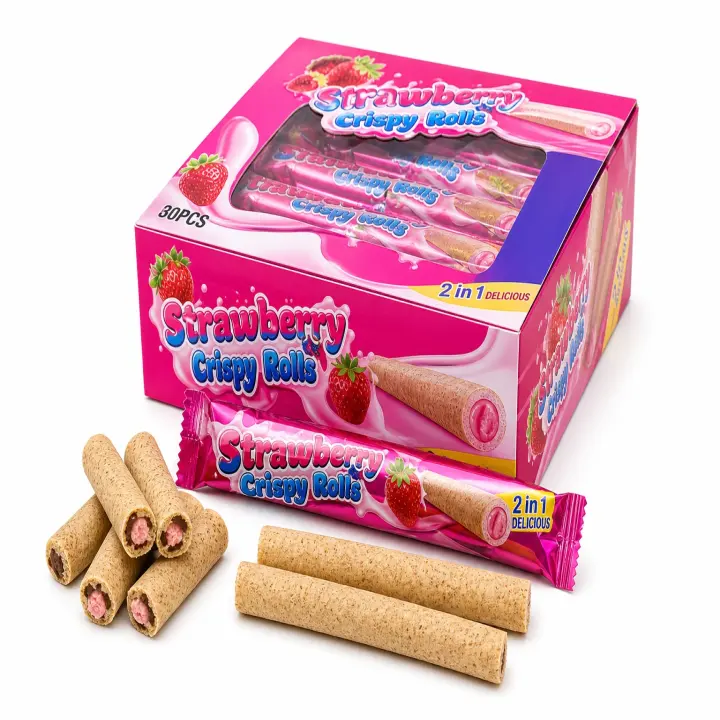
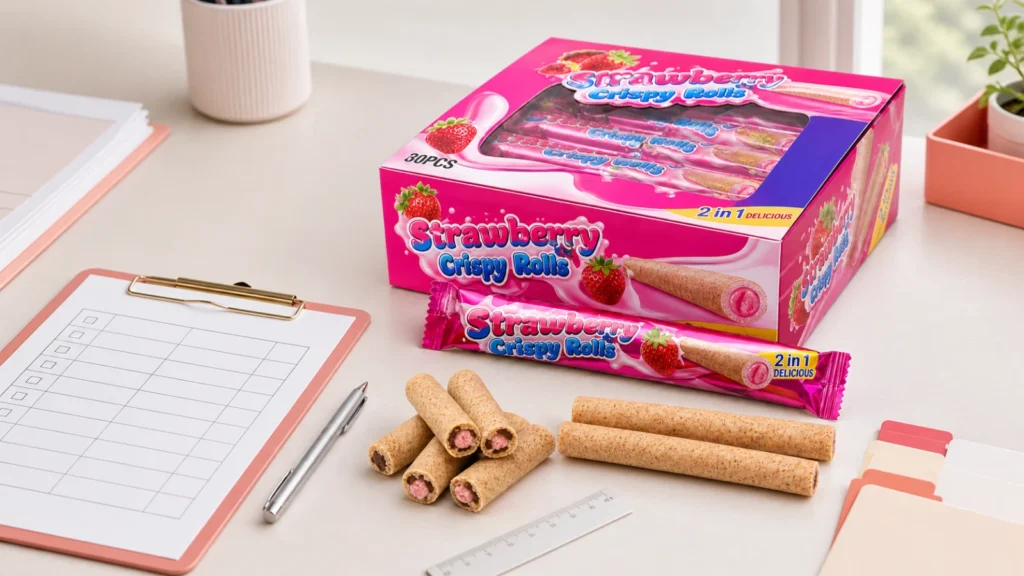
A candy purchase order checklist should lock the buyer’s commercial instruction before the supplier turns it into a proforma invoice or order confirmation. For KidStar YMX-060 Dual-Flavour Crispy Roll Candy, the buyer should state the exact SKU, listed pack route, quantity, currency, Incoterm rule and named place, requested delivery window, pack version, and document or approval references.
The direct answer is to use eight controlled fields and reject ambiguous shorthand. A purchase order that says only “crispy roll candy, same as quote” leaves too much room for version drift. This workflow is deliberately upstream of the existing PI review: the PO states what the buyer intends to order; the supplier’s PI should be checked against that instruction before payment.
Anchor the PO to one exact YMX-060 baseline
The current YMX-060 product page lists the reference route as:
- SKU: YMX-060
- product: Dual-Flavour Crispy Roll Candy
- pack hierarchy: 30 pieces × 20 display boxes per carton
- listed carton size: 66.5 × 20 × 41 cm
These fields identify the product route; they are not a final commercial promise. The page does not by itself lock order quantity, price, trade term, delivery date, label scope, certificate scope, or custom-pack feasibility. Those belong in the actual PO and supplier confirmation.
Attach or reference the approved quote version and sample or artwork record where applicable. Avoid using a photo alone as the product identifier: images help reviewers recognize the item, but the text should still name the SKU and pack hierarchy.
Lock the eight fields in a single order table
Use one table that the buyer, supplier, finance team, and forwarder can read without reconstructing old messages.
| Controlled field | What to write for the order | Why it must be explicit |
|---|---|---|
| 1. Product | YMX-060 Dual-Flavour Crispy Roll Candy | Prevents substitution with another crispy-roll line |
| 2. Pack version | 30 pieces × 20 display boxes/carton baseline, plus any approved change reference | Keeps stock and changed versions separate |
| 3. Quantity | Number of cartons and corresponding display quantity | Removes unit-versus-carton ambiguity |
| 4. Currency and price basis | Agreed currency, unit basis, and quote reference | Lets finance compare the PO with the supplier document |
| 5. Incoterm | Exact Incoterms® 2020 rule plus named place or port | Allocates tasks, costs, and risks more clearly |
| 6. Delivery requirement | Requested ready date or delivery window, marked subject to confirmation | Avoids treating an unconfirmed date as a promise |
| 7. Pack and mark approvals | Standard route or named artwork, label, barcode, and carton-mark version | Stops production against an outdated file |
| 8. Document and approval references | Required review items, responsible approver, quote/sample/artwork IDs | Creates a traceable acceptance basis |
If any field is still open, mark it TBC with an owner and deadline. Do not silently fill the gap with a prior-order assumption.
Write the Incoterm with the named place
The International Chamber of Commerce states that the Incoterms® rules comprise 11 three-letter trade terms that clarify tasks, costs, and risks in the delivery of goods. ICC identifies Incoterms® 2020 as the current edition, effective from January 1, 2020.
Writing only “FOB” or “CIF” is incomplete operationally. The PO should identify the rule, named port or place, and edition—for example, “FOB [named port], Incoterms® 2020”—after the parties have agreed that route. This article is not recommending one term for every order and is not legal advice. The buyer should choose the term with its supplier, logistics provider, and advisers according to the actual shipment.
The freight and FOB preparation guide helps buyers collect the destination and cargo inputs before requesting a freight-linked price.
Separate requested dates from confirmed dates
A buyer PO may contain a requested cargo-ready date or delivery window. Label it as requested until the supplier confirms it. The same distinction applies to production slots, vessel dates, customs clearance, and in-store deadlines.
Use a simple status vocabulary:
- requested — the buyer’s target
- supplier-confirmed — accepted by the supplier in writing
- buyer-approved — accepted by the buyer after checking the response
- revised — changed with a dated reason and owner
This prevents a target date copied from an email from becoming an accidental promise. It also gives both sides a clean record when an artwork approval or document question changes the schedule.
Reconcile the supplier PI back to the PO
Once the supplier sends a PI, compare it line by line with the approved PO. Do not replace the PO file with the PI and assume they match.
The reconciliation should confirm:
1. exact YMX-060 name and SKU 2. same pack hierarchy and approved version 3. same carton quantity 4. same currency and price basis 5. same Incoterm, named place, and edition 6. confirmed timing language rather than the original request alone 7. same artwork, label, carton-mark, and sample references 8. correct beneficiary and payment instructions through a trusted verification route
The detailed candy PI deposit checklist covers the next control point. Keeping the PO and PI as separate records makes any difference visible before deposit.
Use the internal follow-up signal carefully
KidStar’s August 25 follow-up review found 77 open cases tagged around payment or PI handling. This is an internal workflow count, not a market statistic and not evidence that all 77 cases share the same cause. It is still a useful operational signal: order handoffs deserve a structured control before finance action.
The checklist should not be used to invent missing facts or hurry a buyer. Its purpose is to expose open fields early, assign an owner, and preserve the approved version.
Final pre-release checklist
Before issuing the PO, confirm that:
- YMX-060 and the exact product name appear together
- quantity is written in cartons and the pack hierarchy is shown
- currency, price basis, and quote version match
- the Incoterm includes the named place and Incoterms® 2020 edition
- requested and confirmed dates are visibly different
- the pack version points to the approved file or standard route
- document questions are stated without assuming certification or regulatory outcomes
- all TBC fields have an owner and deadline
- the buyer has named the person authorized to approve revisions
- the supplier PI will be reconciled before deposit
Send a controlled YMX-060 order brief
If YMX-060 is moving from quotation into order review, send the destination, carton quantity, agreed price reference, Incoterm and named place, requested timing, pack version, and open approval items through KidStar contact. Ask for the supplier response to repeat those fields so the PO-to-PI check is straightforward.
Sources reviewed
- KidStar YMX-060 product record — first-party SKU and pack reference, reviewed 2026-08-25.
- International Chamber of Commerce Incoterms® rules — official definition and current edition information, reviewed 2026-08-25.
- KidStar candy PI deposit checklist — related downstream control, reviewed 2026-08-25.