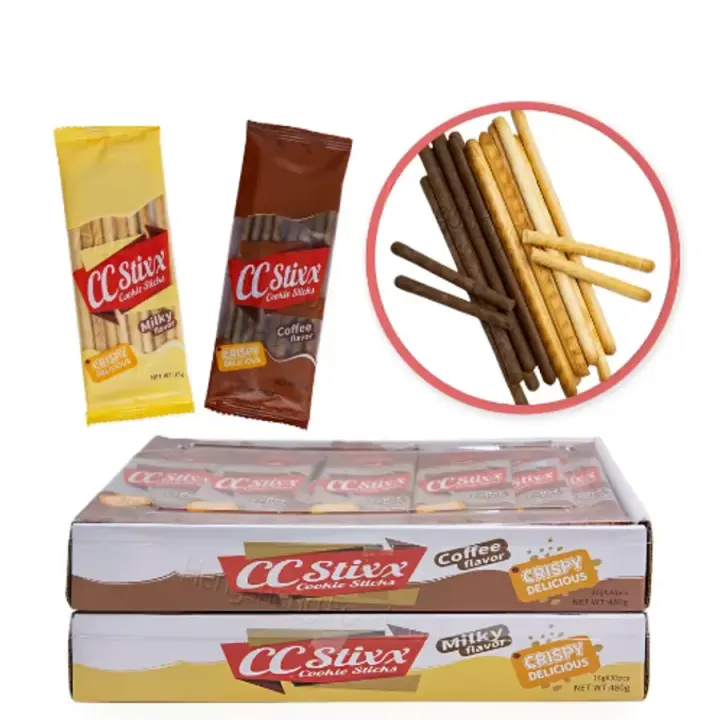
A biscuit stick candy RFQ should not move straight from a catalog image to price comparison. For KidStar SKU YMX-219, the buyer should first request the current ingredient and allergen file, confirm the target-market label route, and define how the sample will be checked for pack integrity and breakage. The current product record lists 15 g × 30 pieces × 20 display boxes per carton.
The direct answer is to keep regulatory evidence and commercial acceptance in the same RFQ pack: one document set should say what the product and label contain, while one physical-sample checklist should say what condition the importer will accept. The product name or image alone is not proof of a specific allergen profile, and no buyer should infer “contains,” “free from,” or cross-contact status without the current supplier documentation for the exact version being quoted.
Separate facts already known from files still required
The YMX-219 product page gives a useful commercial anchor:
- exact SKU: YMX-219
- name: Original Finger Biscuit Sticks
- category: Biscuit Dip Candy
- listed unit weight: 15 g
- retail packing: 30 pieces per display box
- export packing: 20 display boxes per carton
Those fields help the supplier identify the item. They do not replace an ingredient declaration, allergen statement, label artwork, shelf-life file, or market-specific review. Because “biscuit” is part of the product name, buyers should ask the question early, but they should not write wheat, milk, soy, sesame, or any other allergen into their own documents until the exact current file confirms it.
The same evidence rule applies to claims such as halal, vegan, gluten-free, or allergen-free. If a claim is needed, request the supporting document and market applicability. Do not turn a desired positioning into a product fact.
Why the allergen file belongs before artwork approval
The U.S. FDA’s January 2025 final allergen-labeling guidance explains that foods regulated under the FD&C Act must declare major food allergens using the name of the food source when the legal conditions apply. It also notes that FDA guidance expresses the agency’s current thinking and is not itself a substitute for the cited legal requirements.
The European Commission’s February 2026 allergen page lists 14 allergens that must be indicated when used as ingredients in foods sold in the EU and says allergens must be emphasised within the ingredients list. It also states that precautionary “may contain” wording should not replace good manufacturing practices and should be based on risk assessment.
For an importer, the practical lesson is not to copy a U.S. statement into an EU artwork file or vice versa. The RFQ should ask for the current product evidence, then route the proposed label through the buyer’s target-market regulatory review. KidStar can provide product-side information, while the importer remains responsible for confirming the final requirements in the destination market.
Decision table: the minimum YMX-219 approval pack
| RFQ item | What to request | Why it matters | Hold condition |
|---|---|---|---|
| Product identity | SKU YMX-219 and current 15 g specification | Keeps the quote tied to one version | Supplier reply does not identify the exact version |
| Ingredient file | Current ingredient list for the quoted sample | Supports label and buyer review | File and physical sample cannot be matched |
| Allergen information | Declared allergens and relevant cross-contact assessment or statement | Prevents assumptions from the product name | Buyer is asked to infer status from a photo |
| Label draft | Target-market language and mandatory-information layout for review | Connects product evidence to the retail unit | Artwork starts before required text is confirmed |
| Display configuration | 30 pieces per display and 20 displays per carton | Makes the commercial route comparable | Counts differ across quote, sample, and packing sheet |
| Breakage check | Agreed sample inspection method and acceptance record | Makes fragile-stick condition visible | No one records intact, cracked, or crushed units |
| Quote basis | Quantity, destination, packaging route, and revision date | Stops price changes from appearing unexplained | Supplier offers cannot be compared on the same assumptions |
This table deliberately separates regulatory records from physical-condition records. A correct label does not prove the sticks will arrive in acceptable condition, and a clean sample photo does not prove the label file is ready.
Define a breakage check without inventing an outcome
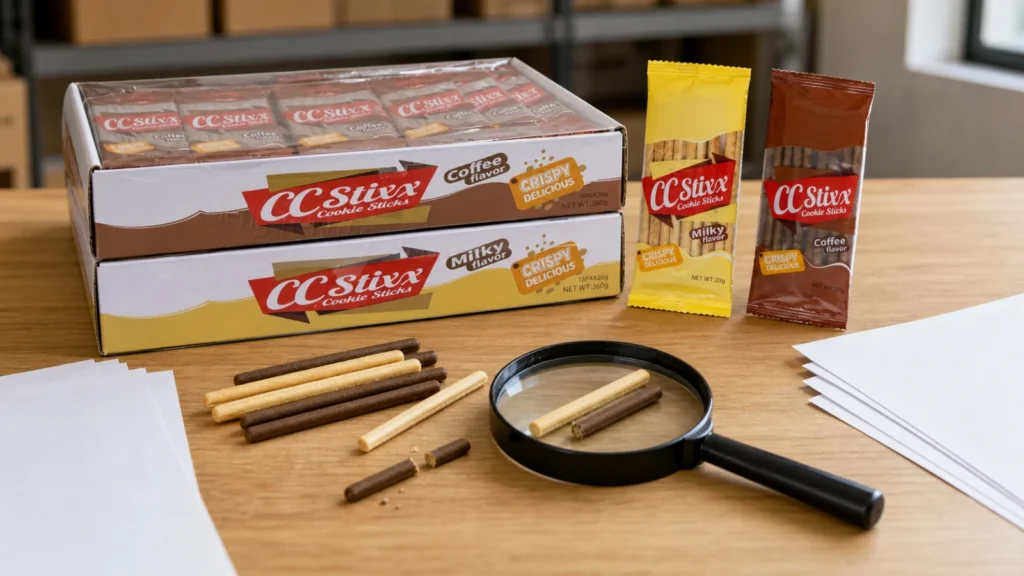
The KidStar product record does not publish a universal breakage tolerance for YMX-219, so the article should not invent one. The buyer can still build a practical inspection routine and ask the supplier to respond.
For the first sample or pilot carton:
- photograph the parcel and outer carton before opening
- record the number of display boxes reviewed
- compare the received unit and display counts with the packing record
- classify visible condition consistently, for example intact, cracked, or crushed
- photograph representative findings without selecting only the best units
- note whether damage appears at unit, display, or carton level
- agree what evidence would trigger packaging review before a repeat order
This is not a promise of zero breakage and not a substitute for a formal inspection plan. It is a buyer-side method for making the sample decision reproducible. If the importer needs a contractual tolerance, sampling standard, or third-party inspection, that requirement must be written and agreed separately.
The samples page can be used to frame the first physical review. If the buyer wants a more extensive order inspection, the scope should be clarified before the quotation is treated as final.
Keep one version number across product, label, and quote
Many approval errors are version errors. Purchasing approves one quote, marketing edits another artwork file, and the warehouse receives a carton linked to a third packing sheet. A simple version block can prevent that.
Include these fields on the YMX-219 approval sheet:
- product version or sample reference
- ingredient-file date
- allergen-statement date
- label-artwork revision
- approved unit weight and counts
- display and carton reference images
- quote revision and currency basis
- reviewer, date, and open questions
Then use the same identifiers when discussing MOQ and lead time or moving into packaging customization. If one file changes, reopen only the affected approval instead of assuming the complete RFQ remains valid.
Checklist before comparing biscuit stick offers
- Anchor every file to YMX-219.
- Confirm the current 15 g × 30 pieces × 20 display boxes route.
- Request the ingredient and allergen evidence for the exact quoted version.
- Do not infer claims or allergen status from the product name, image, or category.
- Route the draft label through target-market review before approval.
- Define how physical samples will be checked and photographed for breakage.
- Put quantity, destination, and packaging assumptions on the quote comparison.
- Keep sample, label, packing sheet, and quotation under one version block.
- Use samples and MOQ and lead time as connected steps, not separate conversations.
If you want KidStar to turn YMX-219 into a reviewable biscuit-stick RFQ, send the destination market, required label language, quantity direction, sample purpose, and document checklist through the contact page. The team can then respond to one controlled product version instead of a price request with missing compliance and condition criteria.
Sources reviewed
- FDA Food Allergen Labeling Guidance, Edition 5 — official U.S. guidance, issued January 2025; reviewed 18 August 2026.
- European Commission: Allergen Labelling in the EU — official EU food-safety source, updated 23 February 2026; reviewed 18 August 2026.
- KidStar SKU YMX-219 product record — first-party product library; reviewed 18 August 2026.
- KidStar samples — first-party buyer workflow; reviewed 18 August 2026.