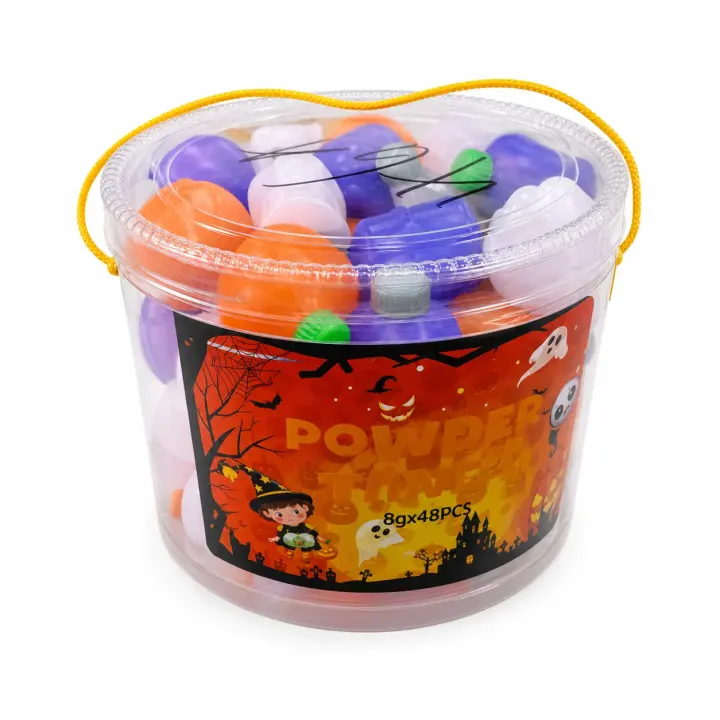
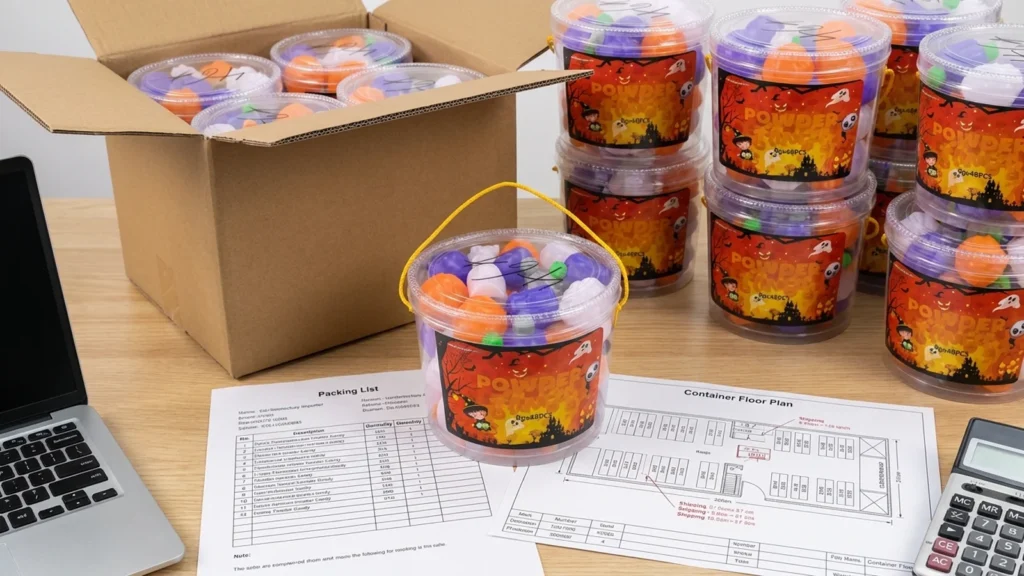
If a mixed confectionery container is planned, add YMX-004 powder candy jars only when the market, display role, carton count, and sample evidence are already named so the quote stays stable. KidStar SKU YMX-004 is a useful example because it is an 8 g powder candy packed as 48 jars x 12 tubs/carton with carton dimensions listed as 48.5 x 33 x 26 cm in the current product library. That means the line is not just a fun seasonal jar. It is a value-line, novelty-shape, sour product with a defined display route, and it earns a container slot only when the buyer can say what the jar is supposed to do in the destination market.
Importers, distributors, wholesalers, and private-label buyers usually make the mistake in reverse. They build the mixed container first from whatever looks interesting, then try to make the product work later. That sequence produces quote rewrites, weak seasonal timing, and cartons that do not fit the planned shelf route. The stronger sequence is to decide what the mixed container must prove, then ask whether a powder candy jar line belongs in it.
Start with the slot, not the jar
A mixed confectionery container is a commercial statement, not a collection of candy. The buyer should be able to say whether the container is testing a market, seeding a retail channel, building a repeat value-line program, or covering a seasonal window.
For YMX-004, that changes everything:
- a market-test container may accept one trial SKU with flexible display assumptions
- a retail-seeding container needs the jar route to match the outlet’s shelf and handling logic
- a repeat value-line program needs carton discipline so the line can be reordered cleanly
- a seasonal container adds timing pressure that the buyer must plan before quoting
The exact YMX-004 product page should anchor this discussion, and the wider product catalog is the right place to compare related novelty and value lines. But the container decision should not start with the catalog. It should start with the commercial job the container is trying to do.
Use a decision table before YMX-004 earns a slot
The fastest way to test whether YMX-004 belongs in a mixed container is to map the container scenario against the facts the buyer must lock.
| Container scenario | What the buyer is really trying to prove | What to lock for YMX-004 | Verdict signal |
|---|---|---|---|
| Market test | Whether a novelty sour jar route moves in the destination | Market, outlet type, display role, sample evidence | Add only if the market is named and a sample plan exists |
| Retail seeding | Whether the jar works on the planned shelf | Display box logic, unit format, carton count per store | Add only when the shelf route is concrete |
| Repeat value line | Whether the line can be reordered without rewrite | Standard pack route, carton dimensions, MOQ assumptions | Add when carton and reorder logic are clean |
| Seasonal window | Whether the jar can hit a fixed holiday date | Timing, production window, launch date | Add only when timing is realistic and agreed |
| Private-label bridge | Whether the buyer is already drifting into custom work | Stock route vs later packaging changes | Usually hold until the stock route proves useful |
This table keeps the container honest. A buyer does not need to solve every scenario in the first email, but the supplier should know whether YMX-004 is being tested as a simple stock jar or as the beginning of a more structured program.
Why carton logic and seasonal timing decide the jar’s fate
YMX-004 is packed as 48 jars x 12 tubs/carton. That is not a small detail. The buyer needs to know how many cartons fit the container, whether the display boxes survive handling, and whether the tub grouping matches the destination market’s shelf pattern.
Seasonal timing matters even more because YMX-004 is tagged as a seasonal and Halloween-oriented value line. A buyer who locks the holiday date after the quote has already been built invites a rushed revision. The practical move is to confirm the sample, the pack route, and the launch window before asking for the final container quotation.
The MOQ and lead time page is the right place to test timing assumptions, and samples should be used to prove the route rather than just the taste. A sample that only confirms flavor does not answer whether the jar and tub route will work in the planned container.
Signals that YMX-004 should stay out of the container
Sometimes the correct decision is to leave YMX-004 out of the mixed container and fix the brief first. The buyer should pause when:
- the destination market is still unnamed
- the display role is vague, such as "we will figure it out at retail"
- the carton count and container plan are not yet discussed
- the seasonal date cannot be confirmed
- the buyer is mixing stock-route evaluation with private-label ambitions before the stock line has proven itself
None of these signals mean YMX-004 is weak. They mean the container plan is still under-briefed, and adding the jar now would only add noise to a quote that cannot yet be held stable.
Turn the decision into one next action
The strongest mixed-container conversation about YMX-004 ends with one precise move:
1. confirm that YMX-004 is the exact SKU under discussion 2. name the market, outlet type, and display role 3. state whether the container is a market test, retail seeding, repeat value line, or seasonal window 4. request a sample or quote update only for that named route 5. move to contact once the container brief is clear enough for a focused reply
That is what makes a mixed-container decision useful. The goal is not to collect more novelty lines than the team can evaluate. The goal is to decide whether one exact jar route can move forward without being rewritten in the next round.
YMX-004 mixed-container checklist
- Anchor the container to exact SKU YMX-004.
- Keep the 48 jars x 12 tubs/carton route and 48.5 x 33 x 26 cm carton visible in the discussion.
- Name the container job: market test, retail seeding, repeat value line, or seasonal window.
- Confirm the display role and outlet type before quoting.
- Use samples to prove the pack route, not only the flavor.
- Confirm timing on the MOQ and lead time page before the seasonal window closes.
- Move to packaging customization only after the stock route has proved useful.
If you want KidStar to review whether YMX-004 fits your mixed confectionery container plan, send the market, channel, display role, quantity direction, and timing through the contact page. That helps the team answer with a cleaner container route instead of a generic powder candy quotation.