
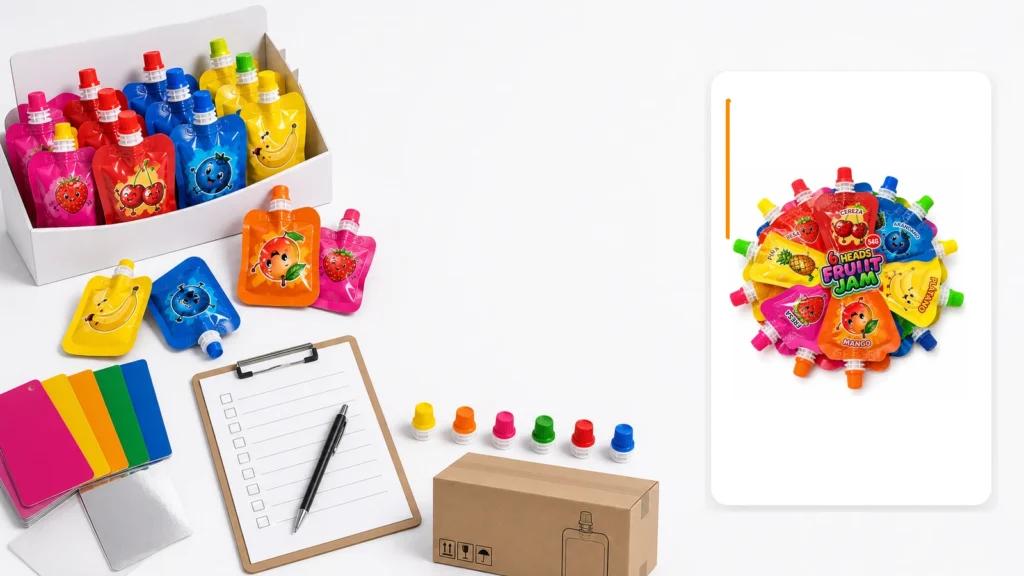
For import buyers searching for EU PPWR Article 71 guidance, the first task is to map every packaging level before artwork or price is approved. Regulation (EU) 2025/40 on packaging and packaging waste entered into force on 11 February 2025 and applies from 12 August 2026. For KidStar SKU YMX-127, that means reviewing the 54 g fruit jam dip candy set packed as 12 bags × 12 display boxes/carton as one packaging route: spouted pouch, closure parts, grouped retail presentation, and outer shipment carton.
That does not mean every importer must become a packaging lawyer. It does mean buyers should stop asking for price and artwork before they have mapped the packaging levels and the data each level requires. The faster the buyer separates confirmed supplier facts from buyer decisions and compliance-review items, the easier it becomes to keep an EU dip-candy program moving without overclaiming.
Read the PPWR timing correctly before you brief the supplier
The rule change is important, but the buyer still needs to read it in a disciplined way. Article 71 of the regulation states that the PPWR applies from 12 August 2026. The European Commission’s June 10, 2026 guidance notice also repeats that date and explains that stakeholders had already raised practical interpretation questions. For a B2B buyer, the takeaway is simple: by late July 2026, an EU-bound packaging review should already be collecting the data that the importer, brand owner, and downstream adviser will need after the application date.
That is different from saying “every candy pack is suddenly non-compliant” or “all artwork must change immediately.” The more accurate reading is narrower:
- the PPWR covers packaging regardless of material or origin
- buyers should identify every packaging level earlier
- environmental or recyclability wording should not be added until the supporting facts are reviewed
- grouped retail packaging and transport packaging should be mapped as part of one route, not as disconnected files
For YMX-127, that means a buyer should treat the pouch, cap/closure, display presentation, and master-carton route as one packaging system rather than as one fun candy sample plus a later logistics task.
Map every packaging level in the YMX-127 route
The reason YMX-127 is a useful example is that it has more than one packaging decision inside one SKU. The buyer is not only sourcing fruit jam. The buyer is reviewing a consumer-facing spouted bag, the closure logic, the grouped display route, and the outer carton route that moves through import and local handling.
Start with a packaging map like this:
- consumer unit: the spouted pouch and its closure parts
- grouped retail level: the display-box or shelf-facing presentation
- transport level: the case route of 12 bags × 12 display boxes/carton
- supporting data layer: dimensions, weights, material descriptions, print zones, and open technical questions
The YMX-127 product page should anchor the exact SKU being reviewed. The product catalog can support comparison if the buyer is still deciding whether a spouted dip route is better than another novelty format. But the regulatory review should always start from one fixed packaging hierarchy, not a broad category label like “dip candy.”
Use a decision table to separate facts from review items
The biggest packaging-review mistake is mixing confirmed data with future assumptions. Use a table before artwork or compliance wording moves forward.
| Review area | What to collect now for YMX-127 | What should stay in review | Why this matters |
|---|---|---|---|
| Spouted pouch | Material description, fill format, dimensions, weight, print area | Final destination-market interpretation of packaging obligations | The buyer needs factual pack data before any EU-facing claim is discussed |
| Closure parts | Type, color, fit, and any separate-component notes | Whether any extra consumer information is needed in market | Small closure details can affect sorting, handling, and product presentation |
| Display route | Box dimensions, unit count, opening method, and shelf logic | Whether the standard display is final for this market | Grouped packaging is part of the EU-facing route, not only a warehouse detail |
| Transport carton | Case count, dimensions, marks, and handling route | Pallet or retailer-specific exceptions still under review | Freight and local handling depend on the real carton path |
| Environmental wording | Nothing beyond documented supplier facts | Recyclability, sustainability, or reduced-waste claims not yet cleared | It prevents unsupported claims from entering artwork or sales copy |
This table keeps the project usable. It allows purchasing, design, and compliance review to work from the same base without pretending that one file already answers every legal question.
Use the Commission guidance to keep implementation practical
The European Commission issued guidance in June 2026 because businesses and authorities had already asked how selected PPWR provisions should be interpreted in practice. Buyers should use that as a signal to organize the file more carefully, not as a reason to invent strict rules that are not yet supported by the cited sources.
For a spouted dip candy set, the practical discipline is:
- keep packaging facts in one working sheet
- mark every unverified environmental statement as “review required”
- reserve artwork space without turning pending assumptions into claims
- document who owns each next step: supplier, importer, packaging reviewer, or destination-market adviser
The certifications and compliance page can support product and document coordination, but it does not automatically clear an EU market claim for every packaging configuration.
Ask for an EU-ready data pack before you ask for a final quote
The first supplier request does not need to resolve the whole regulation. It should create an EU-ready data pack for YMX-127 so the importer can review the right things before locking the project.
Ask for:
- the exact SKU and packaging hierarchy
- current pouch, closure, and grouped-pack dimensions
- unit count and case count
- images of the consumer unit and grouped retail route
- any available packaging specifications or technical descriptions
- open questions that still need importer-side or adviser-side review
The packaging customization page is useful if the buyer is deciding between a stock packaging route and a later adapted route. The MOQ and lead time page is useful if the importer is trying to separate a pilot discussion from a repeat-order discussion. Both matter because regulatory timing is easier to manage when the buyer is honest about what stage the project is actually in.
Know when to hold the launch instead of forcing the artwork
Buyers should hold an EU-bound YMX-127 launch when:
- the packaging hierarchy is still incomplete
- the importer has product photos but not real packaging facts
- the display route may change for the target channel
- environmental or recyclability wording is being drafted from assumption rather than data
- the buyer still has not decided whether this is a pilot route or a repeatable line
In those cases, the best next step is not to reject the SKU. It is to slow the file down before unsupported claims or rushed artwork create a bigger problem later. A short delay at the packaging-data stage is usually cheaper than redesigning grouped packaging after a market reviewer asks for evidence that was never collected.
Build the next YMX-127 message around packaging evidence
The strongest next message to the supplier is not “please confirm compliance.” It is an operational brief that says:
- we are reviewing YMX-127 for an EU-bound route
- we need the pouch, closure, display-box, and carton data separated clearly
- we will keep environmental wording in review until the factual pack data is complete
- please quote or update the project on that exact basis
That is the level of specificity that helps a spouted dip-candy project move forward without manufacturing confidence that the current file does not yet support.
Use YMX-127 only with a packaging file you can defend
KidStar SKU YMX-127 can still be a workable EU-facing dip-candy program, but by July 22, 2026 the buyer should already be organizing the packaging record as if the August 12, 2026 application date matters. That means mapping the full packaging hierarchy, keeping claims separate from facts, and asking for an EU-ready data pack before artwork is treated as final.
If you want KidStar to review whether YMX-127 has the right packaging-data base for an EU route, send the destination market, outlet type, and packaging questions through the contact page. That helps the team answer with the right evidence request instead of a generic novelty-candy quote.