For importers and distributors, a candy sample should do more than prove that the product tastes good. It should help the buyer approve the product format, packaging route, label questions, and next quotation step without restarting the project.
This checklist helps B2B buyers review candy samples for market fit, retail presentation, documentation, and commercial readiness before scaling an order.
Latest market insight
- FDA says it will not enforce the Food Traceability Rule before July 20, 2028, so sample packs should already carry the lot and product details buyers will need later.
- The White House ordered the end of duty-free de minimis treatment for all countries on July 30, 2025, making sample rounds and re-shipments less forgiving on timing and paperwork.
- The 2026 Sweets & Snacks trend reveal showed how quickly format and flavor launches are moving, so sample review now needs faster commercial feedback, not only taste comments.
Sources reviewed: FDA, The White House, Sweets & Snacks.
Start with the commercial question behind the sample
A candy sample should answer one business question at a time. Is the buyer checking flavor acceptance, shelf presentation, fill weight, wrapper quality, carton fit, or whether the SKU can survive market registration review? When the objective stays vague, the supplier sends a polite box of products but the buyer still cannot move to a realistic quote or PI.
Before requesting samples, define the route clearly:
- stock item screening
- private-label format check
- compliance or label review
- retailer pitch or shelf test
- final confirmation before deposit
That short brief is usually enough to stop the sample round from becoming a generic catalog exercise.
Match the sample pack to the intended commercial pack
Sample problems often start when the buyer tests one format and intends to order another. A bulk gummy pouch does not answer the same questions as a retail jar. A plain white flow-wrap does not confirm the same risk as a display box with date-code space, barcode area, and importer line.
If the project may move into custom packaging, ask for samples that reflect the likely commercial route as closely as practical:
- the right candy family and size
- a realistic unit count or fill weight
- the intended pack style
- visible date-code or lot-code position
- carton or inner-pack logic where relevant
The goal is not to demand finished artwork too early. It is to avoid approving the wrong sample and then restarting the conversation.
Build one sample review sheet before the parcel arrives
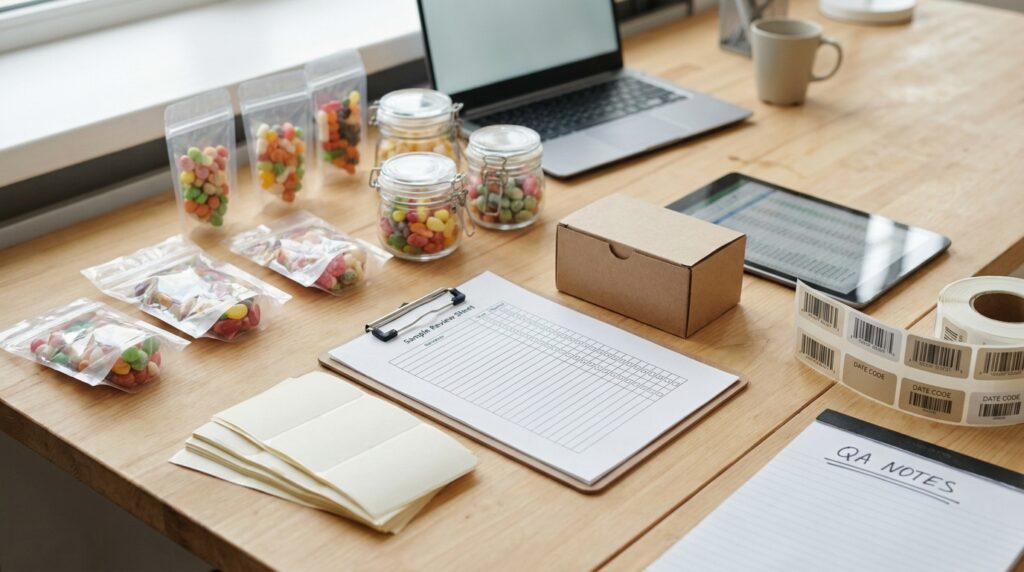
Most sample feedback becomes unusable because it lives in chat fragments. A better workflow is to prepare one internal review sheet in advance so sales, procurement, QA, and compliance are looking at the same criteria.
Useful review fields include flavor, texture, appearance, pack strength, seal quality, retail fit, age positioning, label questions, and whether the sample supports the expected price point. If several markets are involved, add destination-specific notes so the team does not mix EU, GCC, African wholesale, or U.S. requirements into one vague reaction.
Include documents and label points in the sample round
Samples should travel with enough information to support a real decision. That usually means product name, tentative ingredient direction, shelf-life range, storage note, carton quantity, and any available certificate or compliance reference the buyer needs for the next stage.
The importer still needs to verify local market rules, but the sample round is where buyers should start checking:
- label language expectations
- halal or other certification questions
- barcode and importer-line position
- production date and expiry format
- carton marks and traceability references
If those questions wait until after the sample is approved, the project often slows down again right before quote confirmation.
For a U.S.-bound parcel, use the U.S. candy-sample pre-dispatch checklist alongside this approval review.
Decide what must be true before the sample becomes a PI discussion
A good sample round should end with a decision, not only a comment like "looks okay." Buyers should decide whether the sample is strong enough to move into pricing, whether packaging must change first, or whether another SKU family is needed. That is what keeps sampling connected to commercial progress.
This is also the point where buyers can separate a serious sourcing path from a pleasant but low-signal exchange.
Quick checklist before you ask for a quote
| Sample area | What to confirm | Why it matters |
|---|---|---|
| Commercial goal | Shelf test, distributor screening, compliance review, or pre-order confirmation | Keeps the sample round tied to one decision instead of general curiosity |
| Product format | Candy type, flavor set, weight, and piece count | Prevents testing one SKU family and quoting another |
| Packaging route | Pouch, jar, display box, flow-wrap, or bulk route | Changes presentation, carton logic, and label review questions |
| Label and docs | Date-code position, importer line, barcode, shelf-life note, certificates | Reduces delays when the buyer moves from sample to quote |
| Feedback owner | Who signs off taste, packaging, compliance, and commercial fit | Helps the team turn sample comments into a clear next step |
Related KidStar pages
- Review suitable products on Product Catalog.
- Start the sample route on Confectionery Samples.
- Compare commercial pack options on Packaging Customization.
- Check timing and quantity basics on MOQ and Lead Time.
- For label and document questions, visit Certifications and Compliance.
Send a clearer brief
If you are preparing a sample request, send KidStar your market, candy format, target pack route, the decision you need from the sample, and your launch timing. The team can respond with a more focused sample-and-quote path instead of a generic parcel list.