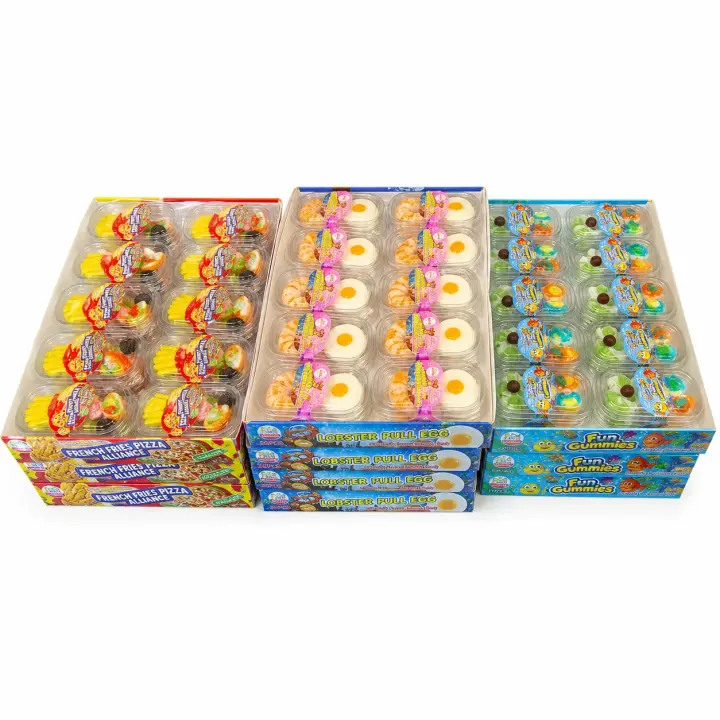
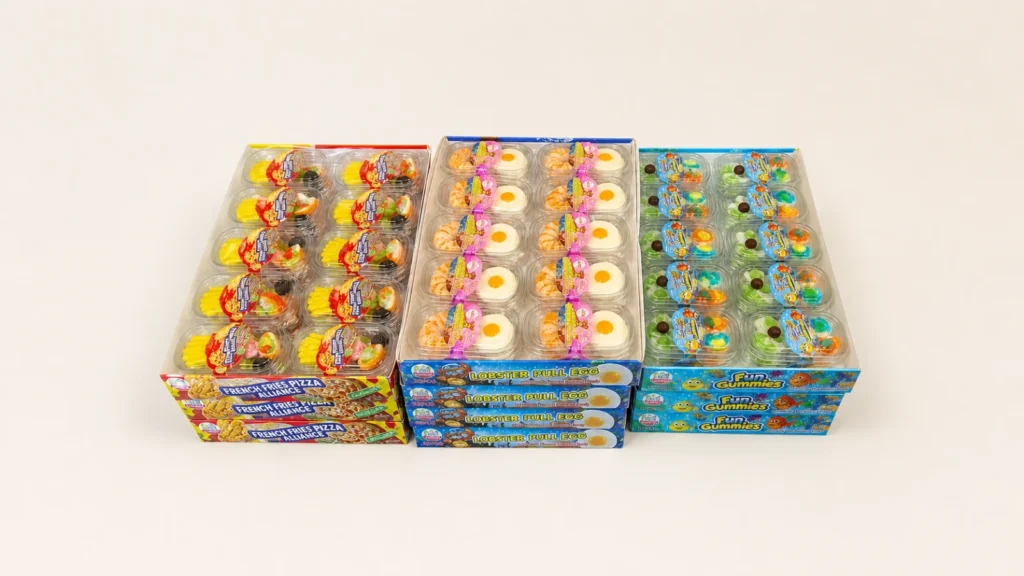
A soft candy RFQ is not quote-ready when it asks only for “mixed gummy” or “soft candy price.” KidStar SKU YMX-002 is recorded as an 8 g unit packed 60 pieces per display box and 12 display boxes per carton, while the reference image shows several clearly different themed variants and display presentations. The buyer must select one exact version before the price, sample, and artwork can be compared.
The direct answer is to send the SKU, chosen physical variant, reference image, 8 g unit, 60-piece display count, 12-display carton, destination, and required product files in one version-controlled brief. Importers, distributors, wholesalers, and private-label buyers should not assume every visible shape, color, label, or assortment uses the same formula, artwork, availability, or quotation.
Why “soft candy” is not a complete product request
Category words are useful for discovery, but they are too broad for procurement. The YMX-002 reference image contains multiple display families with different shapes and label designs. That creates a predictable risk: the buyer points to one variant, the supplier prices another, and both sides still call it YMX-002 or soft candy.
A complete variant record should identify:
- exact SKU and product link
- selected display family and physical shape
- dated reference image or sample code
- unit weight and pieces per display
- display boxes per carton
- flavor or color assortment only as confirmed in the current file
- stock or custom artwork route
- destination and label language
The YMX-002 product page should be treated as the first identity anchor, not the final technical specification.
Separate shape, assortment, and pack hierarchy
Three decisions are often collapsed into one sentence. Keep them separate.
| Decision | Buyer must specify | Do not assume |
|---|---|---|
| Physical shape | Which pictured or sampled candy format is required | All shapes share one formula or production route |
| Assortment | One shape, mixed shapes, flavors, colors, or an exact ratio | The factory will choose a commercially suitable mix |
| Consumer unit | What the 8 g record refers to and how it is wrapped | The display box itself is 8 g |
| Display unit | 60 pieces and the approved display artwork/version | Every visible display has identical dimensions |
| Shipping carton | 12 display boxes and current carton data | Old carton dimensions apply to a new variant |
GS1’s Global Data Model guidance describes a trade-item hierarchy as linked units, packs, cases, and pallets. A buyer does not need final GTINs to request a sample, but it should identify which level is sold, ordered, and shipped. This makes the eventual barcode and retailer-data work cleaner.
Decision table: what to lock at each RFQ stage
| Stage | Minimum evidence | Buyer decision | Hold condition |
|---|---|---|---|
| Catalog screen | SKU, live page, and dated reference image | Select one candidate variant | Request still says only “any soft candy” |
| Sample request | Variant code/image, unit and display hierarchy, test questions | Approve which physical sample should be sent | Sample cannot be matched to the quote |
| Commercial quote | Quantity, destination, Incoterm, pack version, stock/custom route | Compare offers on the same basis | Supplier responses use different variants or counts |
| Artwork review | Current ingredient/allergen file, label template, languages, barcode owner | Approve a controlled artwork version | Claims or required text are copied from another variant |
| Pre-order check | Signed sample reference, final specification, carton data, open issues | Release or hold the order | Any identity or pack-count conflict remains |
This sequence is deliberately stricter than a chat message. It reduces rework by making each approval point auditable.
Build a one-page YMX-002 RFQ
Use a file name such as `YMX-002-variant-A-RFQ-v1-2026-08-20`. Put the following on page one:
1. Buyer route: company, country, outlet type, and intended resale unit. 2. Exact product: YMX-002 with the live link and the selected dated image. 3. Pack hierarchy: confirm the meaning of 8 g, 60 pieces per display, and 12 displays per carton. 4. Variant: selected shape, appearance, and requested assortment, subject to current supplier confirmation. 5. Quantity: cartons, mixed-container allocation, or realistic range. 6. Trade term: requested Incoterm rule and named port or place. 7. Artwork: stock or private label, languages, barcode owner, and approval party. 8. Evidence: specification, ingredient and allergen file, shelf-life information, packaging data, and any buyer-required documents. 9. Sample decision: what the buyer will taste, measure, photograph, and approve.
Do not ask the supplier to confirm a market-wide legal conclusion. Ask for the current product and packaging evidence, then have the importer or its adviser review the exact version for the destination.
Sample the variant, not the category
A useful sample request should identify the expected display family and include acceptance checks. When it arrives:
- photograph the unopened display and individual unit
- compare the shape and artwork with the dated reference
- record unit weight, count, display count, and any difference
- assess the actual taste and texture without turning a sample impression into a shelf-life claim
- review wrap seals, display stability, and handling
- match the sample to the current specification and ingredient/allergen file
- assign the approved sample a code or date for the quotation
If several variants are under consideration, keep each sample and quote on a separate line. “Assorted” should mean a written composition, not a box of whatever is available.
Prevent artwork and claim drift
Reference images can include labels designed for another market or version. Never copy visible flavor, health, ingredient, origin, certification, or compliance wording into new artwork without support from the current file and target-market review.
For private-label packaging, keep a simple change log:
| Version | Product variant | Pack hierarchy | Artwork change | Approved by | Open issue |
|---|---|---|---|---|---|
| v1 | Selected YMX-002 reference | 8 g / 60 / 12, pending confirmation | Stock reference | Buyer product lead | Current file required |
| v2 | Same approved variant | Confirmed hierarchy | Buyer language and barcode panel | Buyer artwork lead | Destination review pending |
Do not let an artwork revision silently change the candy variant or pack count.
Soft candy RFQ checklist
- Use SKU YMX-002 and its product link.
- Select one physical variant with a dated image or sample code.
- Confirm what 8 g × 60 pieces × 12 display boxes means.
- Define any assortment by exact composition or ratio.
- Name the destination, outlet, quantity, trade term, and timeline.
- Separate stock artwork from private-label work.
- Request current product, ingredient/allergen, shelf-life, packaging, and carton files.
- Match the quotation to the approved sample version.
- Record unresolved differences instead of filling them with assumptions.
- Keep unsupported certifications, health wording, and regulatory conclusions out of the RFQ.
Send one comparable request
YMX-002 is a useful case because the reference image makes the hidden choice visible: “soft candy” can mean several different products. A strong RFQ turns that visual choice into one controlled variant, one pack hierarchy, and one evidence request.
Send a Quote-Ready Brief with the selected YMX-002 image, market, display route, quantity, sample checks, and required files. KidStar can then review one exact soft candy version instead of pricing an ambiguous category request.