Canada FOP candy labels require an exact product-and-package assessment for prepackaged foods imported or produced from January 1, 2026 onward. A confectionery buyer should check the nutrient calculation, exemption status, principal display surface, prescribed symbol, bilingual presentation, artwork version, import date, and approval owner before releasing print.
The direct answer is not to assume that every candy needs the symbol—or that a small unit is automatically exempt. Use KidStar SKU YMX-041 Mixed Fruit Mini Jelly as a real multi-unit jar example, listed as 15 g × 100 pieces × 6 jars, then have the responsible Canadian importer assess the exact formula, consumer package, and current rules.
What changed for Canadian food labels in 2026
Health Canada’s industry guide says the front-of-package nutrition symbol rules apply to most prepackaged foods sold in Canada, including imported foods, when saturated fat, sugars, and/or sodium meet or exceed the applicable thresholds and no exemption or prohibition applies. The transition period ended December 31, 2025, and regulated parties must comply from January 1, 2026.
The Canadian Food Inspection Agency states that there is no enforcement discretion after that deadline. Health Canada develops the labeling rules, while CFIA is responsible for enforcement.
The same official guide says products imported, manufactured in Canada, or packaged at retail before January 1, 2026 may remain in warehouses and continue to be sold. Buyers therefore need controlled date and inventory evidence; a new artwork proof cannot be approved merely because older stock used another label.
Map the exact YMX-041 consumer package
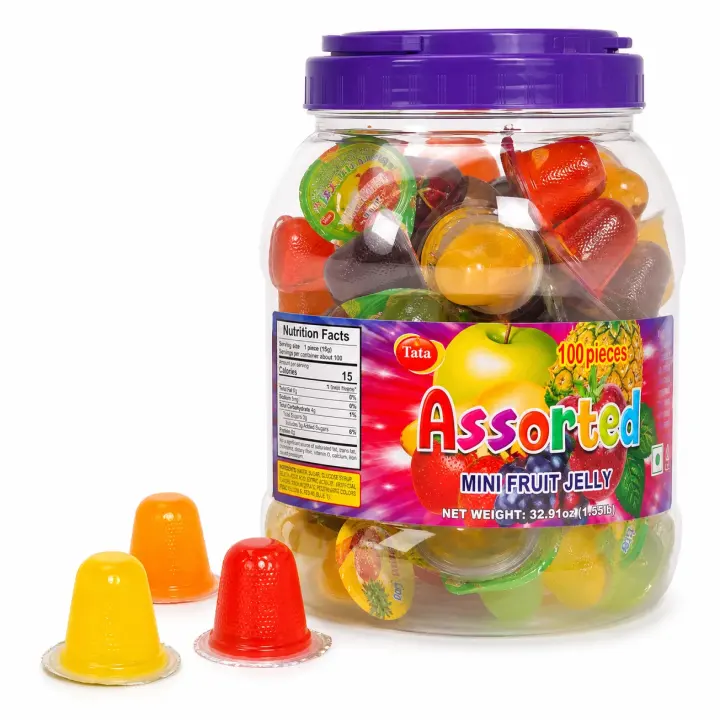
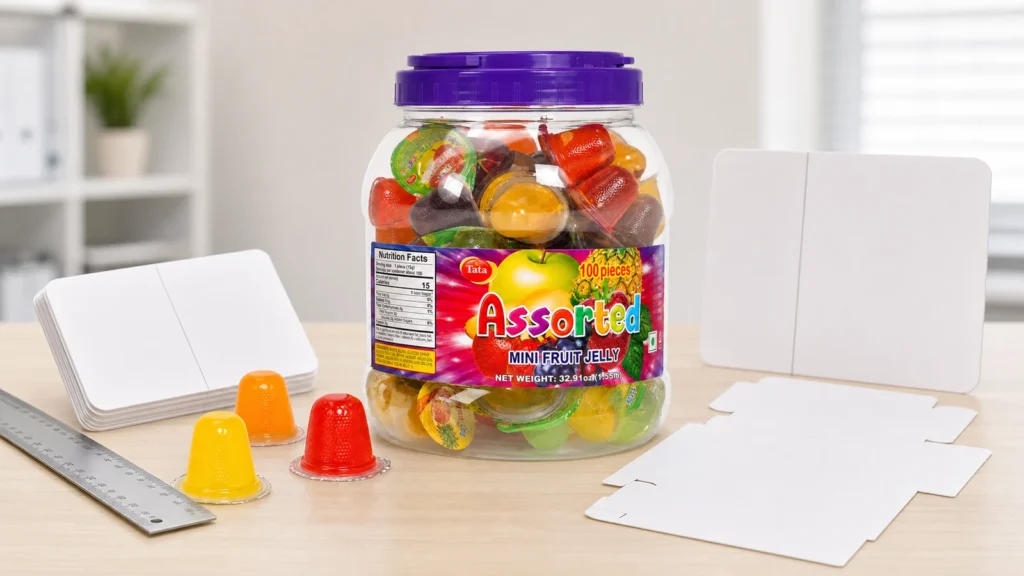
The current KidStar reference shows a large jar containing individually packed mini fruit jellies. That image does not establish the final Canadian formulation, Nutrition Facts table, available display surface, common name, bilingual copy, exemption, or FOP symbol requirement.
Record the packaging hierarchy first:
| Pack level | Current reference | Canadian review question | Evidence owner |
|---|---|---|---|
| Jelly portion | 15 g listed unit | Is this sold separately or only inside the jar? | Buyer and supplier |
| Individual cup/film | Visible mini-jelly pack | What mandatory information belongs here, if any? | Importer/regulatory reviewer |
| Consumer jar | 100 pieces per jar | Which panel is the principal display panel and what is its measured surface? | Packaging/artwork team |
| Shipping carton | 6 jars per carton | Retail unit or transport-only packaging? | Buyer/logistics team |
| Assortment | Mixed fruit reference | Does the controlled formulation and flavor mix match the nutrition file? | Food and quality teams |
Treat each jar artwork and formulation as a controlled version. A change in serving basis, flavor mix, jar shape, label dimensions, or intended retail unit can reopen the assessment.
Audit eight FOP decision inputs
Use one worksheet that links calculation evidence to the exact artwork proof.
1. Controlled formulation: ingredients and nutrient data for the exact product and assortment. 2. Consumer unit: the package offered for sale, not just the shipping carton or an isolated component. 3. Reference amount and serving basis: the inputs selected by the responsible Canadian reviewer. 4. Threshold calculation: saturated fat, sugars, and sodium evaluated under the applicable rule. 5. Exemption or prohibition analysis: cited to the exact provision and package facts. 6. Principal display surface: measured package geometry and selected principal display panel. 7. Symbol format and presentation: prescribed nutrient combination, size, location, orientation, and bilingual treatment. 8. Version and timing record: artwork ID, reviewer, approval date, production/import status, and change control.
Do not copy a threshold, exemption, or symbol from a similar confectionery package. Health Canada’s guide includes detailed rules and appendices; the responsible importer should document which path applies to the controlled YMX-041 version.
Do not confuse a small inner unit with the jar decision
Health Canada and CFIA describe technical exemptions for certain very small packages, but the analysis depends on the regulated consumer package and the exact facts. The presence of small 15 g jelly portions inside a 100-piece jar does not by itself establish that the retail jar—or each inner portion—is exempt.
Ask these questions in order:
- What package does the consumer buy?
- Can any inner unit be sold separately?
- What mandatory information appears on each packaging level?
- What is the measured available display surface?
- Does an exemption apply, and under which conditions?
- Could a voluntary symbol or another graphic be prohibited or misleading?
- Does the proposed English/French presentation match the prescribed format?
Keep the conclusion as `required`, `exempt`, `prohibited`, or `review pending`, with a named reviewer and source reference. “Small candy” is not an evidence category.
Reserve the symbol before artwork becomes crowded
When required, the FOP nutrition symbol must follow prescriptive requirements for visibility, language, size, dimensions, orientation, and location. The official sources say it is generally placed on the principal display panel and must be clearly visible and distinguishable from other information.
That means the artwork team should not finish fruit graphics, claims, flavor names, brand blocks, and promotional badges before the nutrition assessment is complete. Use a wireframe with reserved areas for:
- required FOP symbol, if applicable
- bilingual common name and mandatory copy
- Nutrition Facts table and ingredient/allergen information
- net quantity
- importer/dealer information
- lot/date area
- barcode and quiet zone
- any voluntary claim that has passed review
The candy labeling documentation checklist helps assign data owners. The packaging customization route should begin only after the controlled label brief is clear.
Separate existing inventory from new production
Create an inventory table rather than applying one status to every jar:
| Inventory group | Evidence to capture | Decision owner |
|---|---|---|
| Imported before January 1, 2026 | Import record, exact SKU/version, quantity, warehouse status | Canadian importer |
| Manufactured or packaged before January 1, 2026 | Manufacturing/packaging evidence and controlled artwork | Responsible regulated party |
| New production for 2026 onward | Current formula, calculation, exemption decision, compliant proof | Importer and label reviewer |
| Artwork or formula revision | Change description and refreshed assessment | Change-control owner |
Do not treat this table as legal advice or evidence of compliance. It is a buyer control for routing each version to the responsible Canadian decision maker.
Approve the physical label, not only the PDF
A technically correct PDF can still fail when applied to a curved jar, reduced, covered by a seam, or printed with weak contrast. Before commercial release, inspect the final-size proof and the labeled package.
Confirm that the symbol, if required, remains intact and visible; bilingual text is legible; the barcode area remains scannable; the label fits the jar; and the approved file ID matches the production instruction. Use the sample approval checklist to keep physical evidence tied to the same product version.
Send a controlled Canadian label brief
For a Canada-bound YMX-041 program, send the exact formula version, 15 g × 100 × 6 pack reference, consumer-unit definition, jar dimensions, label dieline, nutrition data, intended import timing, quantity direction, and open FOP questions through the contact page.
KidStar can then respond against a controlled commercial version while the Canadian importer retains responsibility for the market and legal decision.
Sources reviewed
- KidStar YMX-041 Mixed Fruit Mini Jelly product record, reviewed August 29, 2026.
- Health Canada: Front-of-package nutrition symbol labelling guide for industry, reviewed August 29, 2026.
- CFIA: Front-of-package nutrition symbol, modified November 17, 2025 and reviewed August 29, 2026.