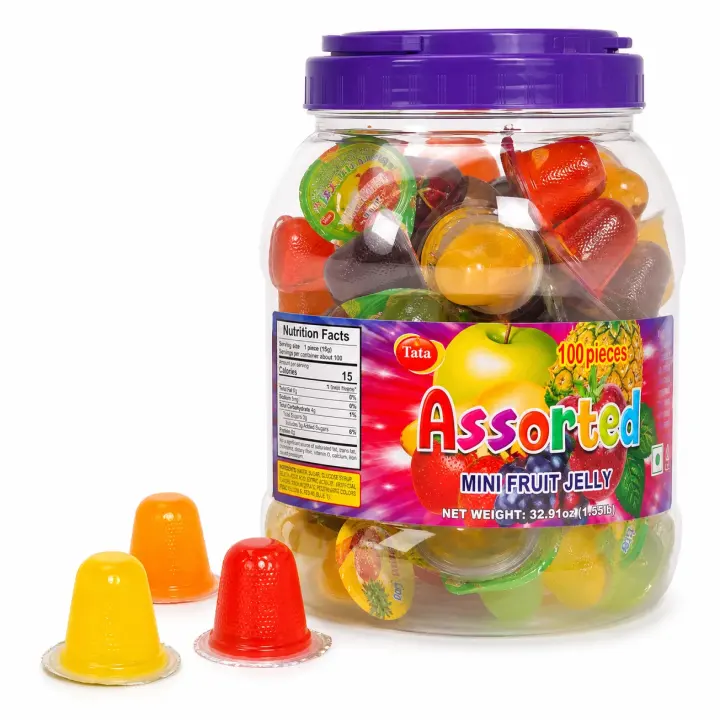
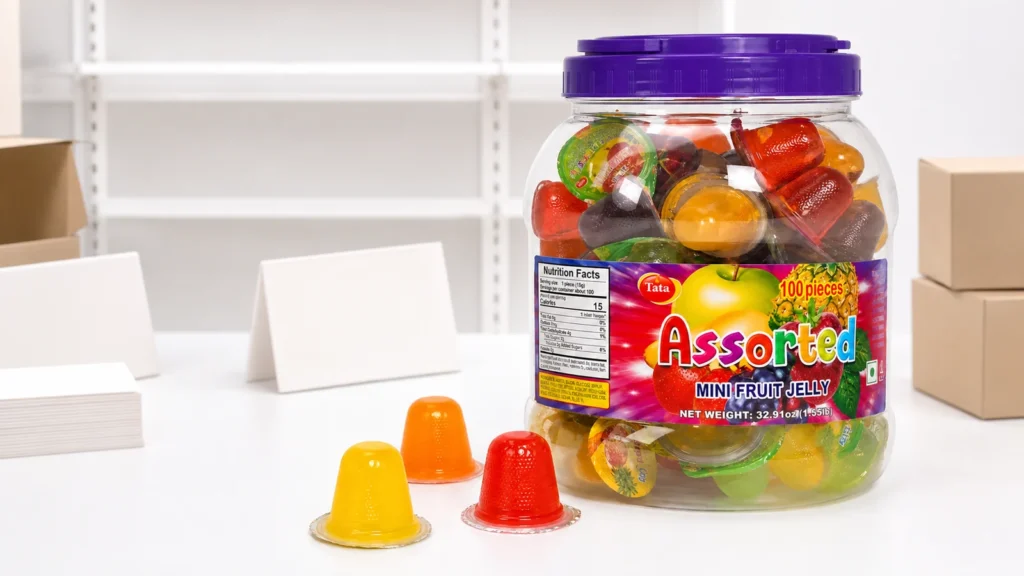
For mini fruit jelly wholesale, the first decision is whether the jar is the sellable trade item or only a source of individual cups. KidStar SKU YMX-041 provides one exact route to assess: 15 g mini jelly cups, 100 pieces per jar, and 6 jars per export carton.
The direct answer is to compare YMX-041 only after the buyer has fixed the resale unit, the required fruit assortment, the jar handling plan, and the carton allocation. A photograph can identify the current purple-lid jar and assorted mini cups, but it cannot confirm a final flavor ratio, label file, shelf life, destination suitability, or customized version. Those points must follow the exact sample and quotation.
Read the 100-piece jar as a commercial unit
Wholesale listings often place “jelly,” “cup jelly,” “mini jelly,” jars, pouches, trays, and display boxes under the same broad category. That makes the search result look comparable when the actual selling units are different. A 100-piece jar should be assessed as a jar program, not compared directly with a consumer pouch or a tray simply because all three contain jelly.
Start the buying file with the live YMX-041 product page and the current hierarchy:
| Packaging level | Current YMX-041 record | Buyer decision to lock |
|---|---|---|
| Individual cup | 15 g mini jelly | Is each cup sold separately, served from the jar, or used as a repack input? |
| Retail or trade jar | 100 pieces | Is the closed jar the invoiced and resold unit? |
| Export carton | 6 jars | How many cartons belong in the first outlet or distributor allocation? |
| Assortment | Mixed fruit presentation | Which exact flavors, colors, and proportions are required in the quoted version? |
This pack hierarchy is useful because each level has a different job. The buyer should not ask for a “100-piece price” until the supplier knows whether the commercial comparison is per cup, per jar, or per carton.
Decide who opens the jar
The person who opens the jar changes the route. In cash-and-carry, a smaller retailer may buy the jar intact. In an independent store, the retailer may open the jar and sell individual cups. A distributor may instead use the jar as an intermediate wholesale unit before allocating stock to several outlets.
Use a channel decision table before requesting the quotation:
| Intended route | Likely resale unit | Evidence to request before approval | Hold signal |
|---|---|---|---|
| Cash-and-carry | Closed 100-piece jar | Jar dimensions, closure, label panels, count record, carton condition | Buyer actually needs small consumer packs |
| Independent value retail | Individual 15 g cup from an opened jar | Cup identification, seal condition, handling plan, retailer acceptance | No approved handling or pricing method for opened stock |
| Distributor allocation | Jar by outlet | Six-jar carton allocation, carton marks, no-substitution SKU line | Jar mix is being changed without a revised quote |
| Private-label review | Current stock jar as a reference | Exact stock sample, artwork scope, version register | Custom artwork starts before the stock route is accepted |
The retail-ready confectionery pack guide helps buyers inspect how the unit will appear and be handled. It does not decide which unit should be sold. That remains a channel and margin decision for the importer and retailer.
Lock the fruit assortment before comparing offers
“Assorted fruit” is not a complete specification. The reference image shows several colors and fruit cues, but a visible color must not be turned into a flavor promise. Ask the supplier to state the current flavor list, color list, and assortment method for the exact YMX-041 version being quoted.
A practical assortment line should include:
- the exact SKU and dated product link
- the current 15 g cup size and 100-piece jar count
- the flavors required, with any acceptable open choices marked clearly
- whether the mix is fixed by count, produced randomly, or confirmed by a current packing rule
- whether substitutions require written buyer approval
- the sample version that will be used as the comparison reference
If the buyer later changes the flavor list or count, treat that as a controlled change. Do not allow an updated assortment to remain under an old price comparison without asking what else changed.
Inspect the jar and cups together
A loose jelly cup is not enough to approve a jar program. Use the KidStar confectionery samples route to request a sample that lets the team inspect the individual cup and the jar as one system.
Review the sample in this order:
1. Match the received SKU, jar, lid, label, and cup presentation against the dated YMX-041 reference. 2. Check the individual seals, visible print, cup condition, and any signs of leakage or deformation. 3. Count or otherwise verify the declared jar configuration using the supplier’s current packing record. 4. Inspect the jar when full, opened, partly depleted, reclosed, and handled as the intended retailer would handle it. 5. Record the received flavor and color assortment without assuming that the same mix will apply to production. 6. Request the current ingredient, allergen, shelf-life, storage, label, and carton files needed for the destination review.
These checks do not establish market approval. They create one dated evidence pack that purchasing, sales, and the supplier can all use when discussing the same version.
Build a comparison-ready jar quotation
Before asking two suppliers to compete, put the following fields into one quote line:
- SKU YMX-041 and the exact product link
- 15 g × 100 pieces × 6 jars as the current reference hierarchy
- destination country, outlet type, and intended resale unit
- required flavor and color assortment, plus the substitution rule
- quantity direction stated in jars or cartons, not only “pieces”
- sample version and open acceptance questions
- requested trade term, named destination or port, and required delivery window
- stock packaging scope, with any packaging customization request separated
This does not create a price, minimum order, or lead-time promise. It gives every respondent the same commercial problem to answer.
Turn the jar route into a buying brief
YMX-041 becomes a useful mini fruit jelly wholesale candidate when the 15 g cup, 100-piece jar, 6-jar carton, assortment, sample, and channel all refer to one controlled version. That is the point at which per-jar comparisons, carton allocation, and reorder questions become meaningful.
Send KidStar a jar-program brief with the destination, outlet, resale unit, exact assortment, carton direction, sample deadline, and required review files. The team can then answer against a defined YMX-041 route instead of a generic request for assorted jelly.