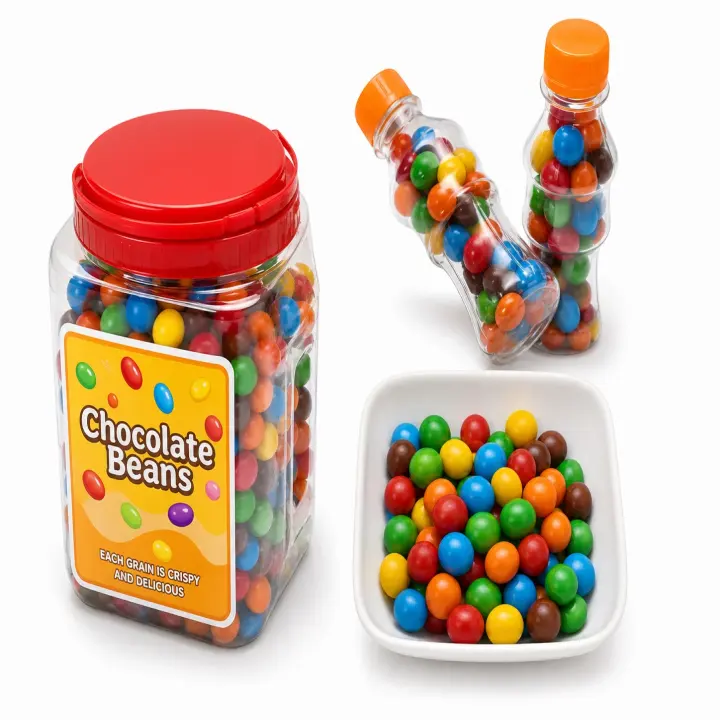
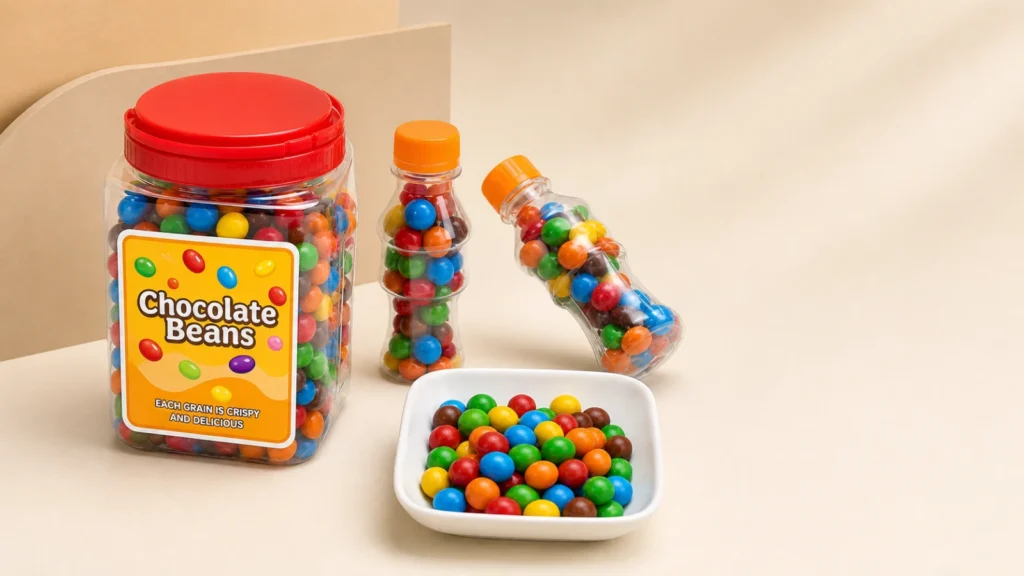
For a large chocolate bottle wholesale program, decide what the buyer is actually reselling before comparing prices. KidStar SKU YM-004 is recorded as a 7 g small bottle unit, with 60 small bottles in one large jar and 10 jars per carton. The reference image shows colorful chocolate pieces inside clear bottle-shaped containers, grouped in a larger clear jar.
The direct answer is that YM-004 fits best when the large jar has a named commercial role: a complete retail unit, a wholesale unit supplied to smaller outlets, or one defined SKU inside a mixed chocolate range. Importers, distributors, wholesalers, and private-label buyers should lock the resale unit, jar handling, count, channel, and sample evidence first. A stock jar should not be pushed into a mixed range simply because unused container space remains.
Start with the three packaging levels
The name “Large Chocolate Bottle” can be misleading if the buyer does not map the hierarchy. The current product record describes three levels:
- 7 g small bottle: the individual product unit
- 60 small bottles per large jar: the grouped retail or wholesale presentation
- 10 large jars per carton: the shipping case
GS1’s trade-item hierarchy guidance separates units, packs, cases, and pallets because each level can have a different ordering or selling job. The same logic helps at the RFQ stage even before final barcodes are assigned.
| Level | Current YM-004 record | Buyer decision |
|---|---|---|
| Individual bottle | 7 g | Is this sold separately, included in a jar, or used only as an inner unit? |
| Large jar | 60 small bottles | Is the jar the scanned retail unit, an outlet supply unit, or a display container? |
| Carton | 10 jars | Does this carton quantity fit replenishment and the first-order allocation? |
The live YM-004 product page should stay attached to every inquiry. “Chocolate bottle” can describe different sizes and formats, so the SKU and image prevent suppliers and buyers from discussing different products.
Decision table: stock jar, single-SKU route, or mixed range
Price becomes comparable only after the route is named.
| Buyer situation | Likely route | Why it can fit | What must be confirmed |
|---|---|---|---|
| Cash-and-carry sells complete jars | Stock jar | Simple carton-to-jar hierarchy | Jar dimensions, closure, label, count, and current price basis |
| Distributor supplies independent stores | Single-SKU jar program | Stores receive a repeatable unit without opening cartons into loose packs | Whether stores resell the jar or individual bottles and how stock is handled |
| Importer builds a mixed chocolate range | Defined mixed-range allocation | YM-004 can add a visual bottle format beside other chocolate SKUs | Exact cartons for YM-004, no vague “fill remaining space” rule |
| Private-label buyer wants custom artwork | Two-stage project | Stock sample can validate product and jar route before custom work | Artwork scope, barcode owner, language versions, quantity direction, and approval process |
| Buyer only wants loose chocolate pieces | Usually hold | YM-004’s commercial identity is the bottle-and-jar presentation | Select another SKU rather than dismantling the format |
This is a buyer-fit screen, not evidence that every customization or order structure is available. Share the intended route through the contact page for a current review.
Treat the jar as part of the product decision
The large jar is not just transport packaging. It affects shelf space, handling, visibility, label area, and the buyer’s unit economics. Confirm:
1. jar height, width, depth, closure, and current material 2. whether the jar is sealed and sold as one unit 3. the exact count of small bottles and the count-check method 4. label panels, barcode position, and destination-language space 5. gross and net weights for the current carton version 6. whether the displayed jar matches the stock sample and quotation
The KidStar carton-data guide can support an early loading estimate, but the buyer should reconfirm the current carton data before purchase. A product-page image cannot prove carton dimensions, pallet pattern, or container loading on its own.
Sample the complete commercial unit
A useful YM-004 sample review includes the small bottle, a representative large jar, current artwork, and available product files. Review the whole presentation:
- Does the sample match the exact SKU and reference image?
- Is the 7 g unit confirmed by the current file?
- Are the bottle shape, closure, chocolate pieces, and jar stable in normal handling?
- Does the jar arrive with the expected 60-count configuration?
- Which unit is intended for barcode scanning and resale?
- Are ingredient, allergen, shelf-life, artwork, and destination-review files current?
Do not infer ingredients, color sources, certifications, or regulatory suitability from the colorful pieces in the image. Those questions require the current written file and destination-market review. If the program involves chocolate or cocoa-source due diligence, keep that work in a separate compliance record rather than turning a product-selection article into a legal conclusion.
Build the first-order carton allocation
For a single-SKU route, the buyer can start with planned outlets, jars per outlet, reorder interval, and safety stock. For a mixed range, list every SKU and an exact carton quantity. Do not use a percentage without also stating the total container or order basis.
A clean allocation sheet includes:
- SKU and product link
- consumer and grouped resale unit
- jars per carton
- cartons requested
- destination and requested trade term
- planned outlet count and jars per outlet
- sample status
- substitution rule: none unless approved in writing
This prevents YM-004 from becoming a filler SKU that no retailer has agreed to carry. It also gives the supplier a defined quantity basis for the quotation.
YM-004 buyer checklist
- Fix the exact SKU: YM-004.
- Confirm 7 g × 60 small bottles × 10 jars.
- State whether the small bottle or large jar is the resale unit.
- Name the outlet, shelf role, and replenishment plan.
- Request current jar and carton dimensions, weights, and artwork.
- Define the exact carton allocation in a mixed range.
- Use a complete sample to check the bottle-and-jar presentation.
- Keep unsupported ingredient, certification, sustainability, and compliance claims out of the listing.
- Start custom packaging only after the stock route passes.
- Send destination, quantity, Incoterm, and required files with the quotation request.
Turn the format into a controlled buying brief
YM-004 is easier to source when the buyer treats the small bottle, large jar, and carton as one commercial hierarchy. The choice is not simply “stock or mixed.” It is which resale unit and replenishment route the buyer can support with real outlet demand.
Start a Buying Brief with the country, outlet, resale unit, carton allocation, sample questions, and required product files. KidStar can then review the current YM-004 route against a concrete program instead of a general request for chocolate bottle prices.