For importers, distributors, wholesalers, and private-label buyers, final confectionery packaging approval is not only a product question. It is a sourcing workflow question. The buyer needs enough information to compare options, request samples, and receive a quote that will not be rewritten after packaging, quantity, or market details become clearer.
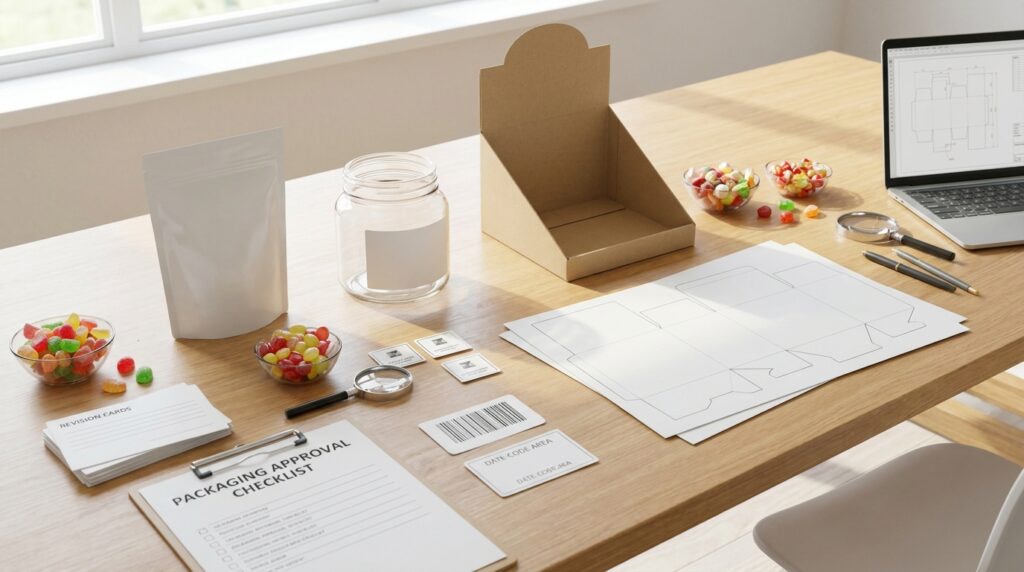
This guide is designed to help buyers confirm artwork, label, date-code, carton, and sample details before approving production packaging. It is written for B2B teams that want a practical route before starting a detailed quotation discussion.
Latest market insight
- The EU Packaging and Packaging Waste Regulation entered into force in February 2025 and starts applying from August 12, 2026, so EU-bound buyers should review pack-material assumptions before final sign-off.
- The White House order of July 30, 2025 ended duty-free de minimis treatment for all countries, making late packaging corrections more expensive on samples and short-run replenishment.
- The 2026 Sweets & Snacks trend reveal shows how fast new candy formats are rotating, so buyers need approval discipline that keeps artwork changes from delaying launch windows.
Sources reviewed: European Commission, The White House, Sweets & Snacks.
Lock the approved SKU before approving the artwork
Packaging approval should happen after the buyer has frozen the commercial SKU, not while the product definition is still moving. If flavor names, net weight, piece count, or channel position are still changing, the artwork review becomes a false approval and the supplier will need to reopen files later.
Before sign-off, confirm that the approved product, pack format, and case-pack logic match the commercial plan:
- the right candy family
- the right flavor or assortment names
- the correct fill weight or piece count
- the intended pouch, jar, box, or display structure
- the correct carton quantity for the program
That short lock step prevents expensive last-minute "small changes" that rebuild the whole packaging path.
Review the front panel, legal text, and data zones separately
Many buyers review packaging as one visual impression. A stronger workflow separates what sells the product from what clears the product. The front panel, product description, and flavor callouts should be checked for commercial clarity. Ingredient, warning, importer, barcode, and date-code areas should be checked for operational accuracy.
This is where import buyers should ask:
- Does the pack clearly state the right candy type and flavor direction?
- Is the importer or distributor line correct for the destination market?
- Is there enough protected space for barcode and date coding?
- Are storage notes, warnings, and market-language assumptions aligned?
- Does the artwork still work if a sticker label or overprint is needed?
The goal is not to overclaim compliance. It is to make the approval pack accurate enough that the next production step is realistic.
Confirm carton marks and outer-pack logic before print approval
Retail pack approval is only half of the packaging job. Buyers should also confirm carton marks, case count, inner-pack references, pallet logic, and how date-code or lot information flows from unit pack to shipper carton. Those details affect warehouse handling, customs review, and retail receiving.
When outer-pack information is ignored until after print approval, the artwork may be correct but the shipment still slows down.
Use one final approval sheet with named sign-off owners
Final packaging approval should end with a recorded decision. One person may approve graphics, another label text, another carton marks, and another channel fit. If no one owns those sign-off lines, the supplier receives mixed feedback and production timing becomes less predictable.
This is also the point where buyers can separate a production-ready pack from a mockup that still needs internal debate.
Quick checklist before you ask for a quote
| Approval area | What to confirm | Why it matters |
|---|---|---|
| SKU lock | Product name, flavor set, net weight, piece count, and pack route | Stops the artwork file from being approved against the wrong commercial version |
| Artwork zones | Front panel, ingredient panel, warnings, importer line, barcode, and date code | Separates visual approval from operational accuracy |
| Outer pack | Carton marks, inner-pack count, case count, and pallet assumptions | Keeps retail pack approval aligned with shipment handling |
| Final sample | Pack appearance, seal quality, readability, and shelf fit | Confirms the printed route still works in the real pack |
| Sign-off record | Buyer owner, supplier owner, revision version, and approval date | Reduces confusion once production starts |
Related KidStar pages
- Compare structural pack routes on Packaging Customization.
- Check label and document expectations on Certifications and Compliance.
- Review sample-stage checks on Samples.
- Use Contact when the approval file needs supplier-side review before print.
Send a clearer brief
If you are close to packaging sign-off, send KidStar your destination market, candy SKU, pack route, artwork version, carton questions, and launch timing. The team can respond with a more focused packaging approval review instead of a generic packaging reply.